
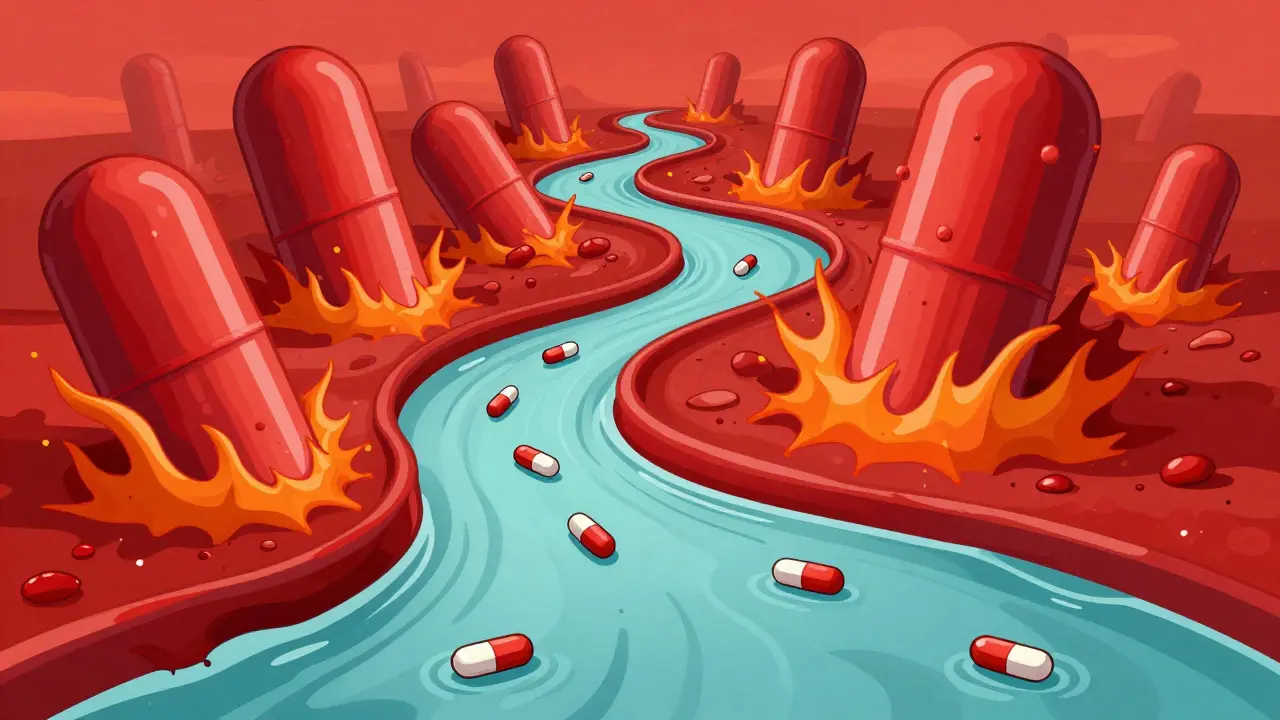
Ever taken a pill and felt awful an hour later-nausea, dizziness, or a pounding headache-only to feel fine by dinner? That’s not just bad luck. It’s your body reacting to a peak concentration of the drug in your bloodstream. For some medications, the problem isn’t the total daily dose. It’s how fast that dose hits your system all at once. That’s where dose splitting comes in-not physically cutting pills, but taking the same total amount in smaller, more frequent doses to smooth out those dangerous spikes.
Why Peaks Cause Problems
Many side effects aren’t caused by the drug itself. They’re caused by how high the drug’s level rises in your blood in a short time. Think of it like drinking a whole bottle of soda in one gulp versus sipping it over an hour. One big gulp gives you a sugar rush and a stomach ache. Sipping? No problem. For drugs like immediate-release metformin, high peak levels cause stomach upset in up to 60% of users. Splitting the dose-say, 500mg four times a day instead of 1000mg twice-can cut that rate to 15%. That’s not magic. It’s pharmacokinetics: how your body absorbs, moves, and clears the drug. When you spread out the dose, you avoid the sharp rise that triggers nausea, dizziness, or flushing. The same goes for stimulants like Adderall. A single 20mg dose can cause jitteriness and rapid heartbeat. Splitting it into two 10mg doses-morning and early afternoon-often reduces those side effects without losing focus. For some people, it’s the difference between tolerating the medication and quitting it.Not All Pills Can Be Split
Here’s the catch: you can’t just cut any pill in half and expect the same result. Many pills are designed to release slowly. These are called extended-release (ER), sustained-release (SR), or enteric-coated tablets. If you split them, you destroy that design. Take felodipine (a blood pressure pill) or tramadol (a painkiller) in SR form. Splitting them releases the whole dose at once. That’s like removing the safety valve on a pressure cooker. The result? A sudden, dangerous spike in drug levels. The FDA has logged over 1,200 adverse events from people splitting these types of pills between 2015 and 2020. Nearly 40% involved blood thinners like warfarin, where even a small overdose can cause internal bleeding. Enteric-coated aspirin is another example. It’s meant to dissolve in the intestine, not the stomach, to avoid irritation. Split it, and you lose that protection. You might as well be swallowing plain aspirin powder. The only pills safe to split are immediate-release tablets with a score line. Even then, you need a proper pill splitter-not a knife or scissors. Studies show people who use knives or scissors often get doses that vary by 20% or more. That’s risky for drugs like levothyroxine, where a 10% difference can throw off your thyroid levels.Which Medications Actually Benefit from Splitting?
Not every drug needs this trick. But for some, it’s a game-changer. The key factors are:- Half-life: Drugs that leave your body quickly (under 6 hours) benefit most. Examples: immediate-release lisinopril (blood pressure), metformin (diabetes), and venlafaxine (depression).
- Therapeutic index: This measures how safe the drug is. A high index (above 10) means you can tolerate some variation. Acetaminophen has an index of 10-splitting is low risk. A low index (under 2) means even small changes can be dangerous. Digoxin (heart drug) has an index of 1.8. Never split that.
- Formulation: Only immediate-release tablets are safe to split. Check the label for “IR” or “immediate release.” Avoid anything labeled ER, SR, XR, CR, or EC.
| Drug | Use | Safe to Split? | Why |
|---|---|---|---|
| Metformin (immediate-release) | Diabetes | Yes | Reduces GI side effects by 70% when split into 4 doses |
| Lisinopril (immediate-release) | High blood pressure | Yes | Smoothes blood pressure control, reduces dry cough |
| Venlafaxine (immediate-release) | Depression | Yes | Reduces nausea and dizziness; trial ongoing (NCT05521034) |
| Warfarin | Blood thinner | No | Narrow therapeutic index-tiny changes cause bleeding or clots |
| Tramadol SR | Pain | No | Splitting releases full dose at once-risk of overdose |
| Atorvastatin (immediate-release) | Cholesterol | Yes (for cost) | 80mg tablet split = two 40mg doses; saves $300/year |

The Hidden Risk: Cost-Cutting Backfires
A lot of people split pills to save money. GoodRx reports that splitting an 80mg atorvastatin tablet into two 40mg doses saves about $300 a year. That’s tempting. But here’s the problem: 42% of patients who split pills do it for cost, and 89% of those who split extended-release or enteric-coated drugs report problems. A 68-year-old woman in a 2023 NIH case report split a 40mg lisinopril tablet, thinking she was getting two 20mg doses. Instead, she got uneven halves-15mg and 25mg. One day she took the 25mg piece and had a hypertensive emergency. Her blood pressure spiked to 192/102. She ended up in the ER. Pharmacists report that the most common mistakes involve:- Splitting oxycodone ER for pain
- Splitting enteric-coated aspirin
- Splitting warfarin because it’s expensive
What to Do Instead
If you’re struggling with side effects, don’t guess. Talk to your doctor or pharmacist. Ask:- Is this medication immediate-release?
- Is there a lower-dose version available?
- Can I switch to a different formulation that causes fewer side effects?
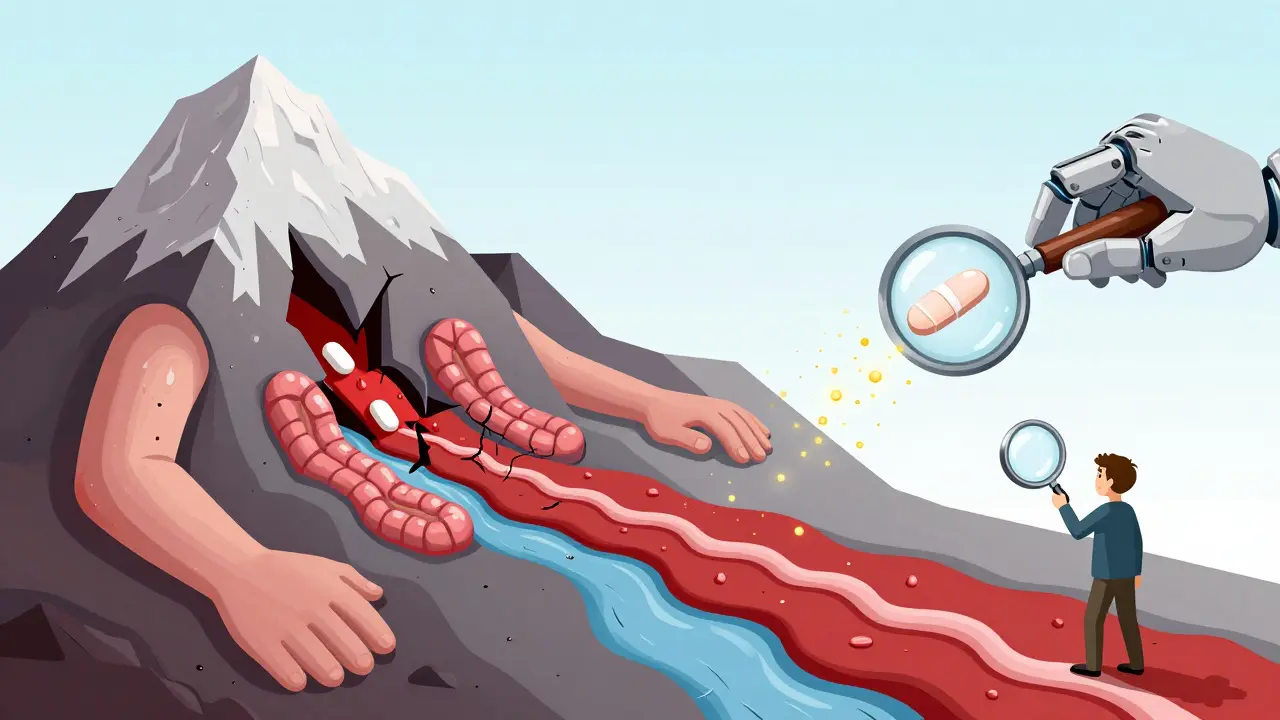
When Splitting Makes Sense-And How to Do It Right
If your provider says splitting is safe, follow these steps:- Use a dedicated pill splitter (not a knife or scissors). It cuts evenly and reduces dose variation to under 8%.
- Only split scored tablets with clear lines.
- Split one pill at a time. Don’t pre-split a week’s supply. Drug stability drops after 7 days.
- Store split pills in the original bottle, away from moisture and light.
- Check your blood pressure, INR, or glucose levels within 7 days after changing your dosing schedule.
The Bigger Picture
Dose splitting isn’t a hack. It’s a clinical tool-like adjusting a thermostat, not turning up the furnace. It works only when you understand the drug’s behavior in your body. For some, it’s a lifeline. For others, it’s a trap. The American Society of Health-System Pharmacists (ASHP) lists 14 drug classes where dose splitting can reduce side effects, including immediate-release opioids, antipsychotics, and stimulants. But they also list 11 classes where it’s absolutely dangerous: chemotherapy, antiarrhythmics, immunosuppressants, and others with narrow therapeutic windows. As drug prices keep rising, the pressure to split pills will grow. But the smarter solution isn’t cutting pills-it’s pushing for better formulations, lower-dose options, and insurance coverage that doesn’t force patients into risky choices. Until then, the rule is simple: Never split a pill without asking your pharmacist first. What seems like a cost-saving move could cost you your health.Can I split my blood pressure pill to reduce side effects?
Only if it’s an immediate-release version like lisinopril or hydrochlorothiazide, and only if your doctor approves. Never split extended-release, sustained-release, or enteric-coated blood pressure pills like felodipine SR or amlodipine besylate ER. Splitting them can cause dangerous spikes in drug levels. Always check the label for “IR” or ask your pharmacist.
Is splitting pills cheaper, and is it worth the risk?
Sometimes it saves money-like splitting an 80mg atorvastatin tablet to get two 40mg doses instead of buying two 40mg pills. That can save $300 a year. But for drugs like warfarin, digoxin, or seizure meds, the risk of side effects or overdose far outweighs the savings. A 2023 GoodRx survey found that 89% of people who split extended-release pills had problems. Cost savings shouldn’t come at the cost of safety.
Why can’t I just cut my pill in half with a knife?
Knives and scissors often produce uneven halves. Studies show people using knives get doses that vary by 20% to 50%. That’s risky for drugs like levothyroxine or warfarin, where even a 10% change can cause problems. A dedicated pill splitter reduces variation to under 8%. It’s a small tool, but it makes a big difference in accuracy and safety.
I split my metformin and my stomach feels better. Is this safe?
If you’re using immediate-release metformin and splitting it into four smaller doses, you’re doing it right. Many patients reduce GI side effects from 60% to 15% this way. But make sure you’re not using extended-release metformin (often labeled “XR” or “SR”). Those must never be split. Always confirm the formulation with your pharmacist.
What should I do if I accidentally split a pill that shouldn’t be split?
Stop taking the split pill immediately. Contact your pharmacist or doctor. If you took an extended-release opioid, blood thinner, or heart medication, seek medical help right away. Even if you feel fine, the drug may be releasing too fast. Report the incident to your provider so they can adjust your treatment and warn others.
Comments (23)
Nicola George
So let me get this straight-you’re telling me I can avoid puking after my metformin by just taking it four times a day instead of two? And I thought my stomach was just mad at me for eating pizza at 2am. 🙃
John Barron
I must respectfully assert, with the utmost scientific rigor, that the pharmacokinetic rationale underpinning dose splitting is not only empirically valid but also elegantly aligned with first-order absorption kinetics. One must, however, exercise extreme caution with enteric-coated formulations, as their structural integrity is non-negotiable. Failure to adhere to this principle constitutes a violation of pharmaceutical ethics.
Alex Lopez
I’ve been splitting my lisinopril for two years now-40mg in the morning, 40mg at night. No more dry cough, no more dizziness. My BP is stable. But I use a proper splitter. Don’t be that person who uses a butter knife. 😅
Elizabeth Ganak
i split my atorvastatin just to save cash and honestly i didnt think it was a big deal until my mom had a scare last year. now i just ask my pharmacist. its not worth it.
Anna Weitz
The real issue here is capitalism forcing people to cut pills like they’re dividing a last slice of pizza while their insurance company laughs in a boardroom somewhere
Jane Lucas
i tried splitting my venlafaxine and my head stopped spinning. i didnt even know it was possible to feel normal on this med. thank you for posting this
dean du plessis
I’ve seen too many people split warfarin because it’s expensive. One guy I knew ended up in ICU. Don’t gamble with your life over a few bucks. Talk to your doc. It’s worth it.
Caitlin Foster
OMG YES. I was splitting my metformin like a savage with scissors until my pharmacist screamed at me. Now I have a $12 pill splitter and I treat it like my firstborn. 🙌 #PharmacistSavedMyLife
Todd Scott
In Nigeria, where brand-name meds are often unaffordable, many patients split pills out of necessity. But we’ve developed community pharmacy education programs to mitigate risks-teaching patients how to identify scored tablets, use proper splitters, and recognize signs of overdose. It’s not just about access-it’s about safe access. Cultural context matters.
Andrew Gurung
You people are literally playing Russian roulette with your internal organs. If you’re splitting pills, you’re not a health enthusiast-you’re a DIY disaster waiting to be admitted to the ER. 😒💊
Paula Alencar
This is one of the most vital public health insights I’ve read in years. The fact that 89% of those splitting extended-release formulations report adverse events is not a statistic-it’s a national crisis. We must demand lower-dose formulations, insurance reform, and pharmacist-led patient education. This is not just pharmacology-it’s human dignity.
Nikki Thames
I can’t believe you’re normalizing pill splitting. You’re essentially encouraging people to become their own pharmacists without training. This is dangerous. And frankly, irresponsible. What if someone reads this and decides to split their oxycodone ER? You’re not helping-you’re enabling.
Chris Garcia
In my village, we say: 'The hand that cuts the pill must also hold the wisdom.' Many of us split pills because we have no choice-but we also gather at the pharmacy every Tuesday to learn. A simple pill splitter, a printed guide, and a listening ear can turn desperation into safety. Innovation doesn’t always come from labs-it comes from communities.
James Bowers
The FDA’s data on adverse events from pill splitting is unequivocal. Any recommendation to split non-scored, non-immediate-release tablets constitutes a breach of clinical best practices. This post, while informative, must be accompanied by explicit warnings that are not diluted by casual tone or colloquialism.
Janice Holmes
I split my Adderall and my anxiety went from ‘I can’t leave the house’ to ‘I can finally finish my thesis.’ But I also had a panic attack when I used a kitchen knife. Now I use a splitter. And I cry every time I see someone trying to break a pill with their teeth. It’s not a snack. It’s a life.
Alex Lopez
I just want to add: if you’re splitting metformin, make sure it’s the immediate-release version. I once split XR thinking it was the same thing. Ended up with a blood sugar crash and a trip to urgent care. Don’t be me.
Todd Scott
That’s exactly why community pharmacists in Nigeria now hand out laminated cards with pill images and labels-‘IR’ in bold, ‘ER’ with a red X. We call it ‘Pill ID Day.’ It’s not glamorous, but it saves lives. Education beats desperation every time.
Paula Alencar
This is why we need policy change. Not just individual responsibility. Insurance companies should cover lower-dose versions. Drug manufacturers should be incentivized to produce them. Pill splitting is a symptom of a broken system-not a solution.
Nicola George
I split my pill with a knife once. My dog ate the other half. We both lived. Mostly.
Caitlin Foster
I just told my doctor I want a 5mg version of my med instead of splitting 10mg. She laughed and said ‘Why didn’t you ask sooner?’ Turns out it’s cheaper than buying a splitter. 🤦♀️
dean du plessis
I’ve been splitting my atorvastatin for 3 years. Never had a problem. I use the splitter, store it right, check my labs. If you do it right, it’s fine. Don’t scare people into doing nothing.
James Bowers
The fact that you are casually referencing anecdotal success with splitting is deeply concerning. Anecdotes are not data. Clinical guidelines are not suggestions. You are potentially endangering vulnerable populations.
dean du plessis
I get it. But when your paycheck doesn’t cover the full dose and your doctor says ‘just split it,’ what are you supposed to do? We need systems, not just warnings.