
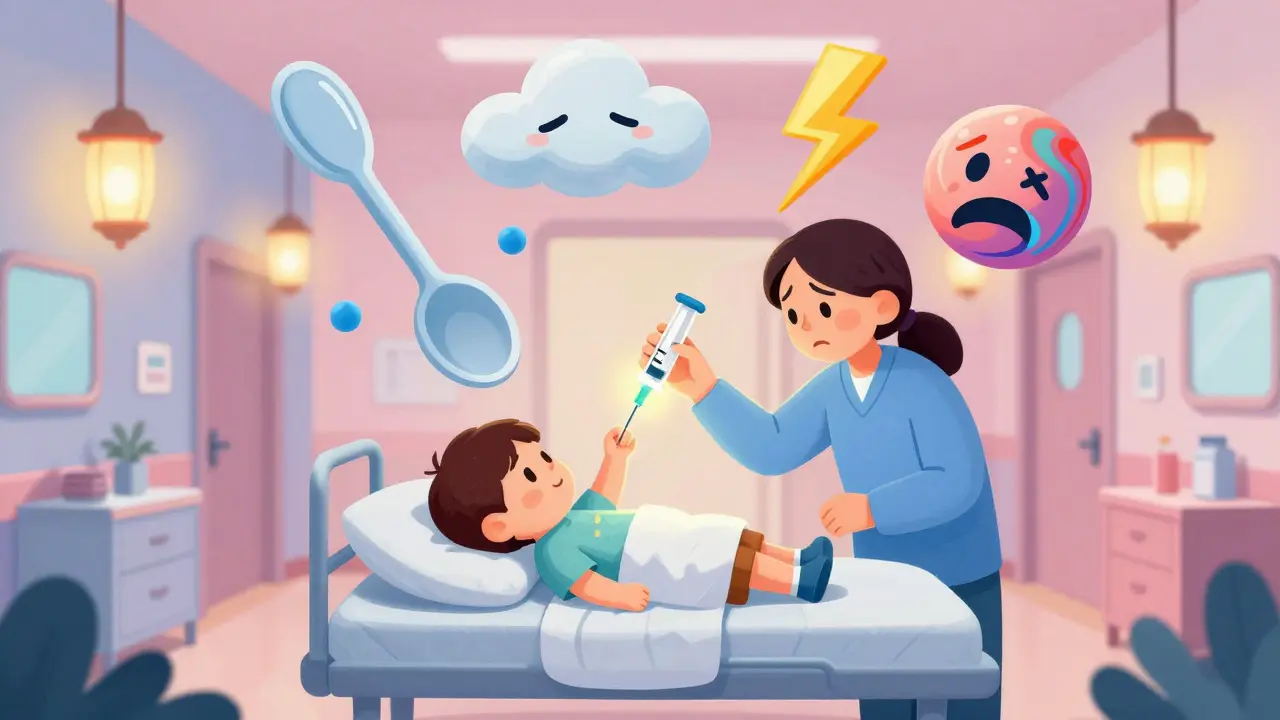
When your child starts a new medication, you’re not just giving them a pill or liquid-you’re stepping into a new role as their first responder. Side effects happen. They’re not always dangerous, but they can be scary, confusing, and overwhelming. The good news? Most can be managed safely at home if you know what to look for and how to respond. You don’t need to panic. You just need clear, practical steps.
Know the Common Side Effects
Not every weird behavior or tummy upset means something’s wrong. Some side effects are normal, expected, and temporary. According to data from Children’s Hospital of Philadelphia, the most common reactions in kids include:- Upset stomach (42% of cases)
- Diarrhea (28%)
- Drowsiness (19%)
- Rashes (23%)
- Hyperactivity (12%)-yes, even with antihistamines like diphenhydramine
Use the Right Tools
One of the biggest causes of side effects isn’t the medicine itself-it’s how it’s given. A 2023 study from UC Davis found that 68% of home medication errors involve wrong dosing. Why? Because most parents use kitchen spoons. A teaspoon is not a tablespoon. A teaspoon holds 5 mL. A tablespoon holds 15 mL. That’s a 300% overdose risk if you mix them up. Dr. Sarah Arbogast’s research shows this mistake happens more than you think. Fix it: Always use an oral syringe with 0.1 mL increments. They’re cheap, available at any pharmacy, and come with clear markings. Never guess. Never use a kitchen spoon. Keep the syringe with the medication-not in a drawer, not in the cupboard. Stick it in the same spot every time. Also, keep a simple log. Write down:- Time given
- Dose (in mL)
- Any reaction (even small ones)
- Food eaten before or after
Store Medications Like a Pro
Accidental ingestion is the #1 cause of pediatric poisoning. The Poison Prevention Packaging Act of 1970 made child-resistant caps standard-and for good reason. They work. But only if you keep the bottle closed and out of reach. Dr. Helen Arbogast’s team at Children’s Hospital Los Angeles found that keeping meds in cabinets at least 1.5 meters (5 feet) high with locks reduces accidental ingestions by 65%. That’s not a suggestion. That’s a lifesaver. Don’t transfer pills or liquids to other containers-even if they look neat. A 2022 study of 1,200 ER cases showed that switching to non-childproof containers increases poisoning risk by 41%. The original bottle? It’s there for a reason. It has the label, the expiration date, the warning, and the child-resistant cap. Store meds at 20-25°C (68-77°F) unless the label says otherwise. About 73% of liquid pediatric meds need refrigeration. Leave them in the fridge, but keep them on a top shelf, behind other items. Kids are climbers. Don’t make it easy.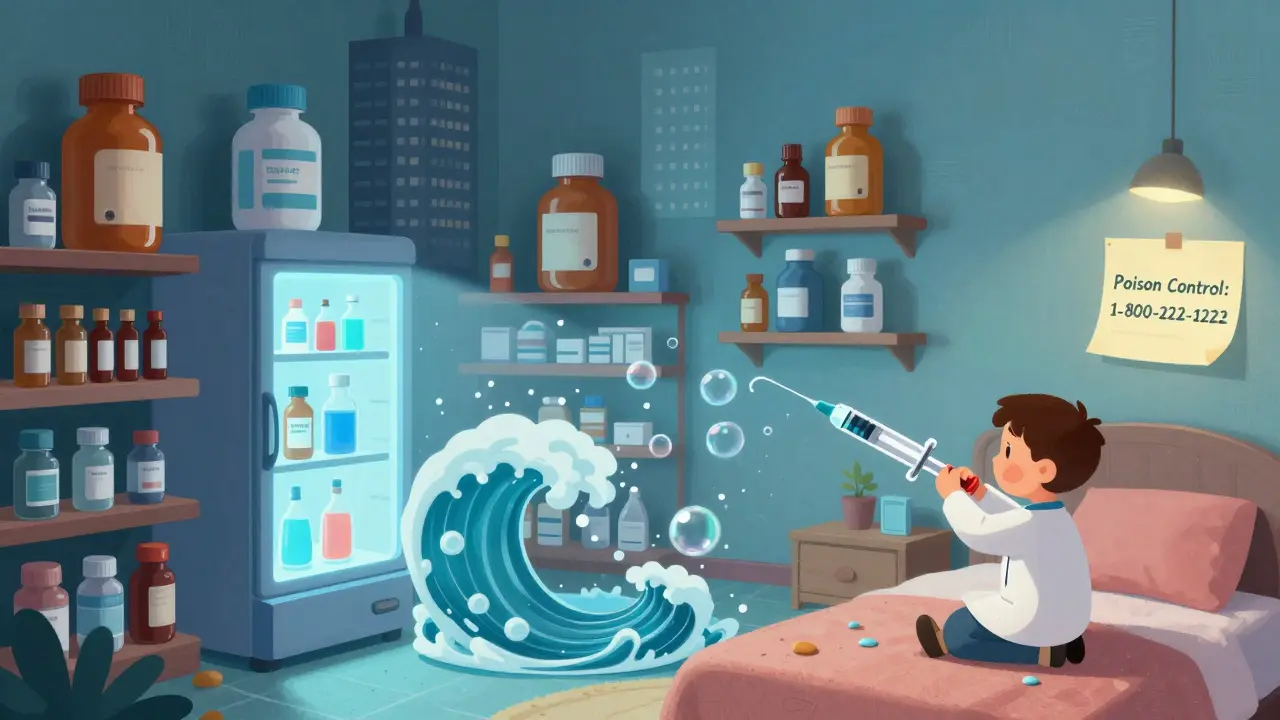
Handle Gastrointestinal Reactions
Upset stomach, vomiting, diarrhea-these are the most frequent complaints. The goal isn’t to stop them immediately. It’s to prevent dehydration and let the body adjust. For vomiting:- Wait 30-60 minutes after the last episode.
- Start with 5-10 mL of oral rehydration solution (like Pedialyte) every 5 minutes.
- If they keep it down for 2 hours, slowly increase the amount.
- Don’t rush back to milk, juice, or solid food. Stick to clear fluids until the vomiting stops for 6-8 hours.
- Keep offering fluids. Water alone isn’t enough. Use electrolyte solutions.
- Try the BRAT diet: bananas, rice, applesauce, toast. These are gentle on the gut.
- Avoid sugary drinks, dairy, and fried foods. They make diarrhea worse.
Spot the Emergency Signs
Most side effects are mild. But some need instant action. Here’s when to call 911 or go to the ER:- Difficulty breathing or breathing faster than 40 breaths per minute (for infants) or 30+ for older kids
- Swelling of the face, lips, or tongue
- Hives covering more than 10% of the body
- High fever over 38.9°C (102°F) that doesn’t respond to fever reducers
- Seizures or unresponsiveness
Watch for Unexpected Reactions
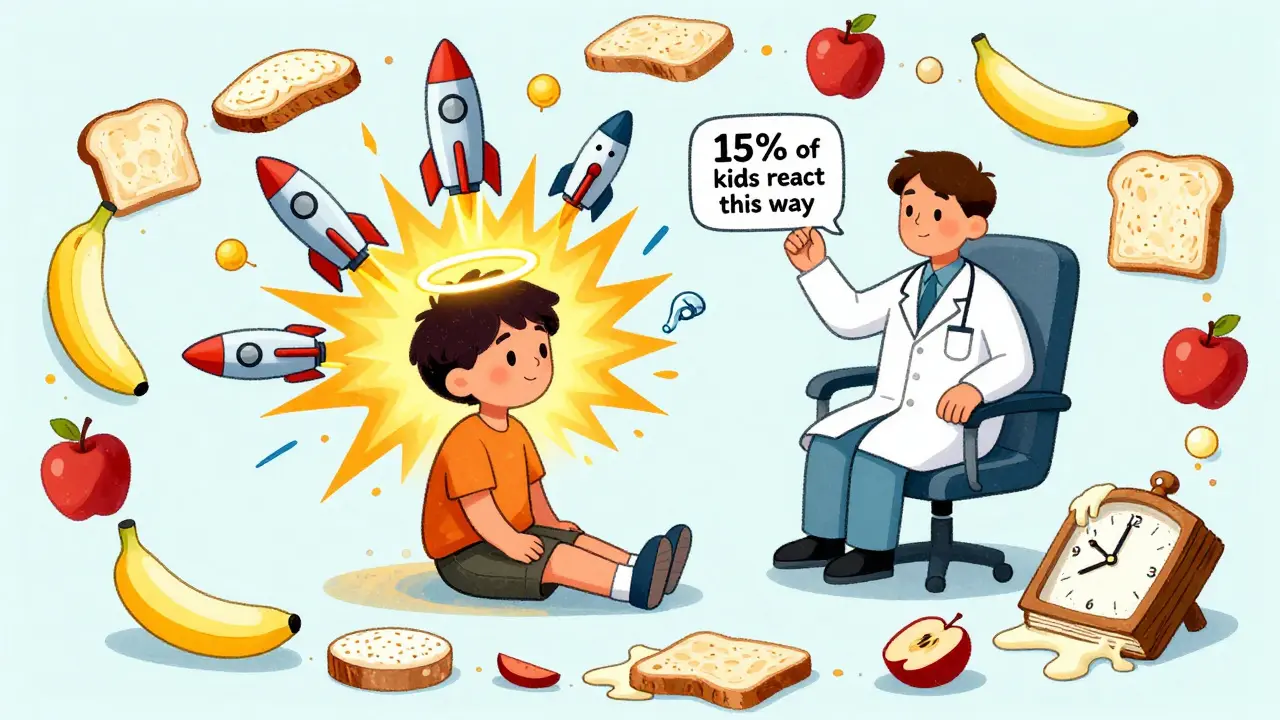
Some side effects don’t match what you’d expect. For example:- Diphenhydramine (Benadryl) is supposed to make kids sleepy. But in 15% of children, it causes hyperactivity-running around, screaming, unable to sit still.
- Antibiotics can cause yeast infections (diaper rash that won’t go away, white patches in the mouth).
- Stimulants for ADHD can cause appetite loss, mood swings, or trouble sleeping.
Don’t Stop Antibiotics Early
This is one of the most dangerous mistakes parents make. If your child starts feeling better after 2 days of antibiotics, it’s tempting to stop. But that’s exactly when the strongest bacteria are still alive. Children’s Healthcare of Atlanta found that stopping antibiotics early leads to treatment failure in 29% of cases-and 18% of those kids end up with a second, harder-to-treat infection. Finish the full course. Even if they seem fine. Even if the medicine makes them feel worse. The benefit of finishing outweighs the discomfort. Talk to your doctor if side effects are unbearable. Don’t quit on your own.Use Technology to Help
New tools are making home medication safety easier. Apps like MedTrak Pediatric, launched in late 2023, let you scan the barcode on the bottle and get:- Correct dosage based on weight
- Side effect alerts
- Reminders for doses
- Emergency contacts pre-loaded
What to Do Next
Start today:- Find your child’s oral syringe. If you don’t have one, go to the pharmacy now.
- Write down your pediatrician’s number and poison control (1-800-222-1222) on a sticky note. Put it on the fridge.
- Check where you store meds. Are they locked? High up? In the original bottle?
- Start a simple log. Use your phone notes or a notebook. Just write down the basics.
What should I do if my child throws up right after taking medicine?
Wait 30 to 60 minutes, then offer 5-10 mL of oral rehydration solution every 5 minutes. If they keep it down for 2 hours, slowly increase the amount. Don’t give another dose of the medicine unless your doctor says to. Giving it again too soon can lead to overdose. If vomiting continues for more than 3 episodes in 4 hours, call your pediatrician.
Can I give my child adult medicine if I cut the dose in half?
No. Adult medications are not formulated for children. Even if you reduce the dose, the inactive ingredients, absorption rates, and safety margins are different. Children’s bodies process drugs differently, especially under age 12. Always use medicines labeled for pediatric use. If you’re out of the right kind, call your pharmacy or doctor-don’t improvise.
My child is acting hyper after taking Benadryl. Is this normal?
Yes, it’s not rare. About 15% of children react to diphenhydramine with hyperactivity instead of drowsiness. Document the behavior-how long it lasts, what they’re doing, if it’s different from their usual energy level. Share this with your doctor. They may switch to a different antihistamine like cetirizine or loratadine, which are less likely to cause this reaction.
How do I know if a rash is an allergic reaction?
A mild, patchy rash that fades after a day is often harmless. But if the rash is raised, itchy, spreading fast, or covering more than 10% of the body, it could be an allergic reaction. Watch for swelling of the face, lips, or tongue, or trouble breathing. If any of these happen, use epinephrine if prescribed and call 911 immediately. Don’t wait to see if it gets worse.
Should I keep giving medicine if my child has a fever after taking it?
A fever after starting a new medication can be a sign of the body reacting to the drug-or it can be from the illness itself. Don’t assume it’s the medicine. Check the temperature. If it’s over 38.9°C (102°F) and doesn’t come down with acetaminophen or ibuprofen, call your doctor. If your child is lethargic, not drinking, or has a stiff neck, seek help right away. Fever alone isn’t always a reason to stop the medication.
Is it safe to use expired pediatric medicine?
No. Liquid medications lose potency faster than pills, and the chemical breakdown can create harmful byproducts. Even if it looks fine, expired medicine isn’t safe. Discard it properly-many pharmacies have take-back programs. Never keep old meds for "just in case." Use what’s current, and always check the expiration date before giving anything.
My child won’t swallow pills. What can I do?
Practice with candy. Nationwide Children’s Hospital recommends a 14-day plan: start with crushed Nerds, then move to Mini M&Ms, then regular M&Ms. Let your child practice swallowing one at a time, with water. Most kids aged 8-12 can learn this method with patience. For younger kids, ask if the medicine is available as a liquid or chewable. Never crush pills unless the pharmacist says it’s safe.
Can I give my child over-the-counter medicine with their prescription?
Only if your doctor or pharmacist says yes. Many OTC meds contain the same active ingredients as prescriptions-like acetaminophen or antihistamines. Giving both can lead to overdose. Always check with your pediatrician before adding anything new, even something you think is harmless like cough syrup or children’s ibuprofen.
Comments (15)
Glenda Marínez Granados
So let me get this straight: we’re now treating parents like lab technicians who must memorize mL increments and log every sneeze like it’s a NASA mission? 🤦♀️ I just gave my kid syrup with a spoon and prayed. It worked. Mostly. 😇
Yuri Hyuga
This is exactly the kind of clear, compassionate guidance every parent needs! 🌟 The emphasis on oral syringes and logging reactions is not just smart-it’s lifesaving. You’ve turned fear into action. Keep sharing this wisdom-it’s a gift to the parenting community. 💪❤️
MARILYN ONEILL
I read this and I just laughed. Like, are we seriously telling people not to use spoons? My grandma gave me medicine with a teaspoon and I turned out fine. Also, why is everyone so scared of a little fever? Kids aren’t glass figurines. 😒
Coral Bosley
I spent three nights crying because my daughter got a rash after amoxicillin and I didn’t know if it was the medicine or the laundry detergent or the cat or the aliens. I felt so alone. This post? It didn’t fix my trauma, but for the first time, I felt seen. Thank you. I’m printing this and taping it to the fridge. 🖤
Steve Hesketh
Brothers and sisters, this is not just advice-it’s a lifeline. I’ve seen too many parents panic because they didn’t know what was normal. You’ve given them clarity, calm, and courage. The log idea? Genius. The syringe tip? Lifesaver. Keep going. You’re changing lives-one drop at a time. 🙏🌍
shubham rathee
you know the real problem is big pharma pushing meds on kids for no reason and then they make you paranoid about side effects so you keep buying more pills and the real solution is just stop giving them meds and feed them organic kale and sunshine and maybe theyll grow up healthy
Kevin Narvaes
i mean like... we all know doctors are just selling us drugs right? like why do kids need so much medicine? i just let my kid ride it out. sometimes the body knows better than the lab. also i think the syringe thing is a scam to sell you more stuff
Alex Carletti Gouvea
This is why America’s falling apart. We’re turning parenting into a compliance checklist. Back in my day, we gave kids medicine with a spoon, told them to tough it out, and they turned out fine. Now we need apps, logs, and syringes just to give a cough drop. Weak.
Ben McKibbin
I love how this balances science with humanity. The data is solid-no doubt-but what really shines is the tone: calm, practical, and deeply respectful of how terrifying this all feels. The BRAT diet tip? Perfect. The warning about expired meds? Critical. This isn’t just information-it’s a hug in article form.
Rod Wheatley
PLEASE-please-please, if you’re reading this and you’re using a kitchen spoon: STOP. NOW. Go to CVS. Buy a $2 oral syringe. It’s not a luxury. It’s not extra. It’s the difference between your kid being okay and ending up in the ER. I’ve seen it. I’ve been there. I’ve panicked. Don’t wait until it’s too late. You’ve got this. 💪💉
Malvina Tomja
Let’s be honest-this article is just a fancy marketing tool for pediatric pharmacies and syringe manufacturers. The real issue? Overmedication. Why are 42% of kids getting upset stomachs from meds? Because we’re overprescribing. This post doesn’t question the system-it just teaches you how to survive it. Sad.
Samuel Mendoza
Benadryl makes kids hyper? Newsflash: it’s not the medicine. It’s the sugar in the liquid. Stop blaming the drug. Blame the syrup.
MAHENDRA MEGHWAL
The precision and clarity presented here are commendable. The empirical grounding of each recommendation, especially regarding dosage accuracy and storage protocols, reflects a profound commitment to pediatric safety. One must acknowledge the gravity of medication administration in home settings and the responsibility borne by caregivers. This is exemplary public health communication.
Dee Monroe
I remember when my daughter went into hyper mode after Benadryl-I thought she was possessed. I called 911. I cried. I Googled until 3 a.m. I thought I was failing as a mom. Then I found out 15% of kids react this way. It wasn’t me. It wasn’t the medicine being evil. It was just biology being weird. That’s the moment I stopped blaming myself. This article? It didn’t just give me tips. It gave me peace. I wish I’d had this two years ago.
Jerry Rodrigues
Good stuff. Syringes. Logs. Locks. Simple. No drama. Just do it.