
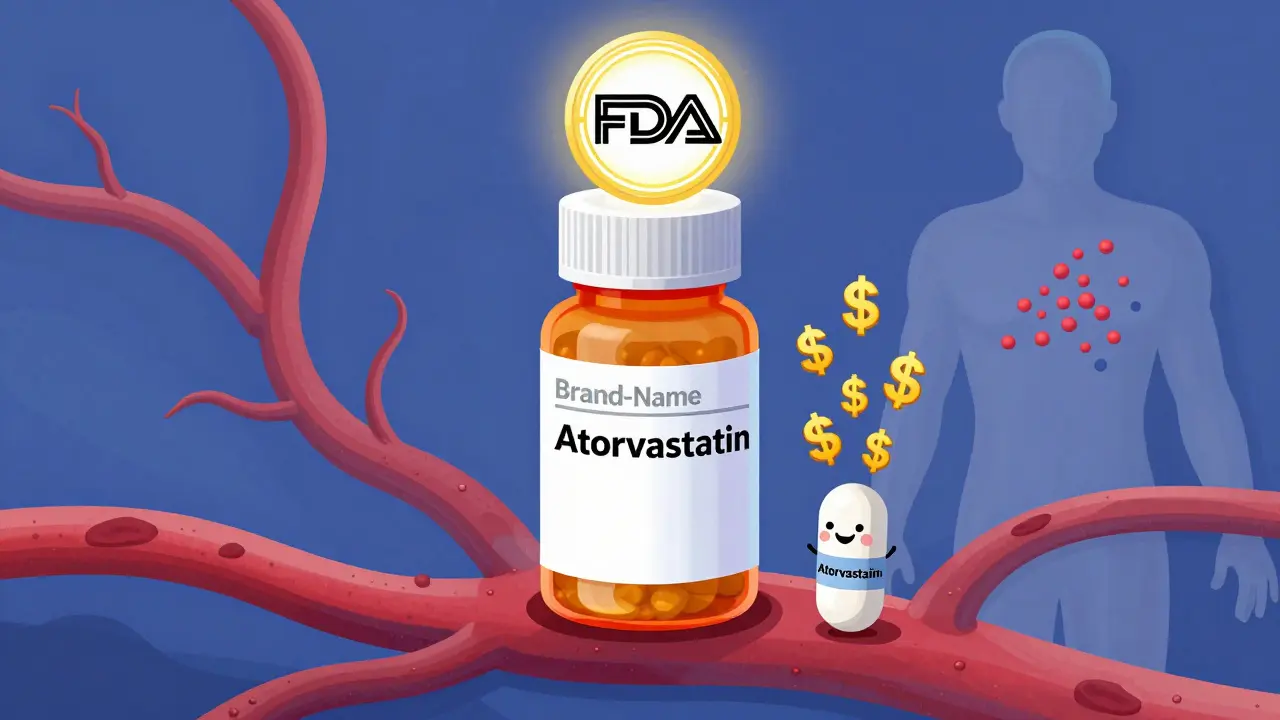
When you pick up a prescription, you might see two options on the label: a brand-name drug like Lipitor or its generic version, atorvastatin. The price difference can be huge-sometimes hundreds of dollars for the same treatment. But are they really the same? If you’re worried about safety, effectiveness, or whether you’re getting a cheaper version that doesn’t work as well, you’re not alone. Millions of people have the same questions. The truth? For most people, generic drugs are just as safe and effective as brand-name ones. And the science backs it up.
What Makes a Generic Drug the Same?
Generic drugs aren’t copies or knockoffs. They’re exact matches in terms of the active ingredient-the part that actually treats your condition. If your brand-name pill contains 20 milligrams of atorvastatin, so does the generic. Same strength. Same form-tablet, capsule, liquid. Same way it enters your body-by mouth, injection, patch. The FDA requires this before even considering approval.
But here’s where people get confused. Some think the 80%-125% bioequivalence range means generics contain only 80% of the active ingredient. That’s not true. That range refers to how fast and how much of the drug enters your bloodstream-not how much is in the pill. The pill itself has the exact same amount. The difference is in how quickly your body absorbs it, and even that’s tightly controlled.
How the FDA Tests for Bioequivalence
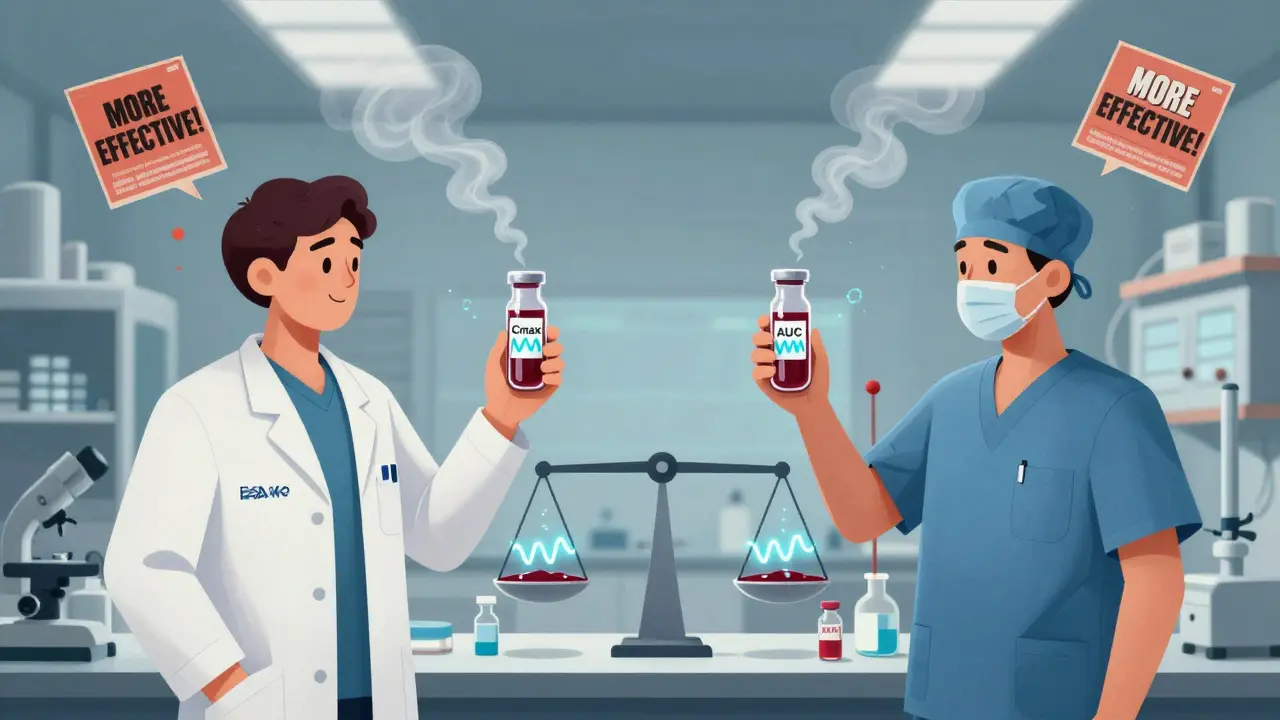
Before a generic drug hits the shelf, the manufacturer must prove it behaves the same way in your body as the brand-name version. They do this with clinical trials involving 24 to 36 healthy volunteers. These are crossover studies: some take the brand-name drug first, then the generic; others switch the order. Blood samples are taken over time to measure two key numbers: Cmax (how high the drug peaks in your blood) and AUC (how much drug is absorbed over time).
The FDA says the generic’s results must fall within 80% to 125% of the brand’s. That’s not a wide margin-it’s tight. In fact, a review of over 2,000 studies found the average difference in absorption was just 3.5% for AUC and 4.35% for Cmax. Over 98% of those studies showed differences under 10%. That’s not just close-it’s nearly identical.
And here’s something most people don’t know: the FDA rates generics with letters. AB-rated means proven bioequivalent and interchangeable. B-rated means it meets standards but may not be ideal for substitution in sensitive cases. Most generics you get are AB-rated.
Do Generics Work as Well in Real Life?
Lab results are one thing. Real patients are another. A major review of 38 studies on heart medications found that generics performed just as well as brand names in 35 of them-including statins, blood thinners, and blood pressure drugs. In fact, a 2020 study of 1.2 million patients in Austria found that generic versions were linked to fewer deaths and fewer heart attacks or strokes in 10 out of 17 drug classes studied. That’s not a fluke. That’s real-world proof.
Even in high-stakes situations like warfarin (a blood thinner), studies show no difference in outcomes when switching from brand to generic. Yet, many patients still refuse the switch. Why? Because of fear, not facts.
When You Should Be Cautious
Not every drug is the same when it comes to substitution. Some medicines have a narrow therapeutic index-meaning even tiny changes in blood levels can cause big problems. These include:
- Warfarin (Coumadin)
- Phenytoin (Dilantin)
- Lithium
- Levothyroxine (Synthroid)
- Digoxin
For these, your doctor or pharmacist might suggest sticking with one version-brand or generic-and not switching back and forth. That’s not because generics are unsafe. It’s because your body might react slightly differently to the fillers or coatings in different versions, and with these drugs, even small shifts matter.
That’s why, if you’re on one of these, your provider may check your blood levels 7 to 14 days after switching. It’s a simple safety step, not a red flag.
Why the Price Difference Is So Huge
Brand-name drugs cost a lot because the company spent years and hundreds of millions developing them. They get a patent to protect that investment-usually 20 years. Once it expires, other companies can make the same drug. They don’t need to repeat expensive clinical trials. They just need to prove bioequivalence. That cuts their costs dramatically.
As a result, generics cost, on average, 80% to 85% less. In 2023, generic drugs saved the U.S. healthcare system $373 billion. That’s not a rounding error. That’s life-changing money for families, insurers, and public programs.
Take Lipitor (atorvastatin). The brand version cost $335 for a 30-day supply. The generic? $0 with a coupon. Plavix (clopidogrel)? $450 for brand. $0 for generic. These aren’t hypotheticals. These are real prices from GoodRx in late 2023.
Why Do Some People Still Doubt Generics?
Despite the data, a 2022 survey found 43% of patients believed generics were less effective. One in four refused substitution when offered. Why? The biggest reason? Fear of inactive ingredients-things like dyes, fillers, or coatings. These don’t treat your condition, but they can affect how the pill looks, tastes, or dissolves.
Some people report feeling different after switching-headaches, nausea, or a sense that the drug “doesn’t work as well.” In rare cases, that’s true. A small number of patients with levothyroxine or epilepsy drugs report changes, often tied to switching between different generic manufacturers. But that’s not because generics are inferior. It’s because even small differences in how the pill breaks down can affect absorption in sensitive individuals.
On Reddit, a thread with over 400 comments found that 67% of users reported no difference between brand and generic. The rest had issues-but most were with specific brands of generics, not generics as a whole.
And here’s the kicker: brand-name companies spend millions marketing the idea that their version is better. Ads, samples, even letters to doctors. It’s not misinformation-it’s marketing. And it works.
What You Should Do
If you’re on a regular medication, ask your pharmacist: Is there a generic version? Is it AB-rated? If yes, and your condition isn’t one of the narrow therapeutic index drugs, switch without hesitation. You’ll save money and get the same result.
If you’re on warfarin, lithium, or levothyroxine, talk to your doctor before switching. Ask if they recommend sticking with one version. If you do switch, ask for a blood test 1 to 2 weeks later to make sure levels are stable.
Don’t let fear cost you more than it should. Generics aren’t second-rate. They’re science-backed, FDA-approved, and used by millions every day. The only real difference? The price tag.
What’s Changing in 2026?
The FDA is pushing harder to approve complex generics-like inhalers, creams, and injectables-that are harder to copy. In 2023, they approved 247 of them, up 19% from the year before. They’re also investing $1.23 billion through 2027 to speed this up.
Meanwhile, biosimilars-generic versions of biologic drugs like Humira-are starting to appear. These are more complex than traditional generics, but they’re already cutting costs by 15% to 30%. By 2030, they’re expected to capture a quarter of the biologics market.
And new tech is helping. A 2023 MIT study showed that advanced manufacturing could reduce absorption differences in warfarin generics to under 2%-nearly eliminating the last bit of uncertainty.
Still, shortages remain a problem. In 2023, there were 312 generic drug shortages, mostly in sterile injectables. That’s up 17% from 2022. Supply chains are fragile. But that’s not a quality issue-it’s a logistics one.
Bottom Line
Generic drugs are not a compromise. They’re the standard. The FDA, independent researchers, and real-world data all confirm: for 90% of prescriptions, generics are just as safe and effective as brand names. The only difference? You pay less. A lot less.
Don’t let marketing or myths keep you from saving money. Ask for the generic. Ask if it’s AB-rated. If you’re on a sensitive drug, get a blood test after switching. Otherwise, take the generic-and keep your wallet full.
Are generic drugs as effective as brand-name drugs?
Yes, for the vast majority of medications, generic drugs are just as effective as brand-name versions. The FDA requires them to contain the same active ingredient, strength, dosage form, and route of administration. Bioequivalence testing shows absorption differences are typically under 4%, which is clinically insignificant for most conditions.
Why are generic drugs so much cheaper?
Generic drugs cost less because manufacturers don’t have to repeat expensive clinical trials. Once a brand-name drug’s patent expires, other companies can produce the same medicine by proving bioequivalence-a much faster and cheaper process. This competition drives prices down, often by 80% to 85%.
Can I switch from a brand-name drug to a generic safely?
For most medications, yes. If your drug is AB-rated (the most common), switching is safe and standard practice. For drugs with a narrow therapeutic index-like warfarin, levothyroxine, or lithium-your doctor may recommend monitoring blood levels after switching. Always consult your provider before making a change.
Do generic drugs have the same side effects as brand-name drugs?
Yes. Since they contain the same active ingredient, side effects are identical. However, inactive ingredients (like dyes or fillers) can differ slightly, which may cause minor reactions in rare cases-like an allergic response to a dye. These are uncommon and usually not related to effectiveness.
What does AB-rated mean on a generic drug?
AB-rated means the generic drug has been proven bioequivalent to the brand-name version and is considered interchangeable by the FDA. This is the highest rating for generics. You’ll see this in the FDA’s Orange Book. Avoid B-rated generics unless your doctor specifically recommends them.
Why do some people say generics don’t work for them?
Some patients report feeling different after switching, often due to changes in inactive ingredients or psychological expectations. In rare cases, people on narrow therapeutic index drugs like levothyroxine may need to stick with one manufacturer’s version to avoid absorption variations. But these are individual cases-not proof that generics are inferior.
Are there any drugs where I should always avoid generics?
No drug is universally off-limits for generics. But for narrow therapeutic index drugs-like warfarin, phenytoin, lithium, and levothyroxine-it’s wise to avoid switching back and forth between different generic versions. Stick with one manufacturer if it works for you. Your doctor can help you decide.
How can I check if my generic drug is FDA-approved?
You can look up your drug in the FDA’s Orange Book, which lists all approved generics and their bioequivalence ratings. Most pharmacies and online tools like GoodRx also indicate if a generic is AB-rated. If your pharmacist says it’s approved, it is.
Comments (15)
Dave Old-Wolf
I switched my statin to generic last year and haven’t had a single issue. My doctor said it’s the same stuff, and my blood work proves it. Why pay more when the science says it’s identical?
christy lianto
My mom was terrified to switch from Synthroid to generic. She cried. I got her blood tested two weeks after. Levels were perfect. She’s now the biggest advocate for generics in her book club. Fear is the real drug here, not the pill.
Kristina Felixita
Wait, so you’re telling me I’ve been overpaying for my blood pressure med for years?? I just got a $0 coupon for the generic… I’m crying. Not because I’m sad, but because I’m so mad I didn’t know this sooner. Thank you for this.
Luke Crump
Let me ask you this-if a drug is so identical, why do brand names still exist? Why do they spend billions on ads telling you their version is better? Maybe because the truth is too boring. Maybe because they know we’re programmed to equate price with quality. Capitalism doesn’t care about science-it cares about profit.
Aubrey Mallory
People who say generics don’t work are either misinformed or have been manipulated by pharma marketing. The FDA doesn’t play games. If it’s AB-rated, it’s as good as the brand. End of story. Stop letting corporations profit off your fear.
Molly Silvernale
It’s funny how we’ll trust a $200 bottle of ‘premium’ skincare with 3% retinol… but balk at a $2 generic pill with 100% identical active ingredient. We’ve been trained to worship the label, not the chemistry. The pill doesn’t care what color the logo is.
Joanna Brancewicz
For narrow TI drugs like levothyroxine, intra-patient variability in absorption can be clinically significant-even within AB-rated generics. Consistency matters. Stick with one manufacturer if you’re stable.
Prakash Sharma
India makes 60% of the world’s generics. We don’t have fancy ads. We don’t have CEOs making $50 million. We just make medicine. If you’re scared of Indian generics, you’re scared of your own ignorance.
Lois Li
I used to think generics were for people who couldn’t afford the real thing. Then I got diagnosed with high cholesterol. My insurance wouldn’t cover Lipitor. I tried the generic. My numbers improved. I felt better. I’m not ashamed anymore. I’m just grateful.
Annette Robinson
My husband’s on warfarin. We switched to generic and asked for a PT/INR test two weeks later. Everything was in range. He was nervous, but the data was calm. That’s what matters. Science over stories.
Manish Kumar
You know what’s really wild? The fact that the same companies that make brand-name drugs often make the generics too. Pfizer makes Lipitor and also makes atorvastatin. So when you say you don’t trust the generic, you’re basically saying you don’t trust Pfizer’s own product. That’s not skepticism-it’s cognitive dissonance.
Evan Smith
So… the $300 pill and the $0 pill are the same? Then why do I feel like I’m getting scammed every time I walk into a pharmacy? Oh right. Because I am. Thanks for the reality check, I guess.
Ken Porter
Generic shortages? That’s on the U.S. government. We outsource everything and then act shocked when the supply chain breaks. Blame the policy, not the pill.
swati Thounaojam
I switched to generic metformin and had a headache for two days. Then I realized I’d been drinking less water. Not the pill. My bad.
Donny Airlangga
Swati’s right. I had the same thing. Thought the generic wasn’t working. Turned out I was sleeping worse. The pill didn’t change. My habits did. We blame the medicine when it’s easier than looking inward.