

Chronic eczema isn’t just dry skin. It’s a broken barrier, a screaming nerve, and a cycle that feels impossible to break. If you’ve been dealing with red, cracked, itchy skin for months-or years-you know it’s not about being messy or not moisturizing enough. It’s biology. And the good news? We now know exactly what’s going wrong, and how to fix it.
Why Your Skin Barrier Is the Root Cause
Your skin isn’t just a surface. It’s a wall. A layered, complex, living wall made of cells and lipids that keeps water in and germs out. In chronic eczema, that wall is cracked. Not just dry-broken. Studies show this damage happens before the redness and itching even show up. In high-risk babies, barrier failure shows up 3 to 6 months before the first flare. The main culprit? Filaggrin. It’s a protein your skin makes to hold everything together. About half of people with moderate to severe eczema have a gene mutation that stops them from making enough of it. Without filaggrin, your skin can’t hold moisture. Water escapes at 3 to 4 times the normal rate. That’s called Transepidermal Water Loss (TEWL). Healthy skin loses 8-12 grams of water per square meter per hour. Eczema skin? 25-40 grams. That’s like leaving your front door open in winter. And when water escapes, your skin’s natural oils-ceramides, cholesterol, and free fatty acids-also vanish. These aren’t just ingredients in fancy creams. They’re the mortar between the bricks of your skin. In eczema, ceramide levels drop by 30-50%. The lipids that remain are the wrong shape, like mismatched puzzle pieces. That’s why regular lotions often fail. They add water, but not the right lipids to seal it in.Barrier Repair: What Actually Works
Not all moisturizers are created equal. A basic petrolatum cream might feel soothing, but it doesn’t fix the broken wall. True barrier repair means replacing what your skin is missing: ceramides, cholesterol, and free fatty acids-in the right ratios. The gold standard? A 1:1:1 mix of ceramide:cholesterol:free fatty acids. That’s the exact ratio your skin uses naturally. Products with this formula-like CeraVe, EpiCeram, or some prescription options-have been shown in clinical trials to restore the barrier in 87% of users. That’s not a guess. That’s from NIH double-blind studies. These products don’t just hydrate. They rebuild. After 2 weeks of consistent use, TEWL drops by 30-50%. Flares become less frequent. Some people see their flare-ups drop from weekly to monthly. In one case study, a 7-year-old reduced steroid use by 80% after switching to barrier repair therapy. Compare that to traditional emollients. Petrolatum-based creams reduce TEWL by about 28%. Ceramide-rich creams? 43%. That’s a 15% difference-and it’s the difference between constant itching and getting some sleep. But here’s the catch: these products cost more. A 200g tube of a ceramide-dominant cream runs $25-$30. A basic petroleum jelly? Under $10. Insurance often covers prescription barrier creams like EpiCeram, but rarely OTC ones. That’s why many people stop using them. They’re expensive. But if you’re in the middle of a flare, the cost of not fixing it-sleepless nights, infections, steroid dependence-is higher.What Makes Eczema Flare Up (And How to Avoid It)
Even with a repaired barrier, eczema can still flare. Why? Triggers. They don’t cause eczema, but they light the fuse. The big ones:- Harsh soaps and detergents-even ‘gentle’ ones can be too alkaline. Your skin’s natural pH is 4.5-5.5. Most body washes are 7-9. That’s like pouring baking soda on a wound. It shuts down the enzymes that make ceramides. Use pH-balanced cleansers (look for 5.0-5.5 on the label).
- Hot showers-heat strips moisture and irritates nerves. Keep water lukewarm, and limit showers to 10 minutes.
- Dry air-especially in winter. Use a humidifier in your bedroom. Aim for 40-50% humidity.
- Sweat-it’s salty. Salt irritates broken skin. Shower after exercise, and pat dry gently.
- Stress-it doesn’t cause eczema, but it makes inflammation worse. Your body releases cortisol, which breaks down skin lipids. Meditation, breathing, or even 20 minutes of walking can help.
- Staphylococcus aureus-this bacteria loves eczema skin. It colonizes cracks, releases toxins, and triggers immune chaos. Barrier repair reduces its presence by 65-75%. That’s why healing the barrier is the first step to killing the infection.

How to Stop the Itch-Without Scratching
The itch isn’t just annoying. It’s a neurological loop. Scratch → inflammation → more itch → more scratch. And you don’t even realize you’re doing it while sleeping. Here’s how to break it:- Cool compresses-damp cloth, cold from the fridge. Apply for 10 minutes. It numbs the nerve endings.
- Wet wrap therapy-after applying your barrier cream, cover the area with damp cotton clothing, then a dry layer. This locks in moisture and reduces itching. Studies show it cuts flare duration by 50%.
- Topical calcineurin inhibitors-pimecrolimus or tacrolimus. These aren’t steroids. They calm the immune response without thinning skin. They take longer to work (2-4 weeks), but they’re safe for long-term use on the face and folds.
- Oral antihistamines-they don’t stop the itch in eczema. Most studies show they’re no better than placebo. But if you’re waking up at night, a sedating one like hydroxyzine might help you sleep.
- Behavioral tricks-tap instead of scratch. Squeeze a stress ball. Wear cotton gloves to bed. These don’t cure eczema, but they break the reflex.
When Barrier Repair Isn’t Enough
For some, even perfect barrier repair doesn’t fix everything. That’s not your fault. It’s biology. If you have a severe filaggrin mutation, your TEWL might be over 45 g/m²/h. That’s beyond what creams can fix. In these cases, the immune system gets stuck in overdrive. Inflammation becomes self-sustaining. That’s when you need help beyond the cream. JAK inhibitors like upadacitinib or abrocitinib-oral or topical-can calm the immune response. They’re not magic. They have side effects. But for people who’ve tried everything else, they’re life-changing. Dr. Emma Guttman-Yassky’s research showed barrier repair normalizes 78% of the genes that go haywire in eczema skin. Steroids? Only 45%. But if the immune system is already raging, you need both. The American Academy of Dermatology says: start with barrier repair. If it doesn’t work in 6-8 weeks, add an immunomodulator. That’s the new standard.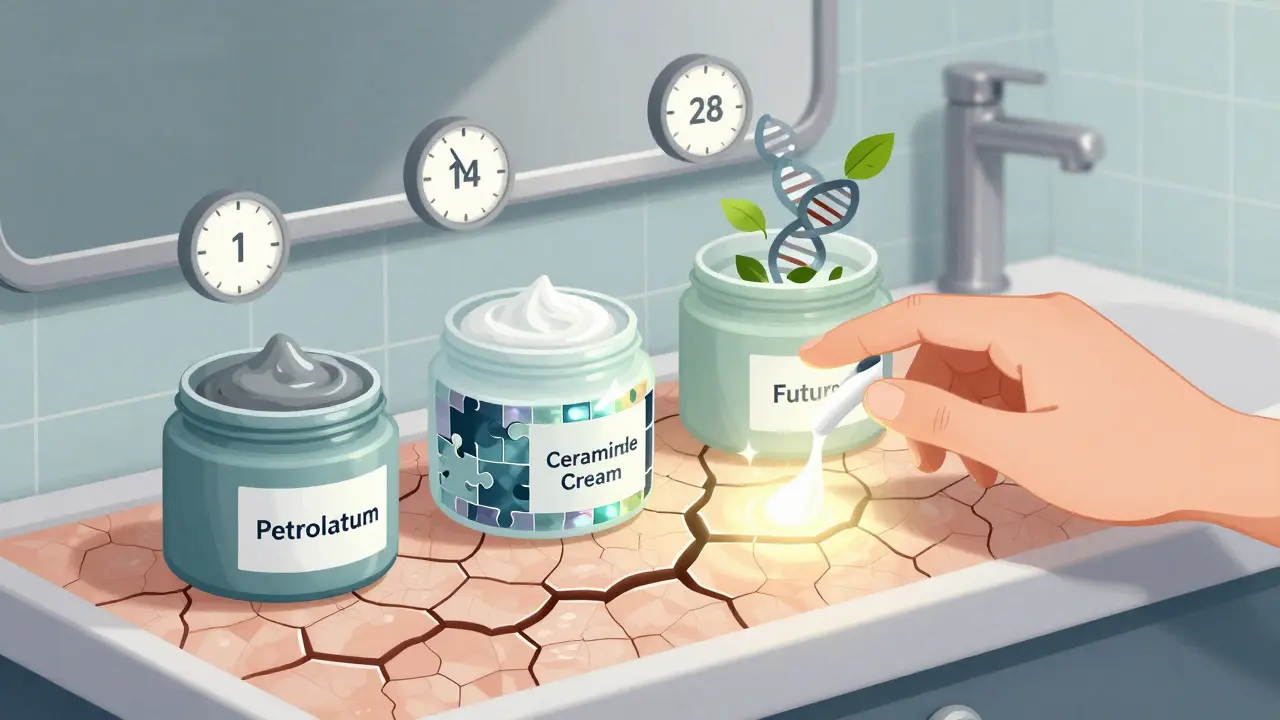
How to Use Barrier Creams Right
Using them wrong is why so many people think they don’t work.- Apply within 3 minutes of bathing-your skin is still holding water. Seal it in before it evaporates. Waiting 10 minutes cuts effectiveness by 35%.
- Use enough-2 fingertip units (FTUs) for each arm. That’s about 5 grams per application. Most people use half that. You need the volume to rebuild the barrier.
- Apply twice daily-morning and night. Even on good days.
- Wait 15 minutes between steroid and cream-if you’re using topical steroids, apply the steroid first, wait, then apply the barrier cream. Mixing them reduces the cream’s effectiveness.
- Be patient-it takes 28-42 days to rebuild the barrier. You won’t feel better on day 3. But by day 30? You’ll wonder why you waited so long.
What’s Coming Next
The future of eczema care is personal. Researchers are already testing products matched to your filaggrin mutation status. Companies like Dermavant are working with 23andMe to build algorithms that predict which ceramide blend will work best for your skin. New treatments are on the horizon too. Platelet-rich plasma (PRP) injections are being studied to boost filaggrin production by 300%. Microbiome-targeted creams-designed to feed good bacteria-are in Phase 3 trials. And sustainability? The EU is requiring barrier creams to be 30% biodegradable by 2027. Silicones and plastics in creams? They’re being phased out. In 10 years, eczema won’t be managed with trial and error. It’ll be precision medicine. But right now? The best thing you can do is fix the barrier. Use the right cream. Apply it right. Avoid the triggers. And give it time. Your skin isn’t broken forever. It’s just waiting for the right tools to heal.Can I use regular lotion for chronic eczema?
No. Regular lotions add water but don’t replace the missing lipids your skin needs. They may feel soothing temporarily, but they won’t repair the barrier. Look for products with ceramides, cholesterol, and free fatty acids in a 1:1:1 ratio. Brands like CeraVe, EpiCeram, and Vanicream are formulated for this.
Why does my eczema cream sting when I apply it?
Stinging is common with barrier repair creams, especially if your skin is cracked or inflamed. These products often have a slightly acidic pH (5.0-5.5) to activate repair enzymes, which can burn on damaged skin. Try applying to less irritated areas first, or use a plain petrolatum ointment to soothe the worst spots before layering on the ceramide cream. The sting usually fades after 3-5 days as your skin heals.
How long until I see results from barrier repair?
You need at least 28 days of consistent use-twice daily, with enough product-to rebuild your skin barrier. Some people notice less itching by day 14, but full barrier restoration takes 4-6 weeks. Don’t stop if you don’t see instant results. The science shows it takes 92% compliance to reduce TEWL significantly.
Are steroid creams bad for chronic eczema?
Not if used correctly. Short-term, low-potency steroids (like hydrocortisone 1%) are safe and effective for flares. Long-term use on thin skin (face, eyelids, folds) can cause thinning. That’s why barrier repair is now the first-line treatment. Steroids should be used only for short bursts (5-7 days) to calm flares, then replaced with barrier repair and non-steroid options like pimecrolimus.
Can diet cure chronic eczema?
No. There’s no proven diet that cures eczema. Some people notice flares after dairy, eggs, or nuts, but food triggers are rare in adults. Unless you have a confirmed allergy (tested by a doctor), eliminating foods won’t help-and may hurt your nutrition. Focus on barrier repair, triggers, and itch control instead. If you suspect a food trigger, work with a dermatologist or allergist-not a social media trend.
Is eczema contagious?
No. Eczema is not contagious. You can’t catch it from someone else. Even if your skin is cracked and oozing, it’s an immune and barrier issue, not an infection. However, the bacteria that thrive on eczema skin (like Staphylococcus aureus) can spread and cause secondary infections. That’s why keeping the barrier repaired is so important.
Should I use natural or organic products for eczema?
Not necessarily. ‘Natural’ doesn’t mean safe or effective. Essential oils, shea butter, and coconut oil are common in ‘natural’ products-but they can irritate eczema skin. Coconut oil, for example, can increase TEWL in some people. Stick to products with proven ingredients: ceramides, cholesterol, fatty acids, and a pH of 5.0-5.5. Look for the National Eczema Association Seal of Acceptance-it’s based on clinical testing, not marketing.
Comments (9)
Emily P
I’ve been using CeraVe for 3 weeks now and honestly? My skin isn’t perfect, but the nighttime scratching has dropped off a cliff. I didn’t think it would work because it feels greasy as hell, but I’m sleeping through the night for the first time in years. No joke.
Also, the 3-minute rule after showering? Game changer. I used to wait until I was fully dressed. Big mistake.
Vicki Belcher
YESSSSSS 🙌🙌🙌 I cried when I finally found a cream that didn’t make my skin feel like sandpaper. CeraVe PM is my baby now. I apply it like it’s holy water. Twice a day. No excuses. My husband thinks I’m obsessed. I am. And I don’t care. 😭💧
Alex Curran
Barriers aren't just lipid ratios they're biological infrastructure. Filaggrin deficiency isn't a deficiency it's a systemic architectural flaw. TEWL isn't just water loss it's your epidermis screaming for help. The 1:1:1 ratio works because it mimics native lipid architecture not because it's marketing. Most people use too little too late. And yes hot showers are criminal. 10 minutes max. Lukewarm. Always.
Also staph colonization isn't a side effect it's a consequence. Fix the wall first. Then the bugs leave.
And no coconut oil. It's a myth. It increases TEWL in filaggrin-deficient skin. I've seen the data. Don't waste your time.
Lynsey Tyson
I just wanted to say thank you for writing this. I’ve been feeling so alone in this. Everyone tells me to ‘just moisturize more’ like it’s that simple. But this? This actually explains what’s going on. I’ve started using Vanicream and wearing gloves at night. It’s tiny progress, but it’s progress. I’m not giving up anymore.
Also, I used to think I was just ‘bad at self-care’ but now I see it’s biology. That’s so freeing.
Edington Renwick
Everyone’s acting like this is some revolutionary breakthrough. Newsflash: dermatologists have known this for 15 years. The fact that you’re only now learning about ceramides means you’ve been listening to influencers, not science. And don’t get me started on ‘natural’ products. Coconut oil is literally a trigger. You’re not healing. You’re just replacing one mistake with another. The real tragedy? You’re paying $30 for a cream that’s basically fancy vaseline with a fancy label. But hey, if it makes you feel better…
Allison Pannabekcer
Edington, I hear you - and I think you’re right about the marketing. But for someone who’s been suffering for a decade, even a fancy vaseline that finally stops the bleeding feels like a miracle. I’ve tried everything. Steroids made my face thin. Antihistamines did nothing. I was ready to give up.
Then I found CeraVe. It didn’t fix me overnight. But it gave me back my nights. And that’s worth every dollar. Science isn’t just in journals - it’s in the quiet moments when you stop scratching and actually sleep.
We’re not all dermatologists. Some of us are just trying to get through the day without crying from itch. And this? This helped. That’s enough.
anthony funes gomez
Let’s deconstruct the epidermal lipidome: ceramide NP, ceramide AP, ceramide EOP, cholesterol, free fatty acids - their molar stoichiometry must approximate the stratum corneum’s native architecture. The 1:1:1 ratio is not arbitrary - it’s phylogenetically conserved. TEWL is a quantitative biomarker of barrier integrity. The NIH data is robust. But here’s the epistemic gap: most consumers don’t understand that ‘moisturizer’ is a semantic trap. A moisturizer hydrates. A barrier repair agent restores lipid matrix integrity. One is symptomatic. The other is curative. And yes - the cost differential is a structural injustice. Insurance coverage should reflect clinical efficacy not corporate lobbying. JAK inhibitors are the future - but only if we fix the foundation first. The skin is not a canvas. It’s an organ. Treat it like one.
Sahil jassy
Bro this is gold. I had no idea about the filaggrin thing. I thought it was just stress. Started using EpiCeram last week. Skin still stings but I'm not scratching in my sleep anymore. 10/10 would recommend. Also humidifier = life saver. 🙏
Kathryn Featherstone
Just wanted to add - if you’re on a budget, try buying the large tub of CeraVe. It’s cheaper per gram. And if your skin stings, start with a small area like your inner forearm. Let it build up slowly. You don’t have to do it all at once. Healing isn’t a race. It’s a rhythm.
And if you’re feeling discouraged? You’re not failing. Your skin is just rebuilding. It takes time. I’m 8 weeks in. I still have bad days. But I have good nights. And that’s the win.