
ADHD Stimulant Cardiac Risk Assessment Tool
Assess Your Risk Factors
Answer these questions to understand your individual risk level for cardiac arrhythmias while taking ADHD stimulants.
Your Risk Assessment
Recommendations
Family History
Age
Medication Type
BP/HR
When you’re prescribed a stimulant for ADHD - whether it’s Adderall, Ritalin, or Vyvanse - the goal is simple: focus better, feel calmer, get things done. But what if that same pill could quietly mess with your heart rhythm? It’s not a common problem. But it’s real enough that doctors now ask questions about your family history, your pulse, and your blood pressure before they write the prescription. And if you’re over 65, or have a history of heart issues, the stakes get higher.
How Stimulants Can Trigger Heart Rhythm Problems
Stimulants like amphetamines and methylphenidate work by boosting dopamine and norepinephrine in the brain. That’s what helps with attention and impulse control. But those same chemicals also hit your heart. They make it beat faster and push blood harder through your arteries. For most people, this is a minor, harmless bump - maybe your heart rate goes up by 5 beats per minute. But for a small group, it’s enough to trigger something dangerous: cardiac arrhythmias.
These aren’t just skipped beats or fluttering. Arrhythmias can mean ventricular tachycardia, prolonged QT intervals, or even sudden cardiac arrest. The mechanism isn’t guesswork. Research shows stimulants interfere with the heart’s electrical system. Cocaine and methamphetamine block potassium and sodium channels, which delays how the heart resets after each beat. That delay can spark abnormal rhythms. Even prescription versions, though weaker, do the same thing - just slower and less dramatically.
A 2021 study in PubMed Central found that adults over 66 who started stimulants had a three times higher risk of ventricular arrhythmias in the first 30 days. That’s not a small number. And while the risk dropped off after six months, the initial window is critical. For younger people, the danger isn’t immediate arrhythmias - it’s long-term damage. A March 2024 American College of Cardiology study showed that long-term use (over eight years) raised the risk of cardiomyopathy by 57%. That’s when the heart muscle weakens, making arrhythmias more likely down the road.
Prescription vs. Illicit: Big Difference in Risk
Not all stimulants are created equal. There’s a huge gap between a prescribed dose of Adderall and a street hit of meth or cocaine. The European Heart Journal (2025) found that cocaine users had a 2.5 to 4.5 times higher chance of ventricular arrhythmias than non-users. Why? Because illicit drugs aren’t measured. They’re cut with other chemicals. They’re taken in binges. They’re combined with alcohol or other drugs. And they’re used without medical oversight.
Even among prescription stimulants, there are differences. Amphetamines (like Adderall and Vyvanse) tend to cause more pronounced spikes in heart rate and blood pressure than methylphenidate (Ritalin, Concerta). That’s because they release more norepinephrine directly into the bloodstream. Methylphenidate works more locally in the brain. So if you’re at risk for arrhythmias, your doctor might lean toward methylphenidate - not because it’s safe, but because it’s less risky.
And here’s the twist: a major 2022 JAMA meta-analysis found no statistically significant link between ADHD medications and cardiovascular disease overall. So which do you believe? The study showing tripled arrhythmia risk in seniors? Or the one saying there’s no real danger?
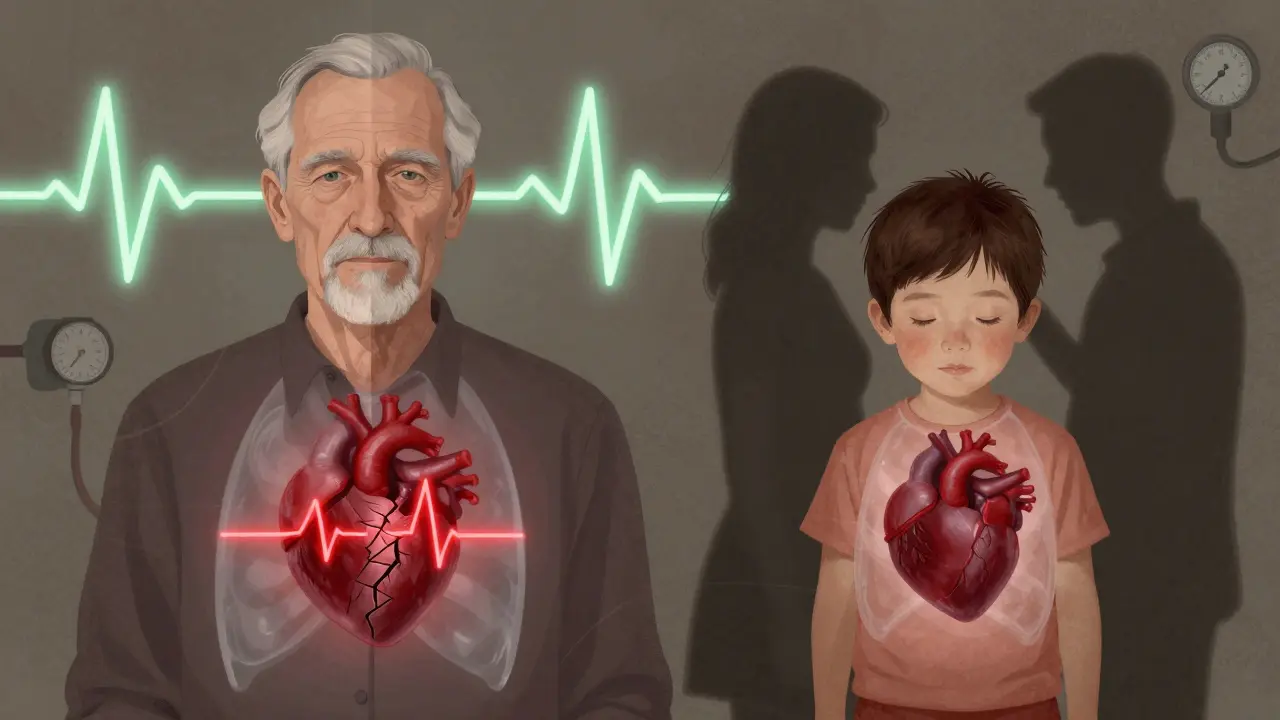
The answer lies in context. For a healthy 12-year-old with no family history of heart disease, the risk is extremely low - so low that the American Academy of Pediatrics says routine ECGs aren’t needed. But for a 70-year-old with high blood pressure and a father who died suddenly at 52? That’s a different story. Risk isn’t about averages. It’s about your personal profile.
Who’s at Highest Risk?
You don’t need to be a heart patient to be at risk. Sometimes, the warning signs are hidden in your family tree. Here’s who should be extra careful:
- People with a personal or family history of sudden cardiac death before age 50
- Those diagnosed with long QT syndrome, hypertrophic cardiomyopathy, or other inherited heart conditions
- Anyone with unexplained fainting, chest pain, or palpitations - especially during exercise
- Adults over 65 starting stimulants for the first time
- People with untreated high blood pressure or existing arrhythmias
Even if you feel fine, these factors matter. A 2010 study in the journal Pediatrics showed that nearly 1 in 10 kids with ADHD had a family history of sudden death or heart disease - and most parents didn’t even realize it was relevant. That’s why doctors now ask: Has anyone in your family died suddenly before age 50? Did a relative have an ICD or pacemaker? Have you ever passed out for no reason? These aren’t just formality questions. They’re life-saving.
What Doctors Actually Do - Real-World Monitoring
Most GPs and psychiatrists don’t order ECGs before prescribing stimulants. The American Heart Association and American Academy of Pediatrics agree: routine ECGs aren’t necessary for low-risk patients. But that doesn’t mean no monitoring.
Here’s what actually happens in clinics across Australia and the U.S.:
- Before starting: Blood pressure and heart rate are measured. A detailed personal and family cardiac history is taken.
- Within 1-3 months: You come back for another check. If your blood pressure is above the 95th percentile, or your heart rate is consistently over 100 bpm, your dose may be lowered or switched.
- Every 6-12 months: Routine monitoring continues. More frequent checks happen if you’re adjusting doses or feeling off.
- If symptoms arise: Palpitations, dizziness, chest tightness - you stop the medication and get an ECG right away.
One study found that 1-2% of patients develop blood pressure high enough to require intervention. That’s rare, but not rare enough to ignore. And if you have a known heart condition - like repaired congenital heart disease - you’ll likely be referred to a cardiologist before even trying a stimulant.
When to Stop - The Red Flags
Stimulants aren’t for everyone. If you start taking them and something feels wrong, don’t brush it off. Here’s when to call your doctor immediately:
- Heart rate stays above 110 bpm at rest
- Blood pressure consistently above 140/90 mmHg
- ECG shows QT interval longer than 0.46 seconds
- Palpitations that last more than a few minutes or happen during rest
- Unexplained fainting or near-fainting episodes
Stopping the medication usually reverses the changes. In most cases, the heart rhythm returns to normal within days. But if you’ve had a serious arrhythmia, you may never be able to safely use stimulants again.
Alternatives That Work - Without the Heart Risk
If stimulants are too risky for you, there are other options. They’re not as fast-acting. They’re not as effective for everyone. But they’re safer for your heart.
- Atomoxetine (Strattera): A non-stimulant that boosts norepinephrine. It takes 4-8 weeks to work, but it doesn’t raise heart rate or blood pressure. Response rate: about 50-60%.
- Guanfacine (Intuniv): Originally a blood pressure pill. It helps with focus and emotional regulation by calming the prefrontal cortex. Works well for kids and adults. Side effects: drowsiness, low blood pressure.
- Clonidine (Kapvay): Similar to guanfacine. Helps with impulsivity and sleep issues. Often used alongside other meds.
These aren’t magic bullets. They don’t give you the same sharp, immediate focus as Adderall. But they work. And they don’t put your heart on the line.
Some people try behavioral therapy, exercise, or diet changes alone. Those help - especially for mild ADHD. But for moderate to severe cases, medication still works best. The key is matching the tool to the person.
The Bigger Picture: Benefits vs. Risks
The global ADHD medication market is worth over $17 billion. Eight out of ten prescriptions are for stimulants. Why? Because they work. For kids who couldn’t sit still in class. For adults who missed deadlines, lost jobs, or felt like they were always falling behind. These drugs change lives.
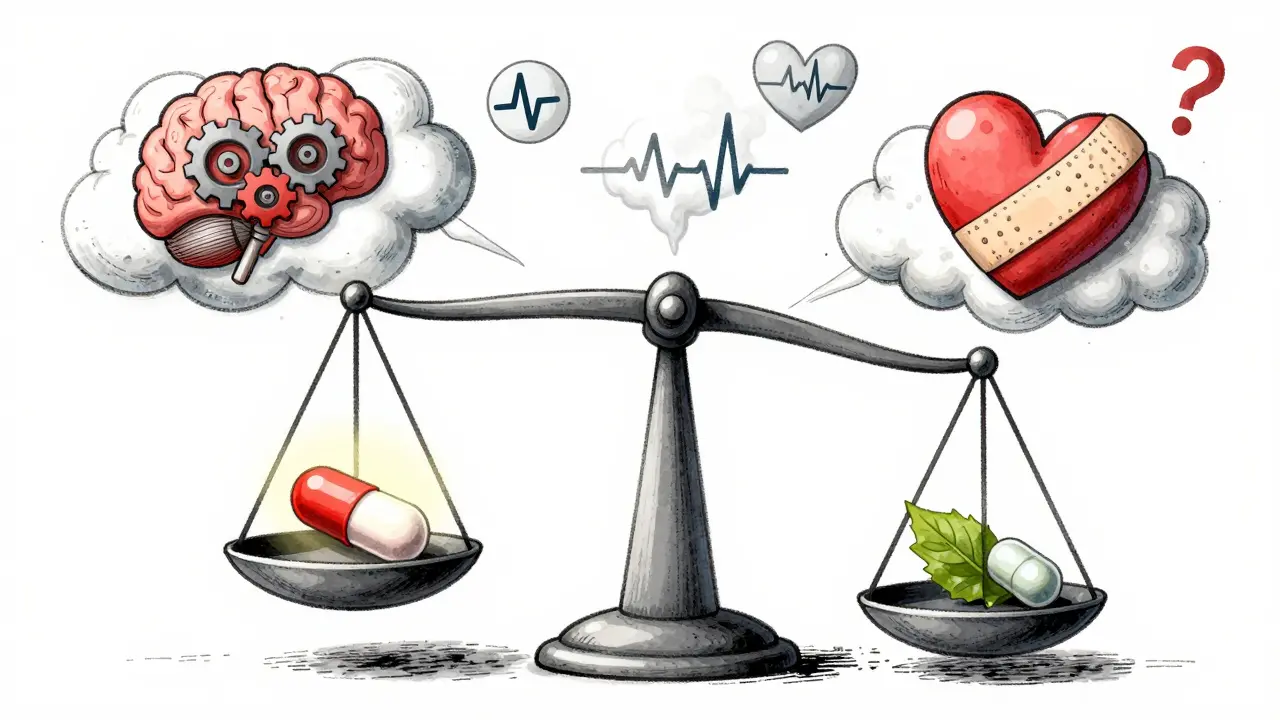
The real question isn’t whether stimulants are dangerous. It’s whether they’re dangerous for you. The absolute risk of sudden cardiac death from ADHD meds in healthy children is less than 1 in 1 million per year. That’s lower than the risk of dying in a car crash on your way to the pharmacy.
But if you’re in the 1 in 10,000 - the one with a hidden heart condition - then the risk is real. That’s why personalized care matters. Not blanket bans. Not fear. Not ignoring the data. Just careful, thoughtful screening.
Future guidelines, expected in late 2025 from the American College of Cardiology, will likely focus on risk stratification. Maybe you’ll get a genetic test someday to see if you carry a mutation that makes you more sensitive to stimulants. Maybe your doctor will use AI to analyze your ECG and predict arrhythmia risk. But for now, the best tool is still the one you’ve had for decades: a good history, a quiet conversation, and a stethoscope.
What You Can Do Today
If you’re on stimulants:
- Know your family heart history. Ask relatives if anyone had sudden death, heart failure, or an ICD.
- Track your resting heart rate and blood pressure at home. Write it down.
- Don’t ignore palpitations or dizziness. Report them - even if they seem minor.
- Ask your doctor: Do I need an ECG? Am I in a higher-risk group?
If you’re considering stimulants:
- Don’t skip the cardiac history questions. Be honest.
- Ask about non-stimulant options. They’re not second-rate - they’re second-choice for safety.
- Understand that improvement takes time. You don’t need to feel a rush to know it’s working.
Stimulants aren’t evil. They’re powerful. And like any powerful tool, they need respect - not fear, not hype, just clear-eyed awareness.
Can ADHD stimulants cause sudden cardiac death?
The absolute risk is extremely low - less than 1 in 1 million per year in healthy children and young adults. However, in people with undiagnosed heart conditions like long QT syndrome or hypertrophic cardiomyopathy, the risk increases. That’s why doctors screen for family history and symptoms before prescribing. Sudden death is rare, but preventable with proper assessment.
Do I need an ECG before starting Adderall or Ritalin?
No, routine ECGs are not recommended for low-risk patients by the American Heart Association or American Academy of Pediatrics. But if you have a personal or family history of heart disease, fainting, or sudden death before age 50, your doctor should order one. For adults over 65, many clinicians now recommend an ECG before starting stimulants due to higher arrhythmia risk.
Are non-stimulant ADHD meds less effective?
Yes, generally. Stimulants work for 70-80% of people. Non-stimulants like Strattera, Intuniv, or Kapvay work for about 50-60%. They take longer to kick in - weeks instead of days - and don’t give the same sharp focus boost. But for people with heart risks, they’re the safer choice and still effective enough to improve daily function.
How long does it take for heart risks to appear after starting stimulants?
For arrhythmias, the highest risk is in the first 30 days, especially in adults over 65. For structural damage like cardiomyopathy, the risk builds slowly - studies show it increases significantly after one year and peaks around eight years of use. That’s why long-term monitoring matters, even if you feel fine.
Can I switch from Adderall to Ritalin to reduce heart risk?
It might help. Methylphenidate (Ritalin, Concerta) tends to cause smaller increases in heart rate and blood pressure than amphetamines (Adderall, Vyvanse). But the difference isn’t huge. If you have a known heart condition, switching alone isn’t enough - you’ll still need close monitoring. For high-risk patients, non-stimulants are usually preferred.
What should I do if I feel my heart racing on stimulants?
Stop taking the medication immediately and contact your doctor. Don’t wait to see if it passes. Record your heart rate and any other symptoms (dizziness, chest pain, shortness of breath). Your doctor may order an ECG or refer you to a cardiologist. Most cases resolve after stopping the drug, but ignoring symptoms could lead to serious complications.
Final Thoughts
There’s no one-size-fits-all answer. For some, stimulants are life-changing. For others, they’re a danger. The difference isn’t in the drug - it’s in the person. The best approach isn’t to avoid stimulants entirely. It’s to know your risks, ask the right questions, and choose wisely. Your brain matters. But so does your heart.
Comments (11)
anthony epps
My grandpa started Adderall last year and now he’s on a pacemaker. Not saying it caused it, but the doc said it didn’t help.
Kayleigh Campbell
So let me get this straight - we’re okay with giving kids pills that make their hearts race like they just ran a marathon, but we won’t let them chew gum in class? 😒
Also, my therapist said Strattera made me feel like a zombie with a spreadsheet. Not great, but at least I didn’t die.
Souhardya Paul
This is one of the most balanced takes I’ve seen on stimulants. Too many people either treat them like magic bullets or demonize them like heroin.
My mom had undiagnosed long QT syndrome - she passed out at 28, got an ICD at 32, and now she’s 61 and alive because someone asked the right questions. I’m 34 and on Vyvanse. I got an ECG before starting, and my doc said my QT was borderline, so we went with the lowest dose and monitor every 3 months.
It’s not about fear. It’s about knowing your numbers. I track my resting HR every morning. If it’s over 90, I skip the pill that day. Simple.
And yeah, non-stimulants suck for focus, but they’re not useless. I tried guanfacine for a month - felt like I was underwater, but I didn’t panic during meetings. That’s worth something.
Also, if you’re over 65 and thinking about stimulants? Please, please get an ECG. Don’t trust the ‘not recommended’ line. That’s for healthy 20-year-olds. You’re not that person.
And if you’re a parent? Ask about sudden deaths in the family. Not just ‘did anyone have heart disease?’ - ask ‘did anyone die suddenly before 50?’ Most people don’t even know that’s relevant until it’s too late.
Dan Padgett
Man, this hit different. I’m from Nigeria, and here, ADHD is either ‘he’s just wild’ or ‘he’s possessed.’ No one talks about the heart. No one even knows what an ECG is unless they’re rich.
I’ve seen kids on Ritalin like candy - bought it from the pharmacy without a script, mixed it with energy drinks, took it before exams. Some of them got dizzy, some passed out. We laughed it off. Now I think… maybe we killed a few without realizing.
It’s not just about pills. It’s about systems. We need doctors who ask the hard questions, not just scribble prescriptions and move on.
And yeah - non-stimulants? In my village, they’d call Strattera ‘the slow medicine.’ But if it keeps you alive? Slow beats dead any day.
Respect to the doc who wrote this. You didn’t scare us. You woke us up.
Hadi Santoso
Okay so I’ve been on Adderall for 6 years and my HR is 85 at rest - which my cardiologist says is ‘fine for someone on stimulants.’ But I’ve had two episodes where my heart felt like it was trying to escape my chest. I didn’t tell anyone for months because I didn’t want to sound like a hypochondriac.
Then I read this and went ‘oh shit.’ Went to the doc, got an ECG - QT was 0.44, just under the limit. They switched me to Concerta. Took 3 weeks to feel ‘normal,’ but now I don’t feel like my heart’s gonna explode during Zoom calls.
Also, my grandma died of sudden cardiac arrest at 51. I didn’t know until I was 25. So now I ask everyone in my family: ‘Did anyone just… drop?’ Turns out, two uncles did. I’m glad I didn’t ignore the signs.
TL;DR - if you’re on stimulants and have a family history? Get checked. Even if you feel fine. Your heart doesn’t care how productive you are.
Randolph Rickman
First off - thank you for writing this. As someone who’s been prescribing stimulants for 15 years, I’ve seen too many patients get scared off by fear-mongering Reddit posts or, worse, ignored by doctors who think ‘it’s just ADHD.’
Here’s what I tell my patients: If you’re under 25, healthy, no family history, and your BP/HR are normal? You’re probably fine. Go ahead.
But if you’re over 40, have a dad who dropped dead at 48, or you get dizzy when you stand up? Stop. Get an ECG. Talk to a cardiologist. Don’t let your pride cost you your life.
And yes, non-stimulants are slower. But they’re not ‘second-rate.’ They’re ‘second choice for safety.’ That’s not a weakness - it’s wisdom.
Also - track your heart rate. Buy a cheap Fitbit. If your resting HR is consistently above 90, something’s off. Don’t wait for a blackout to act.
You don’t need to be a heart expert. You just need to be curious. And brave enough to ask the question: ‘Could this be killing me?’
Josias Ariel Mahlangu
People act like stimulants are some new evil invention. They’re not. Cocaine’s been around for 150 years. The difference? Now we have data. Now we have ECGs. Now we have doctors who care.
Stop pretending you’re ‘too healthy’ to be at risk. My cousin was 22, ran track, ate clean - died of ventricular fibrillation after a weekend of Adderall binges. No family history. No symptoms. Just bad luck and bad choices.
If you’re taking stimulants without monitoring, you’re gambling. And the house always wins.
And for the love of God, stop comparing yourself to ‘healthy kids.’ You’re not them. And your heart isn’t either.
Arun ana
India here. ADHD meds are still kinda taboo here. But I’m on Strattera - took 2 months to work, but I’m finally sleeping and not panicking during meetings.
My mom cried when I told her I was on ‘nervous system pills.’ She thought I was addicted. I showed her this article. She now asks my doctor if my heart is okay. 🙏
Also, I use emojis now and then because I’m a millennial 😅 but seriously - this saved me. Thank you.
Tiffany Machelski
i just started ritalin and my heart feels weird. i thought it was just anxiety but now im scared. should i stop? or just wait? idk
Kim Hines
I didn’t know my uncle had an ICD until I was 30. He never talked about it. I asked my mom - she said, ‘Oh yeah, he had a scare in his 40s.’ No one thought it mattered.
I got an ECG before my first stimulant prescription. QT was normal. But I still check my pulse every morning. I don’t want to be the person who ignored the signs.
Thanks for writing this. It’s the kind of thing you wish you’d read sooner.
Andrew Sychev
Let’s be real - if you’re taking Adderall because you’re a lazy college student who can’t focus without a chemical crutch, you’re not ‘managing ADHD.’ You’re just trying to outwork your own brain.
And now you’re risking your heart for a better grade? That’s not bravery. That’s stupidity.
And if you’re over 40 and still popping pills like candy? You’re not ‘productive.’ You’re just delaying the inevitable.
Stop romanticizing stimulants. They’re not a lifestyle upgrade. They’re a medical tool. And if you don’t treat them like one, your heart will.
And don’t even get me started on people who buy them off Instagram. You’re not a hacker. You’re a corpse waiting to happen.