
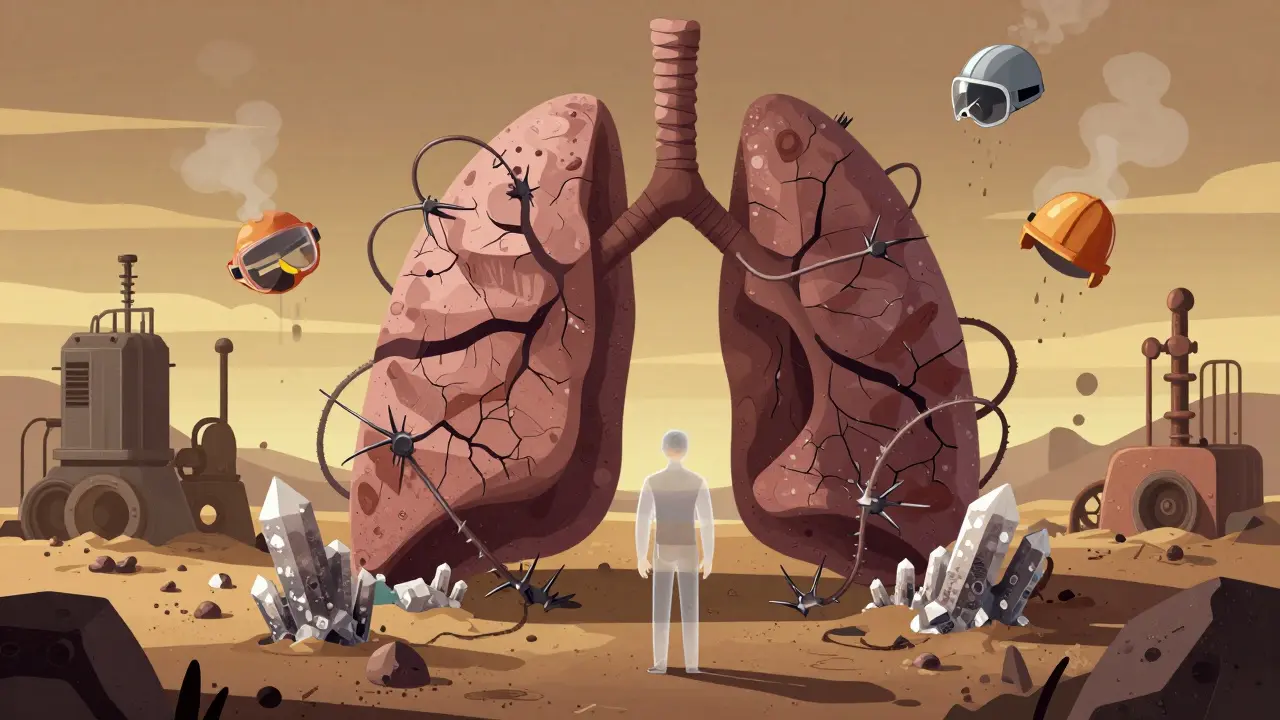
Every year, thousands of workers breathe in dust and fibers they can’t see-and pay with their lungs. Silicosis and asbestosis aren’t rare accidents. They’re preventable diseases that still kill people in 2026, mostly because safety rules aren’t followed, not because the solutions don’t exist.
What Silicosis and Asbestosis Actually Do to Your Lungs
Silicosis happens when you breathe in tiny bits of crystalline silica. This isn’t just regular sand. It’s the kind found in stone, concrete, brick, and sandstone. When workers cut, drill, or grind these materials without protection, the dust gets deep into the lungs. The body tries to fight it off, but over time, scar tissue builds up. Your lungs stiffen. Breathing becomes harder. There’s no cure. Once the damage is done, it only gets worse.
Asbestosis is similar, but it comes from asbestos fibers. These were used in insulation, roofing, pipes, and floor tiles for decades. When those materials break down-during renovation, demolition, or even just aging-the fibers float in the air. Inhaled, they get stuck in lung tissue and cause scarring. Like silicosis, it leads to shortness of breath, coughing, and reduced lung capacity. It can take 10 to 40 years for symptoms to show up, which is why many workers don’t connect their breathing problems to their job until it’s too late.
Both diseases are irreversible. No medicine can undo the scarring. The only way to stop them is to stop the exposure.
Who’s at Risk? It’s Not Just Miners Anymore
People think these diseases only affect coal miners or factory workers from the 1950s. That’s wrong. Today, construction workers, tile installers, stone countertop fabricators, demolition crews, and even landscapers are at high risk.
Think about this: a worker using a dry saw to cut engineered stone for a kitchen benchtop is breathing in silica dust at levels 10 to 20 times higher than the legal limit. That’s not a myth-it’s documented by OSHA inspections. In 2021, over 1,000 construction companies in the U.S. were fined for silica violations. Many of those workers were in their 20s and 30s. They didn’t know they were being poisoned.
Asbestos is still in 733,000 public buildings in the U.S. alone. When schools, hospitals, or old offices are renovated, workers are exposed without proper controls. Even homeowners doing DIY projects on older houses are at risk if they sand or drill into asbestos-containing materials.
And here’s the cruel part: smoking makes both diseases worse. If you work around silica or asbestos and you smoke, your risk of developing lung disease jumps by 50 to 70%. Quitting smoking isn’t just good for your heart-it’s a survival tactic.
The Hierarchy of Controls: What Actually Works
There’s a proven order of how to protect workers. It’s called the hierarchy of controls. And it’s simple: the best way to prevent disease is to remove the hazard entirely. But since that’s not always possible, here’s what works, ranked from most to least effective:
- Elimination or substitution: Don’t use materials with silica or asbestos. Use safer alternatives where possible. For example, some engineered stone now uses non-silica binders.
- Engineering controls: These are physical changes to the job that stop dust from getting into the air. Wet cutting-where water is sprayed on the blade while cutting stone-reduces silica dust by 90%. Local exhaust ventilation systems, attached to tools, suck dust away before it spreads. OSHA says these systems need to pull air at 100-150 feet per minute to work right. When done properly, they cut exposure by 80-90%.
- Administrative controls: Limit how long workers are exposed. Rotate tasks. Schedule dusty work for times when fewer people are around. Train workers properly. This helps, but it’s not enough on its own.
- Personal protective equipment (PPE): This is the last line of defense. N-95 masks filter 95% of particles 0.3 microns in size. But for silica and asbestos, you need P-100 respirators, which filter 99.97%. They’re more expensive and harder to breathe through, especially in 90-degree heat. That’s why compliance drops in summer. A 2022 CDC report found that 68% of worker complaints about respirators were about discomfort or poor fit. And 32% of workers modified their masks to make them easier to wear-making them useless.
Here’s the truth: if you’re relying only on masks, you’re already losing. Engineering controls are the only thing that gives real, consistent protection.
Why Prevention Still Fails-Even When We Know How
We’ve had the tools to stop these diseases for decades. So why do they still happen?
One reason is cost. Small businesses think installing a wet-cutting system or exhaust hood costs too much. But the math doesn’t add up. A proper ventilation system for one workstation costs $2,000 to $5,000. That’s less than one workers’ compensation claim for silicosis, which can run over $100,000. NIOSH found that companies see a return on investment within 18 to 24 months.
Another reason is culture. Workers don’t wear respirators because they’re hot, uncomfortable, or because their boss doesn’t wear one. A 2023 study of 15 construction companies found that when supervisors modeled proper PPE use 100% of the time, respiratory incidents dropped by 65% over three years. Workers follow what they see, not what they’re told.
And then there’s enforcement. OSHA’s National Emphasis Program on silica has issued nearly 1,000 citations since 2022. But inspections are rare compared to the number of worksites. Many workers don’t know their rights. They’re afraid to speak up. OSHA’s whistleblower protections exist, but they mean nothing if no one knows they’re there.
What Workers and Employers Need to Do Right Now
If you’re a worker exposed to dust or fibers:
- Ask for wet cutting or local exhaust ventilation. Don’t accept dry grinding or sanding.
- Get a P-100 respirator-not an N-95-and make sure it fits. Annual fit testing is required by law.
- Get a baseline spirometry test. Then get tested every five years. If you have asthma or COPD, get tested every year.
- Don’t smoke. Period.
- If you’re told to skip safety steps, report it. You have legal protection.
If you’re an employer:
- Invest in engineering controls first. Wet cutting, dust extraction, enclosed systems. These are not optional.
- Train workers for at least 4-6 hours initially, not the minimum 2 hours OSHA requires. Include real-life examples.
- Make PPE use non-negotiable-and lead by example. If you wear a mask, they will too.
- Keep respirators clean and stored properly. Dirty masks don’t work.
- Track exposure. Use simple dust monitors or hire an industrial hygienist. You can’t manage what you don’t measure.

The Bigger Picture: This Is a Global Problem
The European Respiratory Society wants to eliminate occupational lung diseases by 2030. Germany’s pilot programs cut new cases by 55% using mandatory health checks and exposure monitoring. The U.S. has the technology. We have the data. We just don’t have the will.
Right now, occupational lung diseases make up 15-20% of all work-related illnesses in the U.S. Construction, mining, and manufacturing account for 75% of those cases. The global market for respiratory protection is growing fast-projected to hit $11.3 billion by 2027. That’s not because demand is rising because of new dangers. It’s because we’re finally starting to catch up.
NIOSH’s new ‘Prevent eTool’ digital platform gives step-by-step guidance for 15 high-risk jobs. Early results show a 40% drop in respiratory incidents in companies using it. That’s proof that knowledge, when made simple and accessible, saves lives.
The future isn’t about more masks. It’s about smarter systems, better enforcement, and a workplace culture that values a worker’s breath as much as their productivity.
Frequently Asked Questions
Can you get silicosis from one-time exposure?
No, silicosis develops over years of repeated exposure. But even short-term, high-level exposure-like working without protection during a major demolition-can cause acute silicosis, which develops within weeks or months. It’s rare but deadly. There’s no safe level of exposure to crystalline silica.
Is asbestos still used in new buildings?
In the U.S., asbestos is banned in most new products but not completely. Some roofing materials, gaskets, and automotive parts can still legally contain asbestos. In other countries, it’s still widely used. The real danger is in older buildings-any structure built before 1980 likely has asbestos somewhere. Always assume it’s there until proven otherwise.
Do N-95 masks protect against asbestos?
No. N-95 masks filter 95% of particles 0.3 microns in size, but asbestos fibers are often longer and thinner. They can slip through. P-100 respirators are required because they filter 99.97% of particles, including oil-based and non-oil-based aerosols. Using an N-95 for asbestos is like using a sieve to catch sand.
How do I know if my workplace is safe?
Ask three things: Are wet methods or exhaust systems used? Are workers using P-100 respirators with annual fit tests? Is there a written exposure control plan? If the answer to any is no, it’s not safe. You can also request a free OSHA consultation-no fines, just help. Workers have the right to a safe workplace.
Can silicosis or asbestosis be detected early?
Yes. Spirometry tests measure lung function before symptoms appear. Chest X-rays and CT scans can show early scarring. The American Thoracic Society says early detection can slow disease progression by 30-50%. If you’ve worked with dust or asbestos, get tested-even if you feel fine.
Comments (13)
Alexandra Enns
This is such a crock. You think the government actually gives a damn about workers? Nah. They let corporations bleed people dry until the lawsuits start rolling in. Silicosis? Asbestosis? Those are just line items on a balance sheet. And don't even get me started on P-100 masks-half the guys I work with wear them like they're holding a taco. No wonder people are dying. We need to shut down every job site that doesn't have a wet-cutting rig installed yesterday. No excuses.
Marie-Pier D.
Thank you for writing this. 🙏 I work in demolition and I’ve seen coworkers cough for years and just shrug it off like it’s normal. My cousin got diagnosed with silicosis at 34. He never wore a mask because ‘it was too hot.’ Now he’s on oxygen. Please, if you’re reading this-don’t wait until your lungs give out. Ask for wet cutting. Ask for the right respirator. You deserve to breathe. 💙
Sawyer Vitela
N-95s don't work for asbestos. P-100s are mandatory. End of story. Stop spreading misinformation.
Shanta Blank
Let me get this straight-we have the tech to prevent this, but we’re still letting people turn into human lung sculptures because someone didn’t wanna spend $2K on a dust extractor? This isn’t negligence. This is *murder* with a clipboard. And the fact that workers are afraid to speak up? That’s the real horror movie. No jump scares. Just slow suffocation. 😭
Tiffany Wagner
my brother works in countertop fabrication and he just started using wet saws last year. he says the difference is insane. no more dust everywhere. no more coughing after lunch. i wish he’d done it sooner. also he quit smoking. big win
Chloe Hadland
my dad was a roofer in the 80s. he never talked about it but now he’s got asbestosis and he just says ‘it was just part of the job.’ i wish someone had told him back then that he had a right to be safe. please share this with someone who might not know
Amelia Williams
you know what’s wild? the ‘Prevent eTool’ from NIOSH? I used it last month to train my crew. We went from zero compliance to 90% in two weeks. It’s not magic-it’s just clear, simple steps. If you’re an employer reading this, don’t just check the OSHA box. Actually care. Your people are counting on you. And hey-if you’re a worker? Speak up. You’re not being a troublemaker. You’re being a hero.
Kevin Waters
Engineering controls are the only real solution. Masks are a backup. Always. I’ve seen teams save 80% on respiratory exposure just by installing local exhaust on their grinders. Cost? $3K. Liability savings? Over $100K in the first year. It’s not a cost center. It’s an investment. And if your boss says it’s too expensive, show them the NIOSH ROI charts. They don’t lie.
Kat Peterson
OMG I just read this and I’m literally crying. 💔 I work in HR and we had a guy last year who got silicosis. He was 31. His wife posted on LinkedIn and it went viral. We had to shut down three sites for ‘culture reviews.’ Now we have mandatory wet-cutting training. But why did it take a man nearly dying for us to act? 😭 We’re so broken.
Izzy Hadala
It is imperative to note that the hierarchy of controls is not a suggestion but a foundational principle of occupational hygiene. The efficacy of engineering controls has been empirically validated in multiple peer-reviewed studies, including those published in the American Journal of Industrial Medicine. Reliance upon personal protective equipment constitutes a failure of primary prevention. The continued prevalence of these diseases is indicative of systemic institutional neglect.
Elizabeth Cannon
so i work at a small shop and we just got a wet saw last month. my boss didn’t want to spend the money but then we got an osha visit and he panicked. now he’s the first one wearing the p-100. weird how that works. also we started doing spirometry tests. turns out 3 of us already had early signs. we’re getting help now. thank god we didn’t wait
Marlon Mentolaroc
you know what’s funny? the same guys who won’t wear a mask will buy a $600 pair of work boots. why? because they can see the boot. they can’t see the dust. that’s the real problem. we need to make invisible threats visible. maybe put up signs that show lung scans of workers who didn’t protect themselves. make it real.
Gina Beard
we measure the cost of life in dollars and quarters. but the lungs? they don’t come with a warranty.