
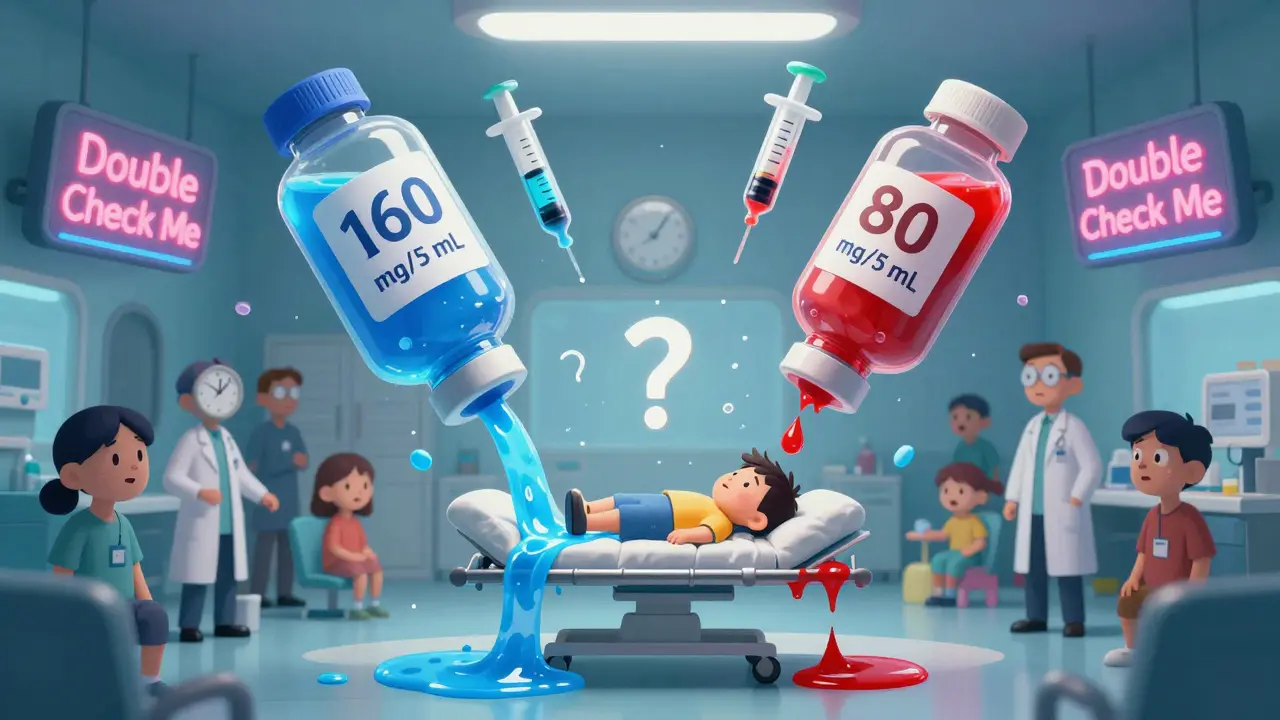
Every year, thousands of children end up in emergency rooms because of a simple mistake: the wrong dose of medicine. Not because parents are careless, but because the system is set up to fail them. In pediatric emergencies, medication errors happen more than twice as often as in adults. One in three kids gets hit with a dosing mistake - and many of those mistakes could have been stopped before they happened.
Why Kids Are So Vulnerable
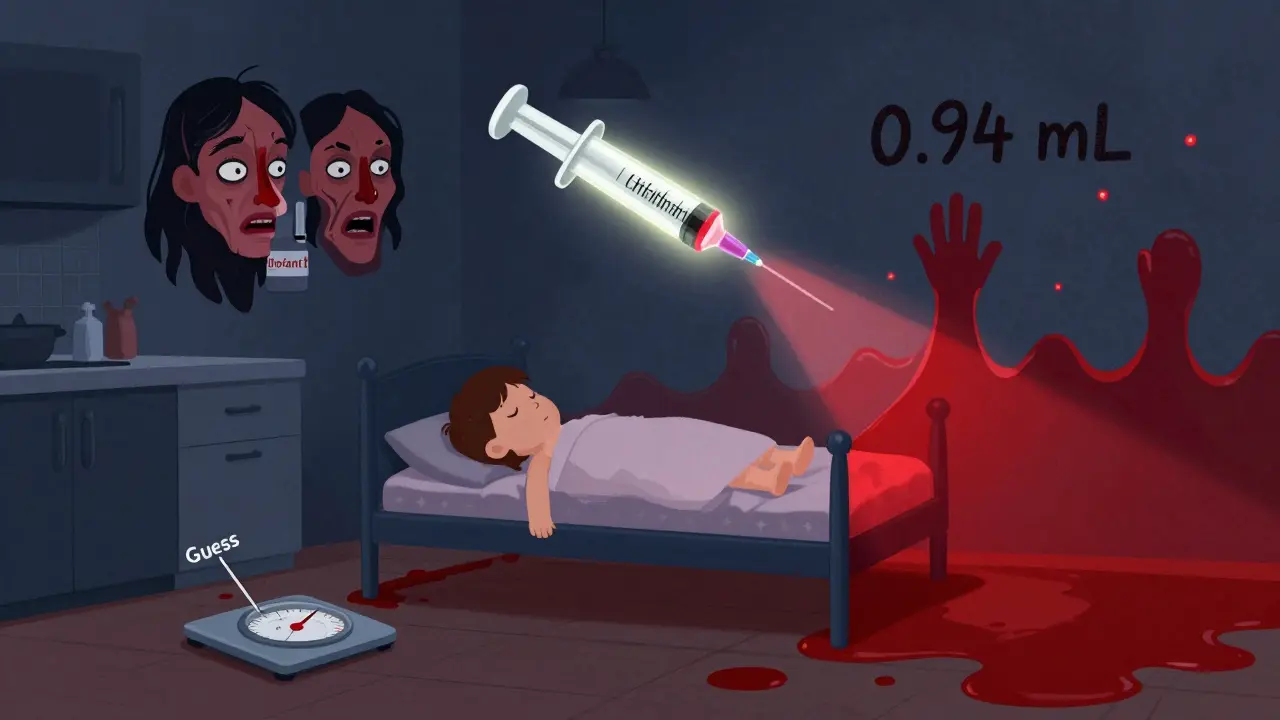
Adults take pills. Kids get liquids. That’s the first big difference. Liquid medications come in different concentrations. One bottle might say 160 mg per 5 mL. Another might say 80 mg per 5 mL. If you mix them up, you’re giving your child twice the dose - or half. And it’s not just parents. Even trained staff in emergency rooms get it wrong.Here’s the math: A 10-kilogram child needs 15 mg of acetaminophen per dose. That’s 0.94 mL if the concentration is 160 mg/5 mL. But if you think it’s 80 mg/5 mL, you’ll give 1.88 mL - double the right amount. One mistake. One overdose. One trip to the ICU.
Weight-based dosing is the standard. But getting a child’s weight right? That’s harder than it sounds. In 10% to 31% of errors, the weight was recorded wrong. A parent guesses. A nurse estimates. A scale is broken. And then the computer spits out a dose based on bad data. No one checks it twice.
The Most Common Mistakes - And What They Cost
The top errors in pediatric emergencies aren’t mysterious. They’re predictable:- Wrong dose (13% of all errors)
- Wrong medication (4%)
- Wrong rate or timing (3%)
- Wrong route (like giving oral meds IV)
And the results? One in eight errors causes real harm. Another 47% reach the child but don’t hurt them - lucky breaks. The rest are caught before they even get to the patient. But that doesn’t mean they didn’t happen. In one study, researchers found errors hidden in syringe labels that no one had ever reported. That’s because most hospitals only track what’s officially logged. They miss the near-misses. And those near-misses are the warning signs.
At home, the numbers are even worse. In families with low health literacy, 68% make dosing mistakes. For non-English speakers, it’s 45%. One mother gave her 2-year-old 5 mL of children’s Tylenol, thinking it was the same as infant concentrate. It wasn’t. The dose was ten times too high. Her child ended up in the hospital. She didn’t know the difference - and no one had explained it clearly.
How Emergency Rooms Make It Worse
Pediatric emergencies are chaotic. Kids cry. Parents panic. Doctors rush. Verbal orders fly. Nurses juggle multiple patients. In that pressure, mistakes slip through.Unlike adult ERs, where most meds come in standard doses, pediatric ERs rely on calculations. Every single dose has to be figured out from scratch. No easy “one size fits all.” And many hospitals still use paper orders. Or EMRs that don’t have pediatric-specific alerts. A 2023 survey found only 68% of children’s hospitals use dosing calculators built into their systems. General ERs? Often none.
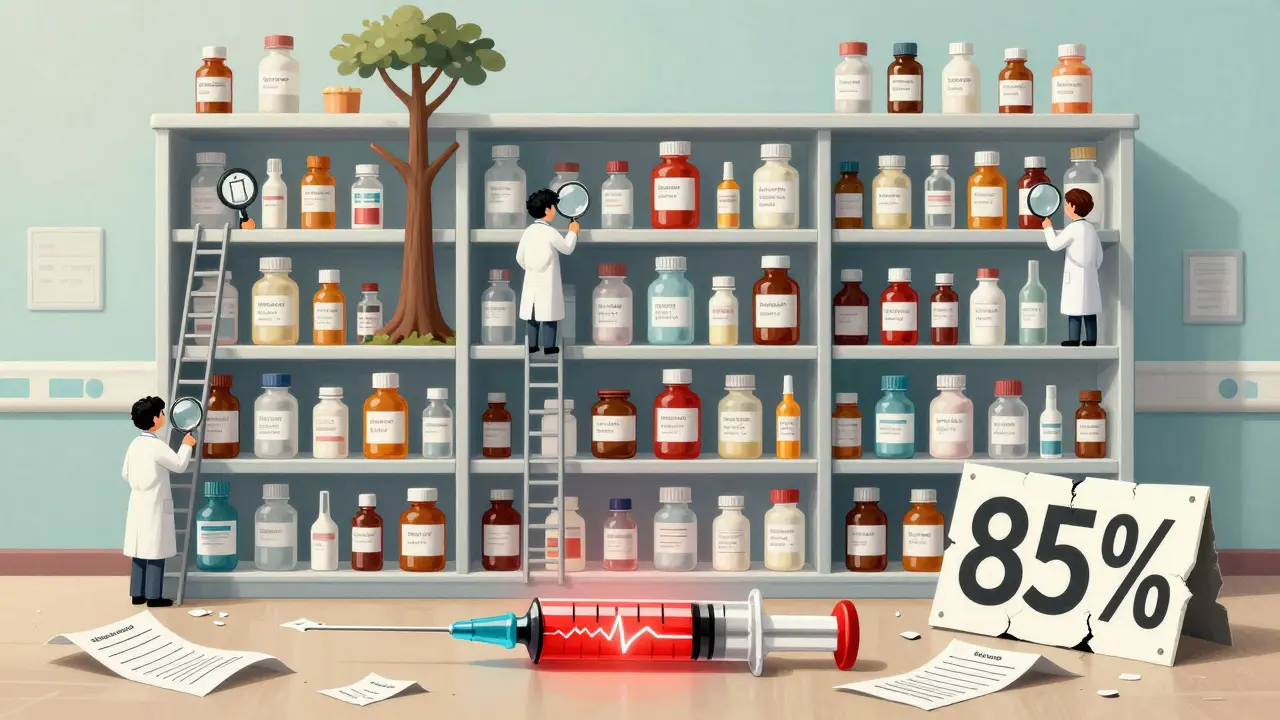
One hospital tracked errors over five years. Nothing changed. Then they added a simple rule: every pediatric dose had to be double-checked by a pharmacist before it was given. Within a year, harmful errors dropped by 85%. That’s not magic. That’s a system that works.
What Actually Works - And What Doesn’t
You can’t fix this with posters or pamphlets. You need systems.At Nationwide Children’s Hospital, they changed three things:
- Every child’s weight is verified by two staff members before any dose is calculated.
- All high-risk meds (like morphine, epinephrine, insulin) require a second clinician to confirm the dose.
- Pharmacists review every single order before it leaves the pharmacy.
Result? Harmful errors fell from 1 in 100 doses to 1 in 600. That’s a 85% drop.
At home, the fix is simpler. A 2024 study tested a 90-second intervention called MEDS. Nurses gave parents:
- Written instructions with pictures - not just words
- A dosing syringe (not a spoon)
- Asked them to repeat back the dose in their own words
Before: 64.7% of parents made dosing errors. After: 49.2%. And six months later? It stayed at 56.7%. The change stuck.
But here’s the catch: This only works if the hospital has the time and staff to do it. In safety-net hospitals - where most low-income families go - nurses are stretched thin. No time for teach-back. No extra syringes. No pharmacy support. That’s where the gap is widest.
What Parents Can Do Right Now
You don’t need to be a nurse to keep your child safe. Here’s what to ask for - and what to insist on:- Ask for the exact dose in milliliters (mL), not teaspoons or tablespoons. Those are not precise.
- Ask for a dosing syringe. If they don’t give you one, ask for one. Bring your own if you have to.
- Confirm the concentration. Is it 160 mg/5 mL or 80 mg/5 mL? Write it down.
- Ask the nurse or doctor to show you how to measure it. Then do it in front of them.
- Never guess a dose. If you’re unsure, call the pharmacy or your pediatrician. Don’t wait.
One parent on Reddit shared: “I gave my kid the wrong medicine because I didn’t realize ‘infant’ and ‘children’s’ were different. I felt like an idiot. But I wasn’t - the labels are confusing on purpose.”
The Bigger Picture
This isn’t just about one ER or one family. It’s about a broken system. Kids aren’t small adults. Their bodies process drugs differently. Their doses need to be precise. Yet we treat them like afterthoughts.The American Academy of Pediatrics says medication safety is one of their top five priorities. But until every hospital - not just children’s hospitals - uses standardized dosing tools, double-checks, and pharmacist reviews, mistakes will keep happening.
And until every parent gets clear, visual, spoken instructions - not just a paper slip - errors will keep happening at home.
The data doesn’t lie. The cases don’t lie. We know how to fix this. We just haven’t made it a priority.
What’s Next?
By 2025, the AAP plans to roll out standardized metrics to track outpatient pediatric medication errors. That’s a start. But real change needs action now:- Hospitals: Implement pharmacist review for all pediatric doses.
- EMR vendors: Build pediatric-specific dosing alerts into every system.
- Pharmacies: Always include a dosing syringe with liquid meds.
- Parents: Never assume. Always confirm. Always measure.
One child. One dose. One mistake. That’s all it takes. But with the right system - and the right questions - it doesn’t have to happen again.
Comments (10)
Matthew Hekmatniaz
So many parents are terrified to ask questions in the ER because they feel stupid. But honestly? The system is designed to make you feel that way. I’ve seen nurses hand out syringes like they’re giving out candy - and then act annoyed when you don’t know how to use it. We need to stop blaming families and start fixing the design.
One time my kid got a dose labeled '160 mg/5mL' - but the bottle cap said '80 mg/5mL'. No one caught it. I caught it because I’d read the article online. That shouldn’t be on me.
We need color-coded caps. Standardized labeling. Period. Not more pamphlets. Not more 'ask your doctor.' Real change.
And if your hospital doesn’t have a pharmacist reviewing every pediatric dose? That’s not a policy gap. That’s negligence.
Liam George
Let’s be real - this isn’t about dosing errors. It’s about the pharmaceutical-industrial complex weaponizing confusion to sell more product. Why do infant and children’s Tylenol even exist as separate products? It’s not medical. It’s profit. They want you buying two bottles instead of one.
And the EMR vendors? They’re not ‘forgetting’ pediatric alerts. They’re charging hospitals extra for the upgrade. Same with syringes - why are they not bundled by default? Because someone’s making money off the scarcity.
Every near-miss is a data point. Every child who gets overdosed? A revenue stream for the next lawsuit. We’re being played. And the AAP? They’re funded by the same pharma giants pushing these confusing labels.
Wake up. This isn’t incompetence. It’s exploitation.
sharad vyas
In India, we don’t have pediatric ERs like this. Most kids get medicine from the local pharmacist - and they use a spoon. No syringes. No labels. But somehow, fewer kids end up in ICU.
Why? Because the doses are simple. One drop per kg. No math. No decimals. No 160 vs 80.
Maybe we’re overcomplicating it. Maybe we don’t need smart systems. Maybe we need dumb, foolproof doses. Like one pill for under 10kg, another for over. No calculations. No confusion.
It’s not about technology. It’s about humility. Let the medicine be simple. Let the parent be safe.
Dusty Weeks
bro i gave my kid 5ml of kids tylenol thinking it was infant and she was fine lmao but like… i felt so dumb 😅
turns out the bottle had tiny print that said 'for 2-3 years' and i just assumed. no one told me. no one showed me. i just googled it at 2am while holding a crying toddler.
pls give us syringes. pls put big letters on the bottle. pls don’t make us feel like criminals for being tired parents 🙏
Sally Denham-Vaughan
I’m a nurse in a busy ER. I see this every day. The worst part? We know how to fix it. We’ve had the tools for years. But admin won’t fund the pharmacist review program because ‘it’s not cost-effective.’
Cost-effective? A single ICU admission costs $120,000. A pharmacist’s salary is $120,000 a year. We’re choosing to pay for mistakes instead of preventing them.
And don’t get me started on the parents who bring in measuring spoons. I’ve seen a teaspoon of ibuprofen. That’s 5mL. That’s 3x the dose. And they think they’re being careful.
We need to stop pretending this is a parent problem. It’s a system problem. And we’re all complicit.
Bill Medley
Standardization prevents error. Verification prevents harm. Accountability prevents repetition. These are not opinions. They are medical imperatives.
Every pediatric dose requires independent double-check. Every label must be unambiguous. Every syringe must be provided. No exceptions.
Failure to implement these is not negligence. It is malpractice.
Richard Thomas
There’s a deeper layer here that no one talks about - the erosion of trust between caregivers and institutions. When parents are told ‘just follow the label’ and then the label contradicts itself, they don’t just make dosing errors. They stop trusting medical advice altogether.
I’ve met mothers who refuse to give Tylenol because they’re afraid of being wrong. They wait until the fever is 104. Then they come in panicked. The system created the panic. Then it blames them for it.
It’s not about literacy. It’s about coherence. If the system can’t speak clearly, why should anyone believe it?
And when the same hospital gives you a syringe labeled ‘for oral use only’ but the IV bag next to it has the same concentration? That’s not an error. That’s a signal. The system is broken. And we’re all learning to live with it.
Paul Ong
My kid had a fever last week. I called the pharmacy. Asked for the right syringe. Asked for the concentration. Asked them to write it down. They gave me a spoon and said ‘it’s fine’
I drove to Walmart and bought a syringe. I measured it myself. I took a picture of the bottle and sent it to my cousin who’s a nurse
That’s what we have to do now. Because the system isn’t built to save our kids. It’s built to move them through.
So I’m not waiting. I’m not trusting. I’m doing it myself. And if that’s the new normal? Then we’ve already lost.
Andy Heinlein
just wanna say thank you for writing this. i was one of those parents who thought i was dumb for mixing up infant and children’s tylenol. turns out the labels are designed to confuse. i didn’t know that until i read this.
now i carry a syringe in my diaper bag. i check the concentration every time. i ask the nurse to show me how to measure it. i feel less scared now.
we can fix this. we just have to keep talking. and not feel guilty for asking.
Ann Romine
I’m a bilingual mom. I read the label in English. My husband read it in Spanish. We both thought it was the same. We didn’t realize the concentrations differed by language on the packaging.
They printed ‘infant’ in English but ‘children’ in Spanish on the same bottle. No one caught it. We didn’t know to ask.
How many other families are missing this? How many labels are translated poorly? This isn’t just about math. It’s about language. And no one’s auditing that.