
Reading your prescription label shouldn’t be a guessing game. If you have low vision, standard pharmacy labels can be impossible to read - tiny text, poor contrast, cluttered layout. That’s not just inconvenient. It’s dangerous. People with vision impairment take the wrong medication, the wrong dose, or miss doses entirely because they can’t read what’s on the bottle. The good news? There are real, proven solutions. Large print, audible labels, QR codes, and other accessible formats are available now - and they’re changing lives.
Why Standard Prescription Labels Fail People with Low Vision
Most pharmacy labels are printed in 8- to 10-point font. That’s fine if you have 20/20 vision. But if you’re over 65 - or have macular degeneration, glaucoma, or diabetic retinopathy - that text is unreadable. A 2021 CDC survey found that 20% of adults aged 45 and older struggle to read medication labels. For many, it’s not just about magnifying glasses. The font style, spacing, and background color make it worse. Glossy paper reflects light. Tiny caps and lowercase letters mix together. Instructions like “take one tablet by mouth twice daily” become a jumble of shapes. These aren’t abstract risks. A study in the National Center for Biotechnology Information (PMC4860753) showed that visually impaired patients took the wrong medication or dose about twice a week before switching to accessible labels. That’s not rare. That’s routine.What Counts as Large Print? The Real Standards
You might think “large print” just means bigger text. But it’s not that simple. The American Foundation for the Blind (AFB) and the Access Board set clear standards: 18-point font minimum. Some people need 20 or even 24-point, especially if they have central vision loss. It’s not just size. Font choice matters. Sans-serif fonts like Arial, Verdana, or APHont™ (a free font designed for low vision users) are easier to read. Avoid decorative fonts. Avoid italics. Avoid all caps - they’re harder to scan. The best labels use uppercase numbers (like 1, 2, 3) and lowercase letters for instructions. High contrast is non-negotiable: black text on a white background. No gray, no cream, no yellow paper. And here’s the catch: standard prescription bottles don’t have enough space for 18-point font with all the required info - drug name, dose, frequency, prescriber, pharmacy, expiration. So pharmacies use a workaround: duplicate labels. They print the full details on a separate, larger sticker and stick it over the original. Some even color-code them - yellow highlights for “take with food” or red for “avoid alcohol.”More Than Just Big Text: Audible and Digital Options
Not everyone can read large print, even if it’s 24-point. That’s where technology steps in. ScripTalk is one of the most widely used systems. It uses a small RFID chip embedded in the label. You hold a handheld reader (or a smartphone app) near the bottle, and it reads the full prescription details out loud - drug name, dosage, instructions, refill info. It works even if the label is worn or smudged. CVS, Walgreens, and other major chains offer it for free. You don’t need to buy the reader - many pharmacies loan them out. Another option is QR code labels. UK HealthCare’s ScriptView system prints a QR code on the label. Scan it with your phone, and it plays an audio version of the label. Some systems even let you choose the voice speed or language. No extra hardware needed - just your smartphone. Then there’s Be My Eyes, a free app that connects you with sighted volunteers via live video. Point your phone at the label, and someone on the other end reads it to you in real time. It’s not automated, but it’s fast and free. Over 1.2 million label readings have been done through this system since 2023.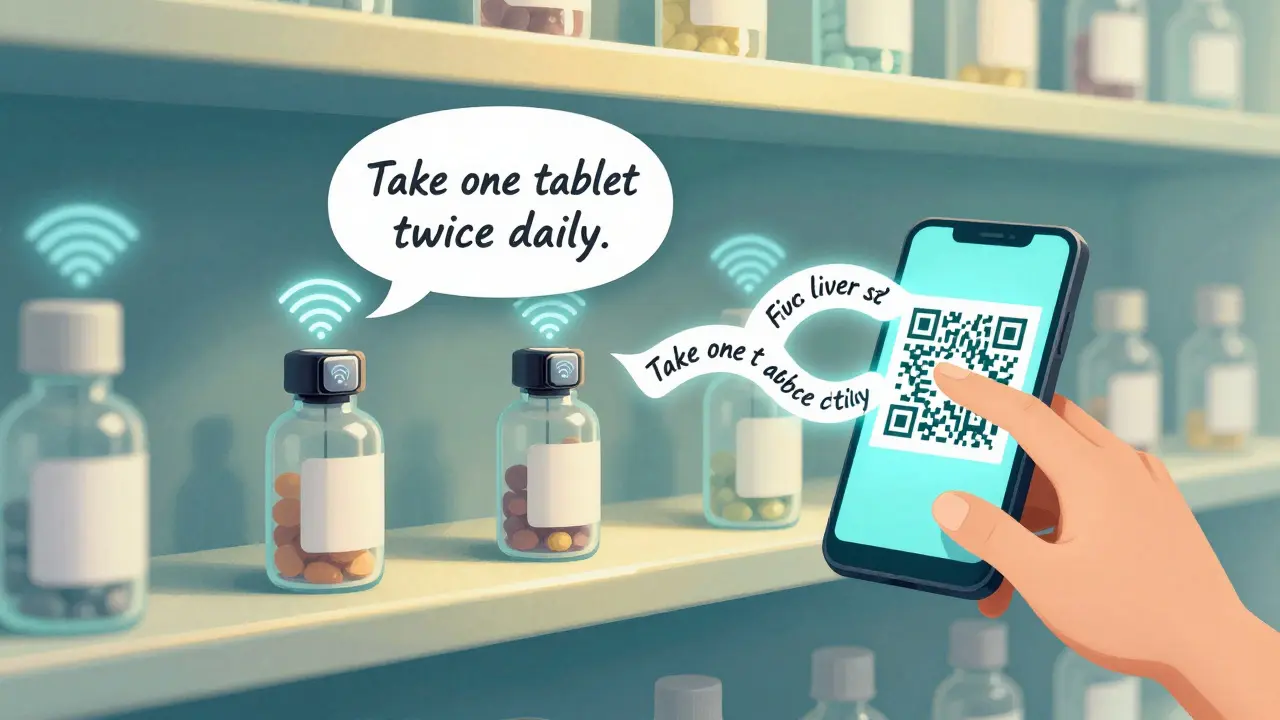
Braille? It’s Not as Common as You Think
Braille labels sound like the obvious solution - tactile, permanent, no tech required. But here’s the reality: only about 10% of people with vision impairment read Braille. That’s according to the American Printing House for the Blind. Most people lose their vision later in life, after learning to read print. They didn’t learn Braille in school. For them, it’s not useful. Plus, Braille labels take up more space. They require special printers and trained staff. Many pharmacies don’t offer them because demand is low. If you’re a Braille reader, ask for it - but don’t assume it’s available.How to Get Accessible Labels - Step by Step
You don’t need to wait for your pharmacy to “offer” this. You have a right to it. Here’s how to make it happen:- Ask your pharmacist directly: “Do you offer large print or audible prescription labels?” Don’t say “Is there something for people with bad eyesight?” Be specific.
- Request the exact format you need: “I need 18-point Arial, black on white, on a duplicate sticker.”
- If they say no, ask: “Can you order a ScripTalk reader for me?” or “Can you print a QR code label?”
- If they still say no, ask to speak to the pharmacy manager. Most chains have a policy - they just need to be reminded.
- Keep a copy of your label request in writing. Email or write it down. This creates a paper trail.
What to Do If Your Pharmacy Doesn’t Help
If your pharmacy refuses or acts like it’s a big deal, you’re not alone. A 2022 survey by the American Council of the Blind found that 37% of users said their pharmacist didn’t know accessible labels existed. That’s not your fault. You have legal rights. The FDA Safety and Innovation Act of 2012 requires pharmacies to make prescription labels accessible. The Department of Justice says failing to do so violates the Americans with Disabilities Act. In 2022 alone, there were 17 formal complaints and 3 settlements totaling $450,000. You can file a complaint with the DOJ’s ADA hotline or your state’s pharmacy board. But before that, try this: call the corporate customer service line for your pharmacy chain. CVS, Walgreens, and Walmart all have national accessibility hotlines. They often fix the issue within 48 hours.
Real Stories: What Accessible Labels Do for People
One 78-year-old diabetic in Kentucky switched to ScriptView large print labels with audio QR codes. Before, she’d mix up her insulin and metformin. She had three hypoglycemic episodes in one month. After switching, her episodes dropped by 75%. A Reddit user named VisionLiberation wrote: “Since my pharmacy started offering 18pt Arial labels, I stopped taking the wrong pills twice a week. It’s literally life-changing.” On Healthgrades, accessible labeling services average 4.7 out of 5 stars. The top two reasons people give? “I can read my meds independently” and “I don’t panic when I open the bottle.”What’s Coming Next
The future of prescription labels is digital. By 2026, the FDA plans to require accessible labels on electronic prescriptions and patient portals. That means if you get your meds through a mail-order pharmacy or online refill system, the digital version will have voice-over, adjustable text, and screen-reader compatibility. CVS is investing $15 million to roll out ScripTalk to all 9,900 of its U.S. locations by late 2024. That’s up from 7,200 in 2022. Independent pharmacies are lagging - only 52% offer full accessibility compared to 78% of hospital pharmacies. But pressure is growing. The global market for accessible healthcare labels is projected to hit $5.7 billion by 2027.Final Thought: This Isn’t a Luxury - It’s Safety
Accessible labels aren’t about convenience. They’re about preventing hospital visits, overdoses, and deaths. One study found that using large print or audible labels reduced medication-related ER visits by 38% over five years. That’s not a small number. That’s thousands of people avoiding emergencies because they could finally read their label. You don’t need to wait for a miracle. You don’t need to suffer in silence. Ask for what you need. Know your rights. Demand the same access everyone else has. Your health depends on it.Can I get large print prescription labels for free?
Yes. Major pharmacy chains like CVS, Walgreens, Walmart, and UK HealthCare offer large print, audible, and QR code labels at no extra cost. You don’t pay for the sticker, the reader, or the app. It’s part of their service under federal accessibility rules.
What if my pharmacy says they don’t offer accessible labels?
Ask to speak to the manager. If they still say no, call the pharmacy chain’s national customer service line. Most have dedicated accessibility teams. You can also file a complaint with the Department of Justice’s ADA hotline. Under federal law, pharmacies must provide accessible labels - it’s not optional.
Do I need special equipment to use ScripTalk or QR code labels?
For ScripTalk, you need a small handheld reader - but many pharmacies loan them out for free. For QR code labels, you only need your smartphone’s camera and a free app. No special hardware is required. Be My Eyes also works with any smartphone and connects you to a volunteer.
Are large print labels better than audible ones?
It depends on your needs. Large print is great if you can read with magnification. Audible labels are better if you can’t read print at all, or if you’re multitasking (like cooking or driving). Many people use both - large print for quick checks, audible for full details. The best option is the one you’ll actually use.
How do I know if my prescription label is compliant?
Check the font size - it should be at least 18-point. The text should be black on white, no glare, and use a simple sans-serif font like Arial. Instructions should be in lowercase letters with uppercase numbers. If you see a QR code or a small chip on the label, it’s likely compliant. If it’s tiny, blurry, or all caps, it’s not.
Comments (9)
Ed Di Cristofaro
Wow, finally someone says it like it is. I’ve been begging my pharmacy for years to give me a readable label, and they act like I’m asking for a damn luxury. It’s not about being ‘special’-it’s about not dying from a pill mix-up. And yeah, 18-point font? That’s the bare minimum. My grandma could read it. Why is this even a debate?
They charge $12 for a bottle of insulin but won’t print text bigger than a mosquito’s tattoo? Unbelievable.
Deep Rank
okay so i just read this whole thing and like… i think we need to talk about how most pharmacies are just lazy? like i had to call 3 different places before one even knew what scriptalk was 😭 and the lady was like ‘oh you mean like… the thing with the chip?’ and i was like YES SISTER THAT’S THE ONE.
also why do they use gray text on white? it’s not 1998. and the font? ahhhhhhhh. i swear if i see one more italicized ‘take one tablet’ i’m gonna scream. also braille is cool but like… 90% of people with low vision didn’t learn it as kids so it’s kinda useless? just saying. also why is this not on every label already? like… we’re not in the stone age? 🤦♀️
Naomi Walsh
Let’s be honest: this article is a textbook example of performative accessibility. Yes, large print exists. Yes, QR codes are trendy. But let’s not pretend these are ‘solutions’-they’re Band-Aids on a systemic failure. The real issue? Pharmacies are still operating under a 1980s paradigm where accessibility is an ‘accommodation,’ not a right.
And don’t get me started on Be My Eyes. A volunteer reading your label over video? That’s not empowerment-that’s exploitation of goodwill. The FDA should mandate embedded audio chips in every prescription container by 2025, not let corporations decide if they ‘want’ to roll it out. This isn’t charity. It’s compliance. And we’re failing.
Naresh L
It’s interesting how we frame accessibility as a technical problem-bigger font, QR code, chip-when really it’s a cultural one. We’ve normalized exclusion so deeply that people don’t even realize they’re denying someone their dignity just by refusing to print text they can read.
I wonder if the same pharmacies that refuse large print labels would refuse to put a ramp in front of their store. Probably not. But the invisible barrier? That’s easier to ignore. Maybe the real solution isn’t more tech, but more empathy. And accountability. Not just ‘ask your pharmacist,’ but ‘demand it until they can’t say no.’
June Richards
Why is this even a thing? 😒 I mean, I have glasses. I just hold the bottle up to the light. Problem solved.
Also, QR codes? So now I need to scan my meds? Next they’ll make me download an app to read my cereal box. 🤦♀️
Lu Gao
Actually, the FDA’s 2012 mandate is misquoted here. It doesn’t *require* accessible labels-it encourages them. The ADA requires ‘reasonable accommodation,’ but ‘reasonable’ is a legal gray zone.
And yes, 18-point is the AFB standard, but many blind users prefer 24-point. Also, ‘black on white’ isn’t universal-some with photophobia need off-white backgrounds. This article is well-intentioned but dangerously oversimplified. 🧐
Jamie Allan Brown
Thank you for writing this. I’ve been helping my neighbor, 81, navigate this for two years. She used to cry every time she opened a new bottle. Now she uses ScripTalk. She says it’s the first time in 15 years she’s felt like she’s not a burden.
It’s not about tech. It’s about dignity. And if your pharmacy doesn’t get that? Tell them to sit down. Then call corporate. They’ll fix it faster than you think. You’re not asking for a favor. You’re asking for your rights.
Lisa Rodriguez
Just got my new label today from CVS and it’s 24-point Arial black on white and it’s the most beautiful thing I’ve seen in months
Also the pharmacist actually smiled and said ‘we’ve been training everyone on this’ and I almost cried. I didn’t even have to ask for the QR code. It was already there.
So yeah. It’s possible. And it’s happening. Keep pushing. They’re listening more than you think 💙
Lilliana Lowe
Let’s not romanticize this. ScripTalk is proprietary. QR codes require internet. Be My Eyes relies on volunteers. None of these are scalable, sustainable, or equitable. The only real solution is a federally mandated, open-source, universally compatible audio-label standard embedded in the bottle’s packaging. Everything else is just marketing.
And yes, I’ve reviewed the ISO 18944-2023 draft. It’s not being adopted fast enough. Shame.