
Why Insulin and Biologics Can’t Handle Air Travel Like Regular Luggage
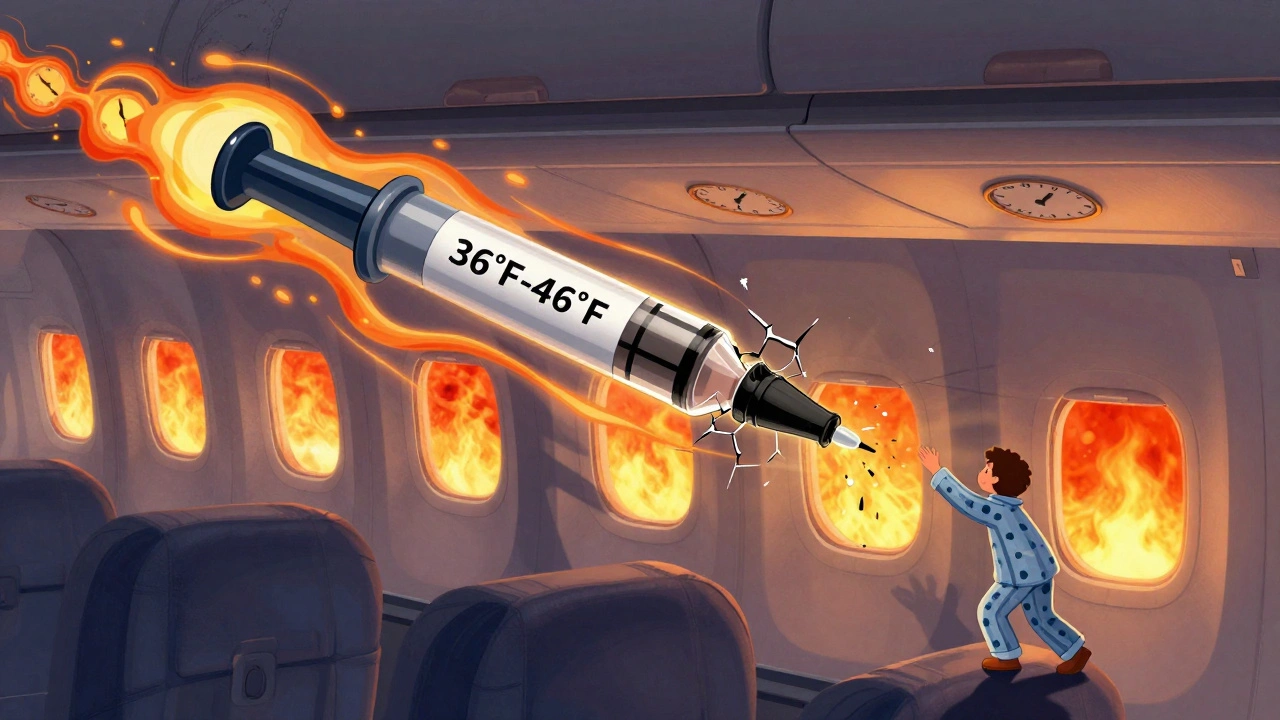
Imagine this: you’re on a 14-hour flight from Melbourne to London. Your insulin is tucked into the overhead bin, right next to the window. By the time you land, the temperature inside that bin has hit 95°F (35°C). Your insulin? It’s damaged. Not broken. Not expired. Destroyed. And now, your blood sugar is spiraling - with no easy fix in sight.
This isn’t a hypothetical. It’s happened. And it’s not rare.
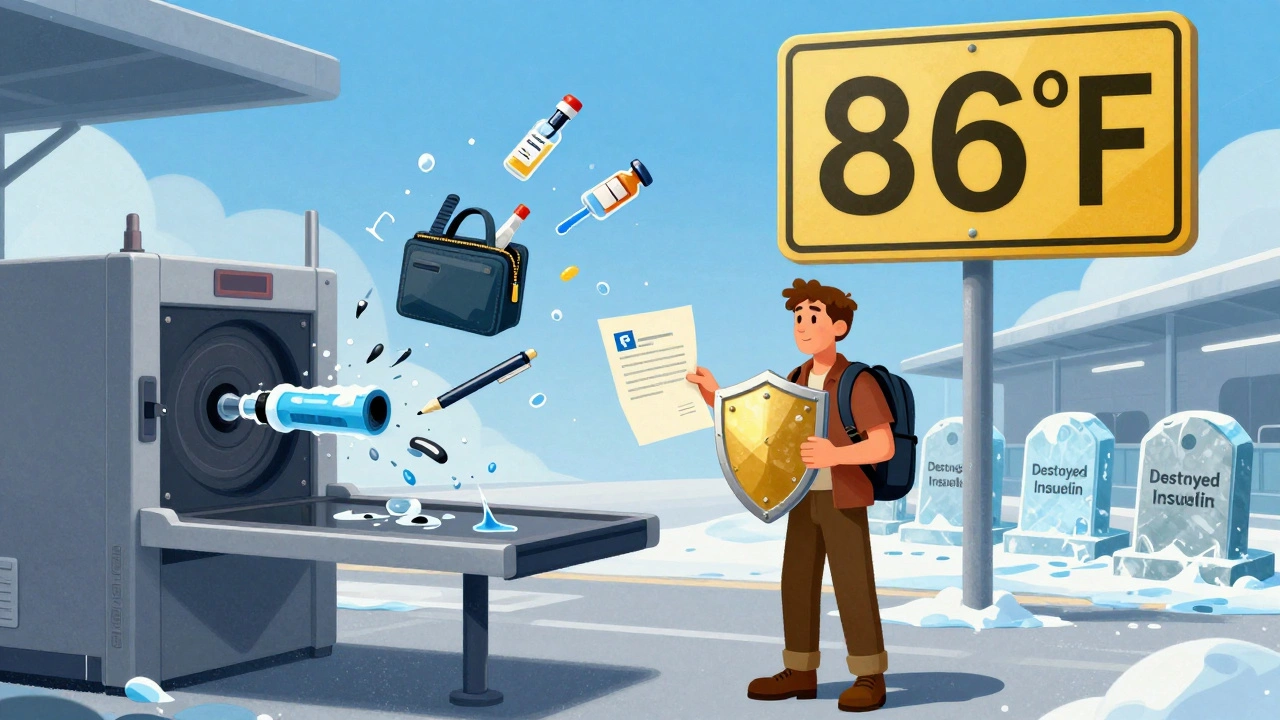
Insulin and biologics like Ozempic, Wegovy, or Trulicity aren’t just pills you can toss in your suitcase. They’re complex proteins that break down when exposed to heat, cold, or direct sunlight. The FDA says unopened insulin must stay between 36°F and 46°F (2°C-8°C). Once you start using it, it’s okay at room temperature - but only up to 86°F (30°C). Go above that, and the insulin starts losing potency. Below 32°F (0°C)? It freezes. And frozen insulin? It’s useless. No matter how much you warm it up.
Biologics are even pickier. Ozempic, for example, can only stay at room temperature for 56 days after first use. On a long flight, you’re not just fighting time zones - you’re fighting the airplane’s internal climate.
What Happens When Insulin Gets Too Hot or Too Cold
Let’s be clear: you can’t tell if your insulin is bad just by looking at it. Some people think cloudy insulin means it’s ruined. But not all insulins are clear. NPH is naturally cloudy. The real red flags? Clumping, frosting, or particles that won’t dissolve when you roll the pen between your hands.
A 2021 study in the Journal of Diabetes Science and Technology tracked a traveler whose insulin was left in a window seat pocket during a 12-hour flight. Cabin temperatures near the window hit 95°F (35°C). By the end of the flight, their insulin had lost over 30% of its potency. They ended up in the ER with diabetic ketoacidosis.
Freezing is just as dangerous. If insulin touches ice directly - even in a cooler bag - it can freeze in minutes. Frozen insulin loses its molecular structure. No amount of thawing brings it back. A 2022 University of Colorado study found that 23% of insulin samples stored directly next to ice packs froze, even if the bag itself felt cool.
And here’s the kicker: most people don’t know their insulin is compromised until it’s too late. No warning. No alarm. Just rising blood sugar that won’t respond to your usual dose.
The Best Way to Store Insulin on a Plane
You don’t need fancy gear. But you do need the right system.
Step 1: Pre-cool your insulin before you leave. Put your unopened insulin in the fridge for at least two hours before your flight. Don’t freeze it. Just chill it to around 50°F (10°C). This gives you a buffer.
Step 2: Use a cooling wallet, not a cooler. Ice packs are risky. They’re unpredictable. Water-activated cooling wallets like the FRÍO Wallet are safer. They use a gel that absorbs water and stays cool for up to 45 hours - even in 104°F (40°C) heat. No ice. No freezing. Just consistent, safe temperatures between 59°F and 72°F (15°C-22°C). They’re lightweight, TSA-approved, and cost about $35.
Step 3: Keep it on your body, not in the overhead bin. The overhead bin? That’s a death zone. Temperatures there can hit 82°F (28°C) or higher. The seat-back pocket? Perfect. Boeing’s own data shows it stays between 68°F and 75°F (20°C-24°C). That’s ideal. Slide your FRÍO wallet into the pocket behind your seat. Or wear it around your neck with a lanyard if you’re comfortable.
Step 4: Avoid direct sunlight and window seats. Even if your insulin is in a bag, if that bag is near the window, it’s getting baked. Pick an aisle seat. Keep your medication away from windows.
What About Biologics Like Ozempic or Wegovy?
Same rules apply - but tighter.
Unlike insulin, most biologics don’t have a long room-temperature window. Ozempic, for example, must be refrigerated until first use. Once you start using it, you have 56 days at room temperature - but only if it stays below 86°F (30°C). On a long flight, that’s not guaranteed.
For biologics, use the same FRÍO wallet system. Don’t risk it. Don’t assume your pen will be fine because it’s “just a shot.” These drugs are expensive. And if they degrade, you’re not just wasting money - you’re risking your health.
Pro tip: If you’re flying with multiple pens, keep them in separate wallets. That way, if one gets damaged, you still have backups.

What to Bring: The Travel Checklist
Here’s what you actually need to pack - no more, no less:
- At least 200% of your expected insulin or biologic dose for the trip (CDC recommendation)
- One or two FRÍO wallets (or similar water-activated cooling pouches)
- Your insulin pens or vials in their original packaging
- A doctor’s letter dated within the last 6 months stating you need these medications
- Original pharmacy labels on all containers
- Digital copies of your prescriptions saved on your phone
- A backup glucose meter and test strips
- Fast-acting carbs (glucose tabs, juice boxes) in case of low blood sugar
Don’t pack ice packs unless they’re under 3.4 ounces (100ml) - TSA will confiscate larger ones. And never check your insulin in luggage. The cargo hold can drop to -40°F (-40°C). That’s not a fridge. That’s a freezer. And your insulin will freeze solid.
Security Screening: What to Expect
TSA lets you bring insulin and cooling devices through security. But they don’t always know that.
When you get to the checkpoint:
- Keep your insulin and cooling wallet in a clear plastic bag - separate from your other liquids.
- Hand your doctor’s letter to the officer before you start screening.
- Don’t let them X-ray your insulin. Ask if they can do a manual check. Most will agree.
- If they try to take your cooling wallet, calmly say: “This is a medical device for insulin storage. It’s allowed under TSA Regulation 1544.219.”
In 2022, TSA logged over 12,000 insulin-related delays. Most were avoidable. A clear letter and calm communication cut delays by 92%.
Some airlines, like Spirit, still require pre-approval for cooling devices. Check your airline’s medical policy before you fly. Delta, United, and American all allow them without hassle. Don’t assume.
Time Zones and Dosing: Don’t Get Caught Off Guard
Changing time zones isn’t just about jet lag. It changes how your body uses insulin.
For eastward flights over 6 hours (like Melbourne to London):
- Your day gets shorter. You might skip a meal or eat earlier.
- Long-acting insulin (like Lantus or Tresiba) can become too strong. The American Association of Clinical Endocrinologists recommends reducing your dose by 20% on the first day.
For westward flights over 6 hours (like LA to Sydney):
- Your day gets longer. You might need extra insulin.
- Consider increasing your basal dose by 15% to cover the extra hours.
Always test your blood sugar more often during travel. Don’t rely on your pump’s auto-adjustments. Manual checks are safer.
And if you use an insulin pump? Most are fine on planes. But turn off Bluetooth and Wi-Fi during takeoff and landing. Follow airline rules.
What Not to Do
Here are the top mistakes travelers make:
- Leaving insulin in the overhead bin - especially near the window
- Using regular cooler bags with ice packs - risk of freezing
- Not carrying extra supplies - delays happen
- Skipping the doctor’s letter - leads to delays or confiscation
- Assuming your airline knows the rules - they often don’t
- Not checking your insulin before and after the flight - damage isn’t always obvious
New Tech: Smart Cases and Future Solutions
There’s new gear on the market. The TempMed Smart Case, approved by the FDA in November 2023, connects to your phone and alerts you if your insulin hits 82°F (28°C). It’s pricey - around $150 - but for frequent flyers, it’s worth it.
By 2024, major airlines will be required to offer temperature-controlled storage compartments upon request. That’s thanks to new ICAO rules. But don’t wait for it. Right now, you’re still responsible for your own meds.
And in the future? Companies like Outset Medical are developing new gels that keep insulin safe in 113°F (45°C) heat for up to 120 hours. That’s huge. But for now, stick with what works: the FRÍO wallet, a seat-back pocket, and a backup plan.
Final Word: It’s Not Just About Comfort - It’s About Survival
Storing insulin correctly on a flight isn’t a suggestion. It’s a medical necessity. One compromised dose can send you to the hospital. One frozen pen can ruin your trip.
You’ve spent years managing your diabetes. Don’t let a long flight undo it. Pack smart. Know the rules. Carry your letter. Keep it cool. And never, ever trust the overhead bin.
Comments (11)
Larry Lieberman
This is life-saving info 🙏 I forgot my FRÍO on a trip last year and ended up in the ER. Don't be me.
Andrea Beilstein
The overhead bin is basically a solar oven with a side of existential dread
we treat our bodies like sacred temples but hand our meds to the void like it's a lost sock
the real tragedy isn't the insulin degrading
it's that we've normalized this level of medical negligence
air travel was never meant to be a survival test for chronic illness
and yet here we are
we've turned medicine into a gamble
and the house always wins
Sabrina Thurn
The FRÍO wallet is a game-changer for biologics. I've used it on 17 international flights since 2021. The key is pre-chilling your pens and keeping them in the seat-back pocket. The cabin temp there is regulated by Boeing's environmental control system, which maintains 20–24°C even when the overhead bin hits 35°C. Also, never rely on airline staff knowing the rules-always have your doctor's letter printed and ready. TSA PreCheck doesn't guarantee exemption, but a calm demeanor + documentation cuts processing time by 90%. Pro tip: carry two wallets-one for active meds, one for backups.
Asset Finance Komrade
I'm Australian. We don't have the luxury of 14-hour flights to London like you Americans. We have 17-hour flights to Dubai. And our airports don't even have proper medical storage. You're lucky you have FRÍO wallets. Here, we use wet towels and hope. Also, your 'FDA says' is irrelevant internationally. The EMA has different guidelines. You're preaching to the choir, but the choir is scattered across continents with no access to your $35 gadgets.
Courtney Black
It's wild how we've turned something as basic as keeping a vial cool into a full-blown logistical operation
we have apps that track our sleep and calories but still can't trust a plane to not turn our life-saving meds into soup
why is this on us
why isn't there a universal medical compartment on every flight
why do we need a doctor's letter to prove we're not lying about needing insulin
it's not a luxury
it's not a preference
it's not even a medical need
it's a biological imperative
and yet we treat it like a request
like a favor
like something we have to beg for
and we wonder why people die
Anna Roh
So... just put it in your pocket? That's it? No fancy tech? No app? No blockchain insulin ledger? I feel cheated.
Tiffany Sowby
Oh great. Another American telling the world how to survive their own country's healthcare system. Meanwhile, in the rest of the world, people don't need a $35 wallet to keep insulin cool. They just... don't die. Maybe if you didn't have to pay $1,000 for a pen, you wouldn't be so terrified of it melting.
Ronald Ezamaru
I've flown with insulin for 22 years. The FRÍO wallet is the single most reliable thing I've ever used. I used to carry ice packs until I watched one freeze my pen solid on a layover in Chicago. Never again. The seat-back pocket is perfect. I also always carry a backup pen in my waistband. And yes, TSA will try to X-ray it. Just say 'medical device' and show your letter. They usually nod and move on. No drama. No fuss. Just calm preparation. This isn't about being paranoid. It's about being responsible.
Raja Herbal
So you're telling me the whole world needs to buy a $35 gel pouch because America can't afford to make planes with climate-controlled medical storage? Interesting. In India, we use a cloth bag and keep it near the belly. Body heat keeps it stable. Also, we don't have 14-hour flights to London-we have 12-hour flights to Dubai with 200 people crying in the aisle. No one has a FRÍO. No one dies. Maybe your problem isn't the plane. It's the price tag on your insulin.
Iris Carmen
frío wallet?? i thought that was a spanish word for cold lmao but ok i guess its a thing now
Delaine Kiara
I read this whole thing and I'm still not sure if I'm supposed to be impressed or terrified. So let me get this straight: if I don't spend $150 on a smart case, my insulin turns into a science experiment, my blood sugar spikes, and I end up in the ER-while the airline staff shrugs and says 'we don't have a fridge for your life-saving drug.' And this is normal? This isn't travel. This is a horror movie where the villain is capitalism and the plot twist is that your medication has an expiration date that's shorter than your layover. I'm not even diabetic and I'm sweating. What have we become?