
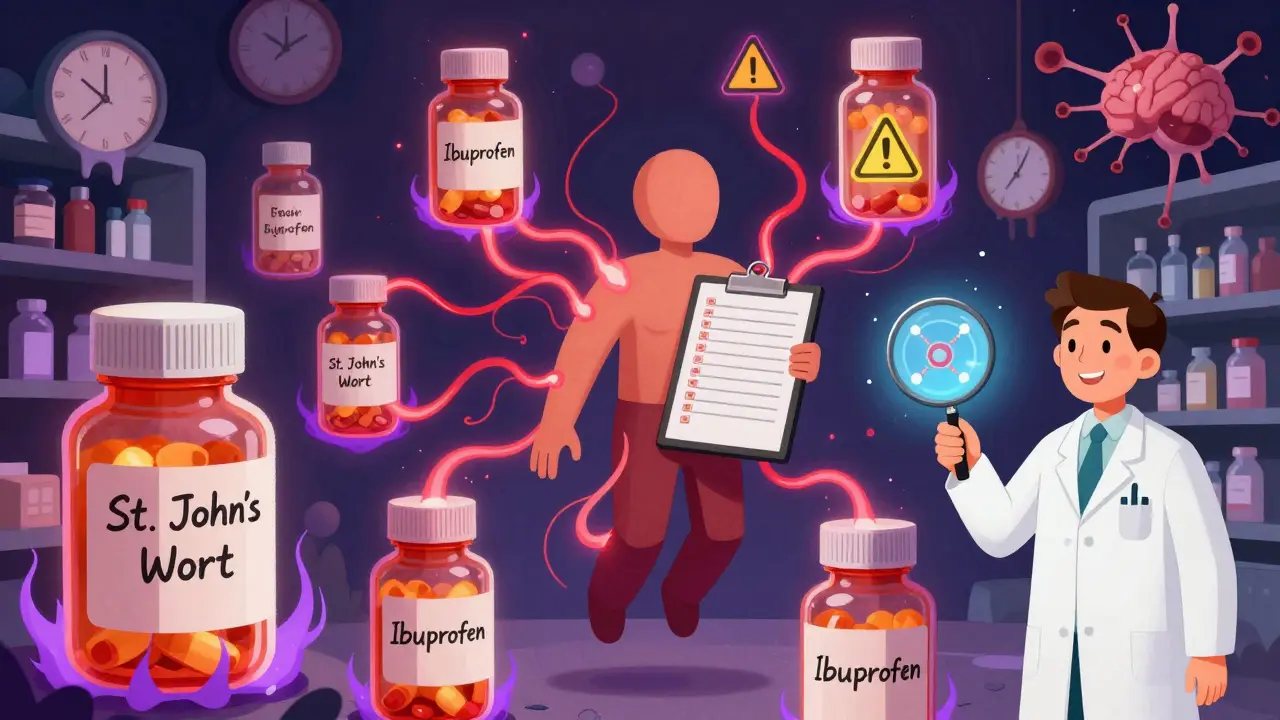
Every year, thousands of people end up in hospitals because of medication mistakes - not because the drugs were wrong, but because the system failed them. A pill taken at the wrong time. A supplement mixed with a prescription without anyone knowing. A bottle labeled in handwriting no one can read. These aren’t rare accidents. They’re preventable. And the best way to stop them? Build a personal medication safety plan with your care team - not just once, but as part of your ongoing health routine.
Start with a Complete Medication List
You can’t protect what you don’t track. Begin by writing down every single thing you take. Not just prescriptions. Not just the big-name drugs. Include over-the-counter painkillers, sleep aids, herbal supplements, vitamins, and even eye drops or topical creams. Many people forget these, but they’re often the hidden cause of dangerous interactions.For example, taking St. John’s Wort with an antidepressant can cause serotonin syndrome - a life-threatening reaction. Or mixing ibuprofen with blood pressure meds can knock your kidneys out of balance. Your pharmacist can spot these risks, but only if you tell them everything.
Write it all down clearly: the name of the medicine, the dose (like 10 mg or 500 mg), how often you take it (once daily, twice a day), and why you’re taking it (for high blood pressure, for arthritis pain). Use a simple spreadsheet or a printed form. Keep it in your wallet, your purse, or your phone. Update it every time you start or stop something - even if it’s just a week’s supply of antibiotics.
Verify Everything With Your Doctor and Pharmacist
Don’t assume your doctor knows everything on your list. Most visits are short. Most doctors don’t remember every supplement you mentioned three months ago. Bring your list to every appointment. Ask two simple questions: “Is this still right for me?” and “Could this interact with anything else I’m taking?”Pharmacists are your secret weapon. They see hundreds of medication combinations every week. They know which ones clash. Ask them to review your list at least once a year - or anytime you get a new prescription. Many pharmacies offer free med reviews. Use them.
If you’re seeing multiple specialists - a cardiologist, a neurologist, a rheumatologist - make sure they all have the same list. One doctor might prescribe a new drug without knowing another doctor already gave you something that does the same thing. Duplication is a silent killer. Your primary care provider should be the one coordinating this, but you have to push for it.
Store Medications Safely - No Exceptions
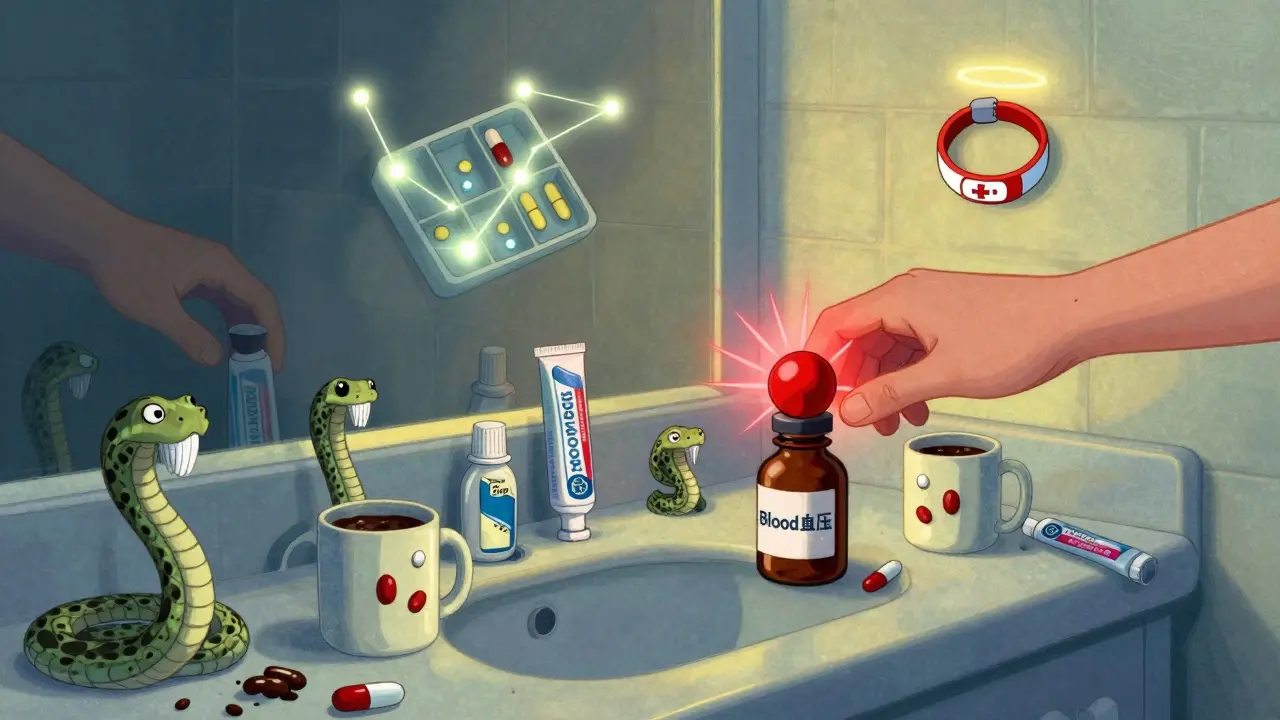
Medications shouldn’t sit on the bathroom counter, next to the toothpaste, or in an unlabeled pillbox from last year. That’s how accidents happen.Keep all your medicines - especially opioids, sedatives, or heart medications - in a locked box or cabinet. This isn’t just for kids. It’s for memory lapses. It’s for stress. It’s for those days when you’re confused or tired and grab the wrong bottle. One woman in Melbourne told her nurse she took two doses of her blood pressure pill because it was sitting next to her coffee mug and looked like the same bottle. It wasn’t. She ended up in the ER with dangerously low blood pressure.
Label everything clearly. Use a permanent marker if needed. Write the full name of the drug, the dose, and the time of day to take it. If you’re visually impaired, use a braille label or ask your pharmacist for a talking pill dispenser. Don’t rely on color or shape. Pills change. Labels fade. Your memory might too.
Use a Pill Organizer - But Make It Work for You
A pill organizer isn’t just for seniors. It’s for anyone who takes more than three medications daily. But a cluttered, confusing organizer is worse than none at all.Choose one that matches your routine. If you take meds once a day, a simple weekly box with seven compartments works. If you take meds morning, afternoon, and night, get a 28-compartment box. Label each slot with tape and a marker: “AM: Blood pressure,” “PM: Pain,” “Night: Sleep.” Use big, bold letters.
Set phone alarms. Put them at the same time every day. Don’t just rely on the organizer. Pair it with a checklist. At the end of each day, check off what you took. If you miss a dose, write why - not just “forgot,” but “felt dizzy, didn’t want to risk falling.” That info matters to your doctor.
Some people use apps. They’re helpful - but not foolproof. If your phone dies, or you forget to open the app, you’re back to square one. A physical organizer you can touch, see, and check off is more reliable.
Schedule Regular Check-Ins - Not Just When Something Goes Wrong
Medication safety isn’t a one-time task. It’s a rhythm. Set a calendar reminder every three months to review your plan with your care team. Don’t wait until you feel sick or confused.During these check-ins, ask:
- Is this medicine still helping?
- Are there any new side effects I should watch for?
- Can any of these be reduced or stopped?
- Do I still need all of them?
Studies show that up to 30% of long-term prescriptions are unnecessary. Some meds lose their purpose after a few months. Others become risky as your body changes. A simple review can cut your pill count, lower your risk, and save you money.
If you live with dementia, Parkinson’s, or another condition that affects memory or coordination, these check-ins should happen every month. Involve a family member or caregiver. Let them sit in on the appointment. Ask them to repeat back what the doctor says. That’s how you catch misunderstandings before they turn into emergencies.
Plan for Emergencies - Before They Happen
Imagine you collapse. Or you’re rushed to the hospital after a fall. The paramedics don’t know what you take. They give you a drug that reacts badly with your blood thinner. That’s not hypothetical. It happens every day.Build an emergency card. Write your name, date of birth, allergies, and your full medication list on a small card. Keep it in your wallet. Put a copy in your phone’s emergency contact info. Tell at least one trusted person - a spouse, sibling, neighbor - where to find it.
If you’re on high-risk meds like warfarin, insulin, or opioids, consider wearing a medical alert bracelet. It’s cheap. It’s simple. And in a crisis, it can save your life.
Also, make sure your care team has a clear plan for what to do if you miss a dose or take too much. Know the emergency number for your pharmacy. Save it in your phone. Don’t wait until you’re panicked to look it up.

Involve Your Care Team - Not Just Your Doctor
Your care team isn’t just your GP. It’s your pharmacist, your nurse, your physiotherapist, your social worker, even your home care aide. Everyone who touches your care needs to be on the same page.Ask your doctor to send your updated medication list to your pharmacist and any specialists you see. If you use a home care service, give them a printed copy. If a family member helps you manage your meds, train them. Don’t assume they know what’s safe. Show them your pill box. Walk them through your list.
Communication gaps are the #1 reason for medication errors. The Institute for Safe Medication Practices found that 20% of adverse drug events happen because the patient and provider didn’t communicate clearly. That’s not the patient’s fault. That’s the system’s failure. You have to fix it - together.
What If You’re Overwhelmed?
If managing all this feels too heavy, you’re not alone. Many people feel this way. You don’t have to do it alone.Ask your doctor for a referral to a medication therapy management (MTM) program. These are free or low-cost services offered by pharmacies and clinics. A pharmacist spends 30 minutes with you, reviews every pill you take, and gives you a written plan. In Melbourne, several community pharmacies offer this.
Or ask a family member to be your medication advocate. Someone who can call the pharmacy, track refills, remind you of appointments. It’s not about taking away your independence. It’s about protecting your health.
And if you’re worried about stigma - thinking “I’m too old to need help” or “I should be able to manage this myself” - remember this: Medication safety isn’t a sign of weakness. It’s a sign of wisdom.
Final Thought: Your Safety Is Your Right
You have the right to understand every medicine you take. You have the right to ask questions. You have the right to a clear, written plan. And you have the right to change that plan if it’s not working.Don’t let busy doctors, confusing labels, or forgotten supplements put you at risk. Build your plan. Keep it updated. Share it. Use it. That’s how you take control - not just of your meds, but of your health.
Comments (8)
Uju Megafu
This is the most irresponsible post I've seen all year. You act like people just forget their meds because they're lazy, but have you ever tried managing 12 different pills while working two jobs and no insurance? No? Then don't act like your checklist is some magical solution. I've been to three ERs because my pharmacy mixed up my blood pressure meds - and no, I didn't 'forget to update my list.' The system is broken, and you're just handing out Band-Aids while the house burns down.
Also, 'use a pill organizer'? My cousin died because the damn thing had 28 compartments and she took her insulin at night instead of morning. You think labeling helps? Try being blind, diabetic, and on Medicaid. The system doesn't care if you 'write it clearly.' It just takes your money and leaves you to figure it out.
Stop pretending this is about personal responsibility. It's about access. It's about power. And until we fix that, your 'safety plan' is just a luxury for people who can afford to care.
MAHENDRA MEGHWAL
While I appreciate the intent behind this comprehensive guide, I must respectfully suggest that its practical applicability is severely limited in resource-constrained environments. In many parts of India, access to pharmacists is infrequent, pill organizers are considered luxury items, and digital reminders are often unfeasible due to unreliable electricity and mobile network coverage. The assumption that every individual possesses the literacy, cognitive capacity, or socioeconomic stability to maintain a written medication log is, unfortunately, a privilege. A more equitable approach would involve community health workers, standardized pictorial medication charts, and mobile-based voice reminders in local languages. The principles are sound, but the implementation assumes a level of infrastructure that simply does not exist for millions.
Kevin Narvaes
ok but like... what if you just... don't care? like i get it, meds are important, but what if your whole life is just surviving and this checklist thing feels like another chore from the capitalist machine? i take my pills when i remember, sometimes i don't, sometimes i mix em up, sometimes i just... forget i'm even on them. is that wrong? maybe. but is your spreadsheet gonna fix my depression? nah. it's just more pressure to be perfect. i'm tired. maybe i just need to be tired without being guilted into a bullet-pointed life.
also who the hell has time to update a spreadsheet every time they get a zpack? i'm not a robot. i'm a human with anxiety and a cat that knocks my pills off the nightstand. it's not a system failure. it's life.
Dee Monroe
There’s something profoundly beautiful about the idea that our health isn’t just something we inherit or endure-it’s something we co-create, daily, with intention and care. Every time someone writes down a pill they take, they’re not just tracking medication-they’re asserting their right to exist without being erased by a system that treats bodies like broken machines. I’ve watched my mother, who survived three strokes and now manages eight different prescriptions, sit at her kitchen table every Sunday with her colored pens and her little notebook, and I’ve seen the peace it brings her-not because it’s perfect, but because it’s hers. It’s a quiet rebellion against chaos, a ritual of self-love in a world that tells you to be quiet, to be grateful, to just take what you’re given. And yes, sometimes the pills get mixed, sometimes the alarms don’t go off, sometimes the doctor forgets-but the act of trying? That’s where dignity lives. That’s where healing begins. Not in the perfect plan, but in the stubborn, messy, human effort to keep showing up-for yourself, even when no one else is watching.
So don’t just make a list. Make a promise. To your future self. To the version of you who will wake up tomorrow and still choose to live. And if you forget? That’s okay. Just start again. You’re not failing. You’re practicing.
Jerry Rodrigues
Good list. Practical. Doesn't scream. Doesn't guilt. Just says: here's what works. I've been doing most of this for years-written list in my wallet, alarms on my dumb phone, pharmacist review every six months. No drama. No apps. Just consistency. I don't need a manifesto. I need to not die from a mix-up. Simple.
Also, the emergency card? Best idea I ever stole from my grandma. She had one in her purse since 1987. When she fell in 2019, the EMTs read it before she even woke up. That's power.
Yuri Hyuga
👏👏👏 This is exactly the kind of calm, clear, actionable wisdom we need in healthcare. Thank you for writing this with such compassion and precision. I’ve trained dozens of caregivers in the UK using this exact framework-especially the 'review every 3 months' part. It’s not about control. It’s about connection. To your body. To your team. To your future self.
And yes-medical alert bracelets. Cheap as chips. Life-saving. I had a patient who wore hers for 17 years. She never needed it... until the day she did. Paramedics saved her life because they saw it. No questions. No panic. Just action.
PS: If you’re overwhelmed? Reach out. You’re not alone. There are MTM programs everywhere. Even in rural towns. You just have to ask. 💪❤️
MARILYN ONEILL
Lol. You think writing stuff down fixes everything? My sister’s doctor gave her a new drug and didn’t even check her list. She ended up in ICU. And no, she didn’t 'forget' to update anything. The system doesn’t care. This post is just feel-good fluff for people who have time to color-code their meds. Real people are just trying not to go bankrupt paying for the pills that are supposed to save them.
Also, 'use a pill organizer'? My mom’s is full of expired Xanax from 2018. She doesn’t even know what half of them are for anymore. This isn’t a checklist problem. It’s a capitalism problem.
Just sayin'. You’re not helping. You’re distracting.
Coral Bosley
They always say 'talk to your doctor' like it's that easy. I did. I brought my list. I asked the questions. They looked at me like I was asking them to perform brain surgery. Said 'you're fine' and walked out. Then my pharmacy gave me the wrong refill-twice. I had to call six times. They said 'oh, we'll fix it next week.' Next week? I was dizzy for three days.
So now I just take them when I remember. Or don't. Because honestly? I'm tired of being the one who has to fix the system. I'm tired of being the problem. I'm just a person trying to stay alive. And sometimes? That's enough.