

When your triglyceride levels climb above 150 mg/dL, it’s not just a number on a lab report. For many people, it’s a silent warning sign that something deeper is wrong - and it could be putting you at risk for two life-threatening conditions: pancreatitis and heart disease. Unlike cholesterol, which gets most of the attention, triglycerides are often ignored until something serious happens. But here’s the truth: if your triglycerides are high, your pancreas and your heart are both under threat - and you don’t have to wait for a crisis to act.
Why High Triglycerides Can Trigger Pancreatitis
Most people think pancreatitis is caused by drinking too much alcohol or having gallstones. But in up to 25% of cases, the real culprit is high triglycerides. When triglyceride levels hit 1,000 mg/dL or higher, the risk of acute pancreatitis jumps sharply. At levels over 2,000 mg/dL, about one in five people will develop it. And even levels between 500 and 999 mg/dL carry a 5% risk - not something to shrug off.
The problem isn’t the triglycerides themselves. It’s what happens when your body tries to break them down. Pancreatic enzymes, especially lipase, go into overdrive and chop up the fat molecules into free fatty acids and lysophosphatidylcholine. These byproducts don’t just float around harmlessly. They damage the lining of blood vessels in the pancreas, trigger inflammation, and cause cells to leak fluid. The result? Swelling, pain, and potentially organ failure.
There’s another hidden factor: viscosity. When triglycerides get really high - say, above 3,000 mg/dL - your blood thickens. Think of it like syrup instead of water. That thickened blood can’t flow properly through the tiny capillaries in the pancreas. Without enough oxygen, those cells start dying. That’s why some people with triglycerides over 10,000 mg/dL never get pancreatitis - their bodies clear fat faster - while others crash at 400 mg/dL because their system just can’t keep up.
The Heart Connection: More Than Just Cholesterol
For years, doctors focused on LDL cholesterol as the main villain in heart disease. But new research shows that high triglycerides are an independent risk factor - even if your LDL is normal. A landmark study in JAMA Internal Medicine tracked over 113,000 Danes and found that every 89 mg/dL increase in triglycerides raised the risk of heart attack by 17%. That’s not a small bump. That’s a clear, measurable danger.
What’s happening? Triglyceride-rich particles, especially VLDL and chylomicrons, stick around in your bloodstream longer than they should. They get stuck in artery walls, contribute to plaque buildup, and make blood more likely to clot. Over time, this leads to heart attacks, strokes, and peripheral artery disease. In fact, 70% of deaths in people with severe hypertriglyceridemia come from cardiovascular causes - not pancreatitis.
And here’s the twist: lowering triglycerides doesn’t just reduce pancreatitis risk - it also cuts heart disease risk. The REDUCE-IT trial showed that taking 4 grams of pure EPA (a type of omega-3) daily reduced heart attacks and strokes by 25% in people with triglycerides over 150 mg/dL and existing heart disease. But not all omega-3s work the same. The STRENGTH trial, which used a mix of EPA and DHA, showed no benefit. That’s why doctors now recommend specific, prescription-grade formulations - not over-the-counter fish oil pills.
Where Does Risk Really Start? The Confusing Thresholds
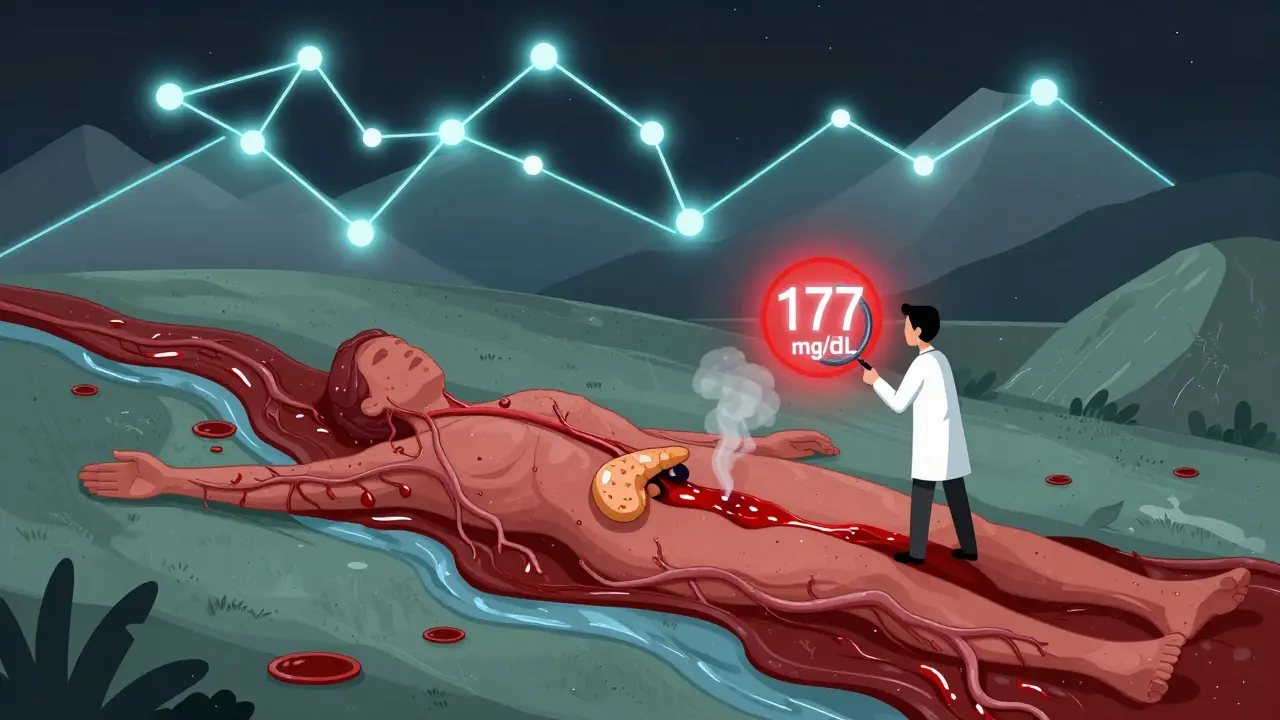
Here’s where things get messy. One study says even 177 mg/dL is risky. Another says you’re safe until 1,000 mg/dL. Why the contradiction? It comes down to who’s being studied.
The JAMA study looked at a general population - people without known heart disease or diabetes. In that group, even modestly elevated triglycerides increased risk over time. But the 1,000 mg/dL threshold comes from clinical observations of patients who actually developed pancreatitis. In those cases, levels were almost always sky-high.
The European Pancreatic Club found that 85% of triglyceride-induced pancreatitis cases occurred above 3,000 mg/dL. But those patients were already in a lipid clinic - they were already severely affected. The general population data doesn’t show that extreme. So which one should you follow? The answer: both.
If you’re otherwise healthy and your triglycerides are 200 mg/dL, you should still take it seriously. Lifestyle changes can bring that down. But if you’re diabetic, obese, or have a family history, even 500 mg/dL is a red flag. And if you’ve had pancreatitis before, any level above 500 mg/dL requires urgent action.

What Actually Works to Lower Triglycerides
There’s no magic pill. But there are proven strategies - and they work fast.
- Stop sugar and refined carbs. A single sugary drink can spike triglycerides for hours. Cutting out soda, white bread, pastries, and even fruit juice can drop levels by 30% in 6 weeks.
- Reduce alcohol. Even moderate drinking - just 2-3 drinks a day - can raise triglycerides by 200%. For people with levels over 500 mg/dL, complete abstinence is often the first step.
- Get moving. Just 30 minutes of brisk walking five days a week can cut triglycerides by 20%. You don’t need to run a marathon - just move more.
- Choose healthy fats. Swap butter for olive oil, and skip fried foods. Omega-3s from fatty fish (salmon, mackerel) help, but you’d need to eat them daily to match prescription doses.
For levels above 500 mg/dL, lifestyle alone isn’t enough. Medications kick in here:
- Fibrates (fenofibrate): Reduce triglycerides by 40-50%. First-line for high-risk patients.
- Prescription omega-3s (icosapent ethyl): Only the EPA-only version (like Vascepa) has proven heart benefits. Dose: 4 grams daily.
- Statins: If you also have high LDL, a high-intensity statin (like atorvastatin 40-80 mg) helps both.
There’s also a new drug called volanesorsen, which slashes triglycerides by over 80% in people with a rare genetic condition called familial chylomicronemia syndrome. But it costs $450,000 a year - and most insurance won’t cover it without a fight.
Hidden Triggers You Might Not Know About
High triglycerides aren’t always about diet. Sometimes, they’re caused by other conditions:
- Uncontrolled diabetes: HbA1c over 9% can double triglyceride levels.
- Estrogen therapy: Birth control pills or hormone replacement can raise them by 200-400%.
- Propofol: The IV sedative used in surgery can spike triglycerides in hours.
- Thyroid problems: Hypothyroidism slows fat breakdown.
Many people are misdiagnosed. One Reddit user shared that doctors blamed his pancreatitis on alcohol - even though he hadn’t drunk in 5 years. His real problem? Undiagnosed hypothyroidism. Once treated, his triglycerides dropped 60% in 3 months.
What to Do Right Now
If you’ve never checked your triglycerides, get a fasting lipid panel. Don’t rely on nonfasting tests - they’re less accurate. Fasting means no food or drink (except water) for 12 hours.
Here’s what to do based on your result:
- Below 150 mg/dL: Maintain healthy habits. No action needed.
- 150-499 mg/dL: Focus on diet, exercise, and cutting sugar. Recheck in 3 months.
- 500-999 mg/dL: Talk to your doctor. You likely need medication (fibrate or omega-3) plus strict lifestyle changes.
- 1,000+ mg/dL: This is urgent. You’re at high risk for pancreatitis. Start medication immediately and avoid alcohol and sugar completely.
And if you’ve had pancreatitis before? Treat every triglyceride reading above 500 mg/dL like a fire alarm. Don’t wait for the next episode.
What’s Changing in 2026
New guidelines from the European Society of Cardiology now treat nonfasting triglycerides above 177 mg/dL as a standalone risk factor - no cholesterol needed. That means more people will be screened and treated earlier.
Drugs like pemafibrate and olezarsen are coming. Pemafibrate reduces triglycerides by 63% - better than older fibrates. Olezarsen, an RNA-targeted therapy, cuts levels by up to 80% in early trials. These aren’t available yet, but they’re on the horizon.
And AI is stepping in. Mayo Clinic’s algorithm now predicts pancreatitis risk based on triglyceride trends over time - with 89% accuracy. That means doctors can spot danger before it hits.
One thing won’t change: prevention beats treatment. Every person who cuts sugar, walks daily, and avoids alcohol doesn’t just lower a number - they protect their pancreas and their heart. And that’s worth more than any pill.
Can high triglycerides cause heart attacks even if cholesterol is normal?
Yes. High triglycerides are an independent risk factor for heart disease, even when LDL and HDL cholesterol levels are in the normal range. Triglyceride-rich particles contribute to artery plaque, increase blood clotting, and promote inflammation. Studies show that for every 89 mg/dL increase in triglycerides, the risk of heart attack rises by 17%. Prescription omega-3s like icosapent ethyl have been proven to reduce cardiovascular events in people with high triglycerides and existing heart disease.
Is it safe to take fish oil supplements for high triglycerides?
Over-the-counter fish oil supplements are not reliable for treating high triglycerides. Most contain a mix of EPA and DHA, and studies show this combination doesn’t reduce heart risk. Only prescription-grade EPA-only formulations (like Vascepa) have been proven effective in large clinical trials. These are FDA-approved, regulated, and dosed at 4 grams daily. Regular fish oil pills vary in potency and purity - and may not lower triglycerides enough to make a difference.
Why do some people with very high triglycerides never get pancreatitis?
Individual biology plays a big role. Some people naturally clear triglycerides faster from their blood, even when levels are over 10,000 mg/dL. Others have genetic differences in how their pancreas responds to free fatty acids. A person’s overall health, insulin sensitivity, and liver function also affect risk. That’s why doctors don’t rely on one number - they look at the whole picture: medical history, other risk factors, and how quickly levels rise or fall.
How long does it take to lower triglycerides with lifestyle changes?
Significant reductions can happen in as little as 4 weeks. Cutting sugar and alcohol, increasing fiber, and exercising regularly can drop triglycerides by 20-50%. For example, losing 5-10% of body weight often cuts triglycerides by 30%. But if levels are over 500 mg/dL, lifestyle alone is usually too slow. Medication is needed immediately to prevent pancreatitis while lifestyle changes take effect.
Should I get tested for genetic causes if my triglycerides are very high?
If your triglycerides are consistently over 1,000 mg/dL despite lifestyle changes and medication, you should be tested for familial chylomicronemia syndrome (FCS). This rare genetic condition prevents your body from breaking down fat properly. People with FCS have a 10-fold higher risk of pancreatitis. Testing involves genetic screening for mutations in genes like LPL, APOC2, or GPIHBP1. If confirmed, treatments like volanesorsen may be an option - though access is limited and expensive.
Comments (12)
Marissa Staples
It's wild how we treat triglycerides like a background character in heart disease drama. We obsess over LDL like it's the villain, but triglycerides? They're the quiet guy in the corner who just set the whole building on fire. And nobody notices until the smoke alarm screams.
I think the real issue isn't the number-it's how we've trained ourselves to ignore anything that doesn't come with a flashy name or a statin ad. Triglycerides don't have a Marvel movie. They don't have a celebrity spokesperson. So we forget.
But here's the thing: your pancreas doesn't care about your cholesterol. It only cares if you're drowning it in fat. And if you're eating a bagel with jam for breakfast, a pasta bowl for lunch, and a glass of wine for dessert? That's not a lifestyle. That's a slow-motion disaster.
It's not about willpower. It's about systems. Your body isn't broken. You just fed it the wrong fuel for decades. And now it's screaming.
I used to think 'cut sugar' meant switching to diet soda. Nope. It meant cutting out every liquid sugar, every hidden carb, every 'healthy' granola bar that's basically candy with fiber. Took me 6 months. But my triglycerides dropped 70%.
And honestly? The best part isn't the number. It's the energy. The clarity. The fact that I don't feel like a sloth after 2 p.m. anymore.
People say 'it's genetic.' Sure. But genes load the gun. Environment pulls the trigger. And we're all holding the trigger right now.
Maybe the real question isn't 'how do I lower triglycerides?' Maybe it's 'how do I stop treating my body like a trash can?'
I don't have all the answers. But I know this: if you're reading this, you're already one step ahead of 90% of the population. You just need to stop waiting for permission to change.
Start small. Skip the soda today. Walk after dinner. That's it. The rest follows.
And if you're scared? You're not alone. We're all scared. But fear doesn't kill you. Ignorance does.
rebecca klady
My dad had pancreatitis at 58. They blamed alcohol. He hadn't drunk in 15 years. Turned out his thyroid was asleep. Took 3 months of meds to bring his triglycerides down from 2800 to 340.
Don't assume. Get tested.
Caroline Dennis
Triglycerides >500 = metabolic emergency. Not a 'maybe.' Not a 'watch it.' Emergency. Like a high fever or uncontrolled BP. If your doc says 'just diet and exercise,' they're not up on the guidelines.
Fibrates first. EPA-only omega-3 second. Lifestyle as adjunct. Period.
And stop confusing 'omega-3' with 'fish oil.' They're not the same. One is a drug. The other is a supplement with no regulatory oversight. Big difference.
Also-propofol? Yeah. That's real. ICU docs know this. But primary care? Nope. Another blind spot.
Stop treating this like a lifestyle tweak. It's a pathophysiological cascade. And if you're above 500, you're already in the danger zone. Don't wait for pain to wake you up.
Zola Parker
So... you're telling me the whole thing is just sugar and alcohol? 😏
What about the *real* cause? 🤔
5G towers? 📶
Fluoride? 🚫
Big Pharma hiding the truth? 💊🤯
My cousin’s cat got triglycerides after eating kale. Coincidence? I think not.
florence matthews
I’m from India, and I’ve seen this play out in my family. My aunt had triglycerides over 2000. She thought it was 'just fat.' But in our culture, we eat a lot of ghee, fried snacks, and sweet tea every day.
When she cut all that out and started walking 30 mins after dinner? Her numbers dropped like a stone.
It’s not about deprivation. It’s about rhythm. Small changes, daily. Not perfection. Just consistency.
Also-hormone pills? Yeah. My cousin’s triglycerides spiked after her IUD. No one told her. She thought it was 'just weight gain.'
So many of us are walking blind. But awareness? It’s the first step.
And hey-your body isn’t your enemy. It’s just trying to survive what you’re feeding it. ❤️
Kenneth Jones
Stop overcomplicating this. Sugar and alcohol kill triglycerides. Cut them. Move. Done. No magic. No conspiracy. Just facts. If you're above 500 you're playing russian roulette with your pancreas. Get real.
Mihir Patel
omg i had triglycerides at 1900 last year and i thought it was just because i ate too much biryani 😭 then my doc said 'you need to stop drinking chai with 3 sugars' and i was like WAIT WHAT? i drink chai 5x a day!! so i cut it out and now i'm at 480 and i feel like a new person 🙌 also i started walking with my mom after dinner and we talk about her gossips and its so healing 🥹
Kevin Y.
Thank you for this comprehensive, evidence-based breakdown. I’ve been following this topic closely since my lipid panel showed 620 mg/dL last year. I was terrified.
What stood out to me most was the distinction between EPA-only and mixed omega-3s. I’d been taking generic fish oil for years-thinking I was doing something good. Turns out, I was wasting money and time.
I switched to Vascepa after my cardiologist insisted. Within 8 weeks, my triglycerides dropped to 210. My HDL also improved. No side effects. Just science.
I also eliminated all added sugars. No more granola, no more 'healthy' yogurt. Just whole foods. It’s been life-changing-not just physically, but mentally.
For anyone reading this: don’t wait for a crisis. If you’re above 150, take it seriously. And please, talk to a lipid specialist. Not just your GP. This is too important.
Thank you again for sharing the truth. It matters.
Rachele Tycksen
i read like 3 paragraphs then got bored lol. my doc said cut sugar so i did. my triglycerides are fine now. peace out 🍕
Grace Kusta Nasralla
I used to think my fatigue was just aging.
Then I found out my triglycerides were 1800.
My doctor said 'it's your diet.'
But I didn't eat sugar. I ate 'clean.' Organic kale. Quinoa. Cold-pressed juices.
Turns out… those juices? Sugar bombs.
I cried for three days.
Not because I failed.
Because I trusted the system.
And it lied to me.
Now I eat eggs. Bacon. Olive oil. And I feel… alive.
Who knew the truth was so simple?
And so cruel.
Korn Deno
The real issue isn't triglycerides. It's that we treat medicine like a menu. You want to fix high triglycerides? Stop treating it like a number. Treat it like a symptom. The symptom is insulin resistance. The symptom is inflammation. The symptom is a body that's been fed poison for decades. The number is just the canary. The canary's dead. But we keep buying more canaries. We don't fix the cage.
Aaron Sims
So let me get this straight: Big Pharma wants you to take a $450,000/year drug (volanesorsen)… but they won’t tell you that the REAL cause of high triglycerides is… GMO corn syrup? The FDA’s been covering this up since 1992. And now they’re pushing 'prescription omega-3s' to sell you Vascepa while hiding the fact that ALL triglyceride issues are caused by fluoride in the water? I’ve got a cousin in Canada who tested his water. It’s 0.7 ppm. Coincidence? I think not. Also-why is propofol even a thing? Who approved that? 🤨