
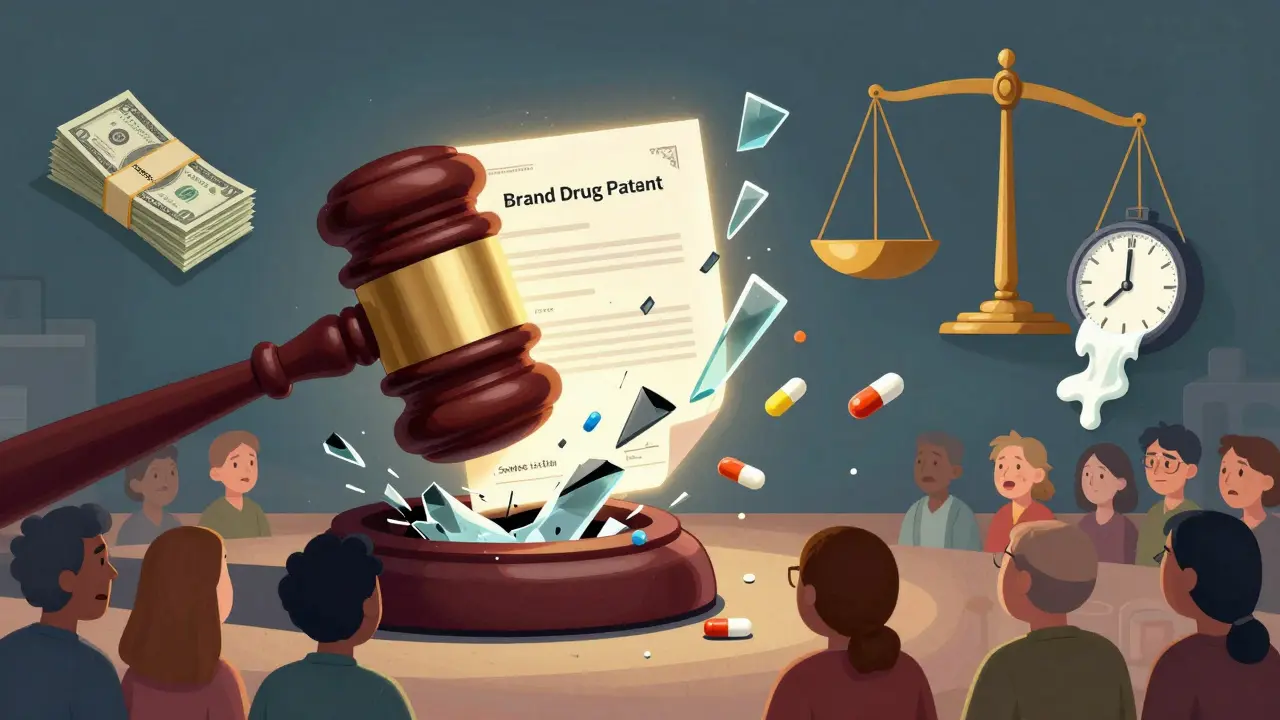
When a brand-name drug’s patent is about to expire, a race begins-not for speed, but for legal strategy. Generic drug makers don’t wait for the patent to fade away. They file a Paragraph IV challenge, a legal move built into U.S. law since 1984, to knock down those patents before they even expire. This isn’t just paperwork. It’s a high-stakes game that can save consumers billions and flip the market overnight.
What Exactly Is a Paragraph IV Challenge?
A Paragraph IV challenge is a formal notice filed by a generic drug company when applying to the FDA to sell a cheaper version of a brand-name drug. It says: "Your patent is invalid, unenforceable, or our drug won’t break it." This isn’t a guess. It’s a legal declaration backed by science and legal arguments. The system was created by the Hatch-Waxman Act of 1984 to balance two things: rewarding drug innovation and getting affordable generics to market faster.
Before this law, only 19% of prescriptions in the U.S. were filled with generics. Today, that number is 90%. But generics cost only 23% of what brand drugs do. That’s because Paragraph IV challenges broke the monopoly. Without them, many drugs would still be priced at brand levels long after patents should have expired.
How the Process Works
The process starts when a generic company files an Abbreviated New Drug Application (ANDA) with the FDA. Inside that application, they check the Paragraph IV box and list every patent they’re challenging from the FDA’s Orange Book-a public list of brand drug patents.
Within 20 days of filing, the generic company must send a detailed letter to the brand-name drug maker. This letter explains why the patent doesn’t hold up-maybe the invention wasn’t new, or the patent was written too broadly. The brand company then has 45 days to sue for patent infringement. If they do, the FDA can’t approve the generic for 30 months. That’s called a regulatory stay.
But here’s the twist: if the court rules the patent is invalid before the 30 months are up, the stay ends early. That’s what happened in 2020 when Hetero Labs challenged Celgene’s patent on Revlimid. The court struck down the patent after 22 months, and the generic hit the market immediately.
Meanwhile, the generic company must prove its drug works the same way as the brand. That means running bioequivalence studies-typically with 24 to 36 healthy volunteers-and showing their drug’s absorption matches the brand within strict FDA limits (80-125% for key measurements like Cmax and AUC).
The Big Prize: 180 Days of Exclusivity
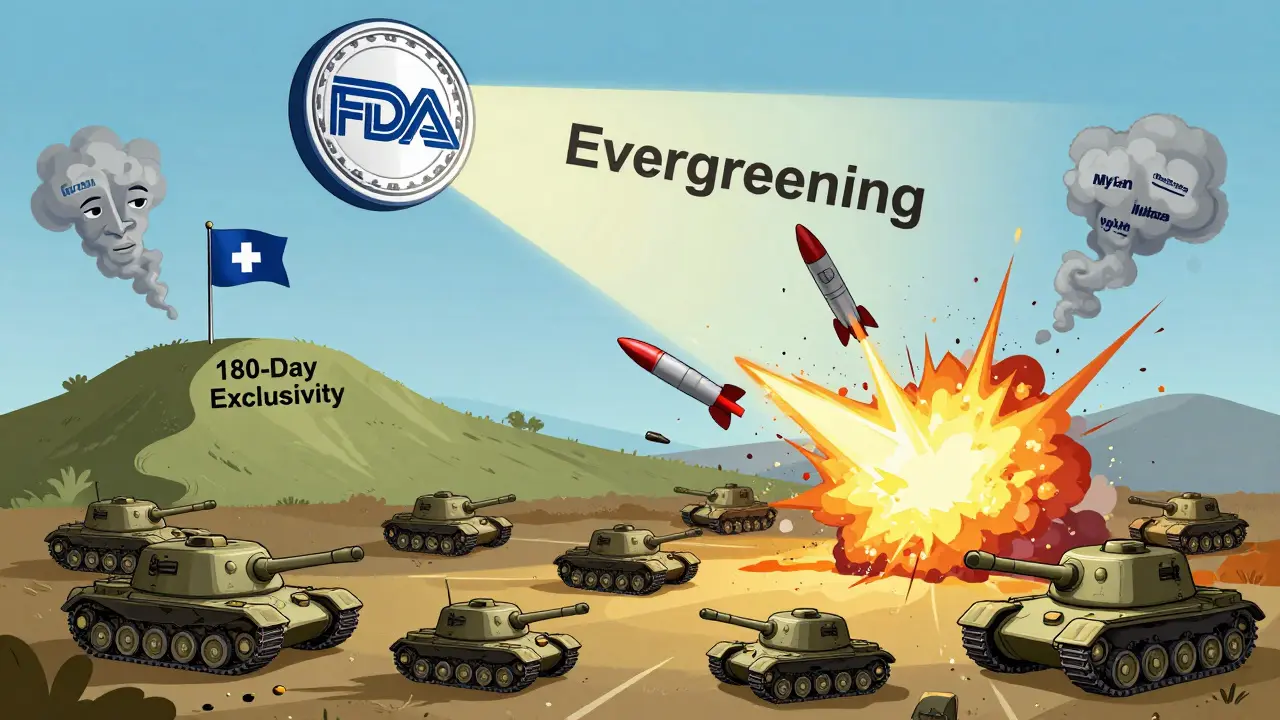
The real reason companies risk millions in legal fees is the 180-day exclusivity period. The first generic company to successfully challenge a patent gets to be the only generic on the market for six months. During that time, they capture 70-80% of the generic sales.
Take Teva’s challenge to Copaxone in 2017. They won exclusivity and made $1.2 billion in just six months. Mylan did the same with EpiPen in 2016, taking 75% of the market. That’s not luck. It’s strategy. These companies spend years preparing-analyzing patents, building manufacturing capacity, and lining up distribution.
But exclusivity isn’t guaranteed. If the first filer doesn’t get FDA approval within 30 months of filing, or if they delay launch without good reason, they lose the exclusivity. That’s happened more than a dozen times since 2010.
Why Most Cases Settle-And What That Means
Only 28% of Paragraph IV cases go to trial. The rest settle. Why? Because both sides have too much to lose.
Brand companies don’t want to risk losing a patent in court. Generic companies don’t want to spend $15 million on litigation only to lose. So they cut deals. But not all deals are fair.
Before 2013, brand companies would pay generics to stay off the market-called "pay-for-delay." The Supreme Court shut that down in the Actavis case. Now, settlements must let the generic enter no later than 75 days before the patent expires. That’s still a delay, but it’s legal.
Still, 72% of Paragraph IV cases settle today. That’s up from 65% in 2015. And the average cost of litigation has jumped from $5 million in 2000 to $15.7 million in 2022. That’s a barrier for small generic makers. Only the top 10 companies now file 68% of all challenges.
Patent Thickets and the Battle Over Evergreening
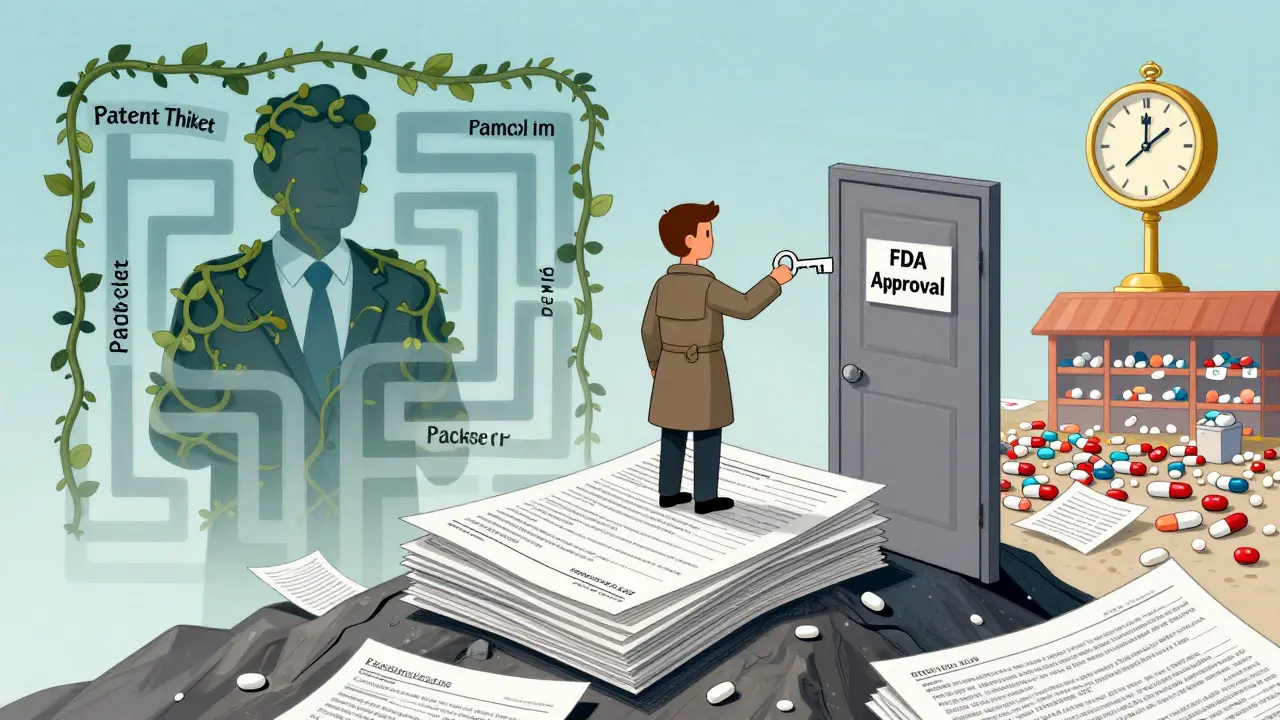
Brand companies don’t just rely on one patent. They build "patent thickets"-a web of 10, 20, even 40 patents covering everything from the pill’s shape to the way it’s taken. Copaxone had over 40 patents. That makes it expensive and slow for generics to challenge them all.
Some companies use "product hopping"-slightly changing the drug (like switching from a pill to a pen injector) and getting a new patent. The FTC called this anti-competitive in the Restasis case against Allergan in 2019.
But the FDA is pushing back. Since 2020, new drug approvals have shown 23% fewer patents listed in the Orange Book. The agency now demands stronger proof that each patent is truly novel.
Who Wins and Who Loses
Consumers win. Since 1990, Paragraph IV challenges have saved U.S. patients over $1.2 trillion. The FTC estimates each successful challenge saves $13.7 billion per drug annually.
Generic companies win too-if they’re big enough. Teva, Mylan, Hikma, and Sandoz dominate the field. Smaller players struggle with the cost and complexity.
Brand companies lose market share-but they still make billions. Many use Paragraph IV challenges as a signal. If a generic files, they know the patent’s weak. Some even license their own patents to generics early to control the entry date.
What’s Changing Now?
The Inflation Reduction Act of 2022 lets Medicare negotiate prices for the costliest drugs. That’s making Paragraph IV challenges even more valuable. If a drug is targeted for price negotiation, a generic entry could slash its cost even further. Analysts predict a 15-20% rise in challenges for top Medicare drugs by 2025.
Companies are also starting to challenge patents one by one-not all at once. This "patent cliff stacking" lets them extend their market presence beyond the 180-day window. Hikma did this with Novo Nordisk’s Victoza, filing multiple challenges over two years to stay ahead of competitors.
And the FTC is watching closer. In 2023, they sued Endo International for listing fake patents to block generics. That’s a warning: playing games with the system won’t fly anymore.
The Future of Generic Entry
Paragraph IV challenges aren’t going away. In fact, 92% of generic manufacturers say they’re essential to their business. But the system is under strain. The average litigation now lasts 32 months-longer than the 30-month stay. That delays access.
Experts are calling for reforms: faster court timelines, limits on patent thickets, and clearer rules on what counts as a valid patent. Until then, the system works-but it’s a marathon, not a sprint.
For patients, it means cheaper drugs sooner. For the industry, it means a constant tug-of-war between innovation and access. And for the generics? It’s still the most powerful tool they have to bring down drug prices-one patent at a time.
What is a Paragraph IV certification?
A Paragraph IV certification is a legal statement made by a generic drug manufacturer when filing an Abbreviated New Drug Application (ANDA) with the FDA. It claims that a patent listed for the brand-name drug is invalid, unenforceable, or will not be infringed by the generic version. This triggers a 45-day window for the brand company to sue for patent infringement.
Why do generic companies file Paragraph IV challenges?
They file to enter the market early-before the brand’s patent expires. The first company to successfully challenge a patent gets 180 days of exclusive rights to sell the generic version, which can bring in hundreds of millions in revenue. It’s a high-risk, high-reward strategy.
How long does a Paragraph IV challenge take?
The process can take anywhere from 2 to 5 years. The FDA grants a 30-month regulatory stay once litigation begins, but if the court rules the patent invalid earlier, approval can happen sooner. On average, generic drugs enter the market about 5.2 years after the brand drug’s approval, according to JAMA Internal Medicine.
Can a brand company stop a Paragraph IV challenge?
They can’t stop it, but they can delay it. By suing within 45 days of being notified, they trigger a 30-month FDA approval hold. They can also settle with the generic maker, often agreeing to a delayed entry date. However, "pay-for-delay" deals are now illegal under antitrust law after the 2013 Supreme Court ruling in Actavis.
How do generics prove their drug is safe and effective?
They must prove bioequivalence. That means showing their drug delivers the same amount of active ingredient into the bloodstream at the same rate as the brand. This is tested in clinical studies with 24-36 volunteers, using strict FDA guidelines: the 90% confidence interval for key measurements (Cmax and AUC) must fall between 80% and 125% of the brand’s values.
Are Paragraph IV challenges only for small-molecule drugs?
Yes. Paragraph IV challenges apply only to traditional small-molecule drugs approved under the New Drug Application (NDA) pathway. Biosimilars-generic versions of biologic drugs-use a different process under the Biologics Price Competition and Innovation Act (BPCIA), though they can also challenge patents.
How much does a Paragraph IV challenge cost?
The average cost has risen to $15.7 million per case as of 2022, up from $5 million in 2000. This includes legal fees, expert testimony, bioequivalence testing, and manufacturing prep. Smaller companies often can’t afford it, which is why the top 10 generic manufacturers now file nearly 70% of all challenges.
What impact do Paragraph IV challenges have on drug prices?
They drive prices down dramatically. Once a generic enters, prices typically drop 80-95% within months. Since 1990, these challenges have saved U.S. consumers over $1.2 trillion. The FTC estimates each successful challenge saves $13.7 billion per drug annually.
Comments (8)
Virginia Seitz
So generics are basically the OG disruptors of Big Pharma? 🙌 I love that this system lets regular people actually win for once.
Pawan Chaudhary
This is so inspiring! In India, we see how these challenges bring life-saving meds to millions. Kudos to the generic makers who fight for the little guy. 💪
Linda Caldwell
Big Pharma’s patent thickets are just a tax on sick people
They don’t invent, they just extend
And we pay for it
Chris Van Horn
One must, with due diligence, examine the structural underpinnings of the Hatch-Waxman Act-not merely as a legislative artifact, but as a paradigmatic rupture in the epistemology of pharmaceutical monopolies. The Paragraph IV certification, far from being a mere procedural checkbox, constitutes a jurisprudential counterweight to the neoliberal enclosure of therapeutic knowledge. One is compelled to note, with sober academic rigor, that the 180-day exclusivity window, while ostensibly a market incentive, functions as a de facto oligopolistic trigger, wherein the first filer-often a corporate behemoth-exercises quasi-regulatory dominance over therapeutic access. The notion that this system democratizes access is, frankly, a neoliberal mythos. The true beneficiaries are not the patient, but the shareholders of Teva and Hikma, who have weaponized litigation as a form of rent extraction. The FDA’s recent tightening of Orange Book listings, while laudable, remains insufficient; one must demand the abolition of all secondary patents, not merely their scrutiny. The 30-month stay is an affront to public health. The Supreme Court’s Actavis ruling was a pyrrhic victory. We are still in the gilded cage.
Victoria Rogers
So the government lets foreign companies destroy American patents? That's why our drugs are cheap now-because we let China and India rip us off. We should ban Paragraph IV. This is economic warfare.
Jonathan Morris
Did you know the FDA and Big Pharma are in cahoots? The Orange Book isn’t public-it’s a secret list they update after midnight to block generics. The 180-day exclusivity? A front. The real winners are the lawyers. They own the system. And the ‘bioequivalence’ studies? They use the same volunteers as the brand. It’s all rigged. Wake up.
BETH VON KAUFFMANN
Let’s not romanticize this. Paragraph IV challenges are a zero-sum game disguised as consumer advocacy. The 180-day exclusivity period creates artificial scarcity, distorting pricing dynamics. The litigation costs are so prohibitive that only oligopolistic generics can play-meaning competition is actually reduced. The FTC’s focus on pay-for-delay ignores the deeper structural problem: the entire patent system is broken. Patents are being used as strategic delay tools, not innovation incentives. The real solution? Shorten patent terms, eliminate evergreening entirely, and let the market decide. The current system doesn’t lower prices-it just redistributes rents from brand to generic monopolies. And don’t get me started on bioequivalence thresholds. 80-125%? That’s a therapeutic gray zone. If your drug varies by 25% in absorption, it’s not the same. It’s just legally the same.
Steven Lavoie
Chris Van Horn’s analysis is technically correct but misses the human core. This isn’t just about patents or profits-it’s about a diabetic in Ohio who can’t afford insulin, or a veteran in Texas who skips doses because the copay’s $500. Paragraph IV isn’t perfect, but it’s the only thing keeping the system from collapsing into pure corporate extraction. The fact that 90% of prescriptions are generics? That’s not luck. That’s millions of people breathing easier because someone fought a patent in court. The cost is high. The process is messy. But the outcome? Life. And that’s worth every dollar of litigation.