
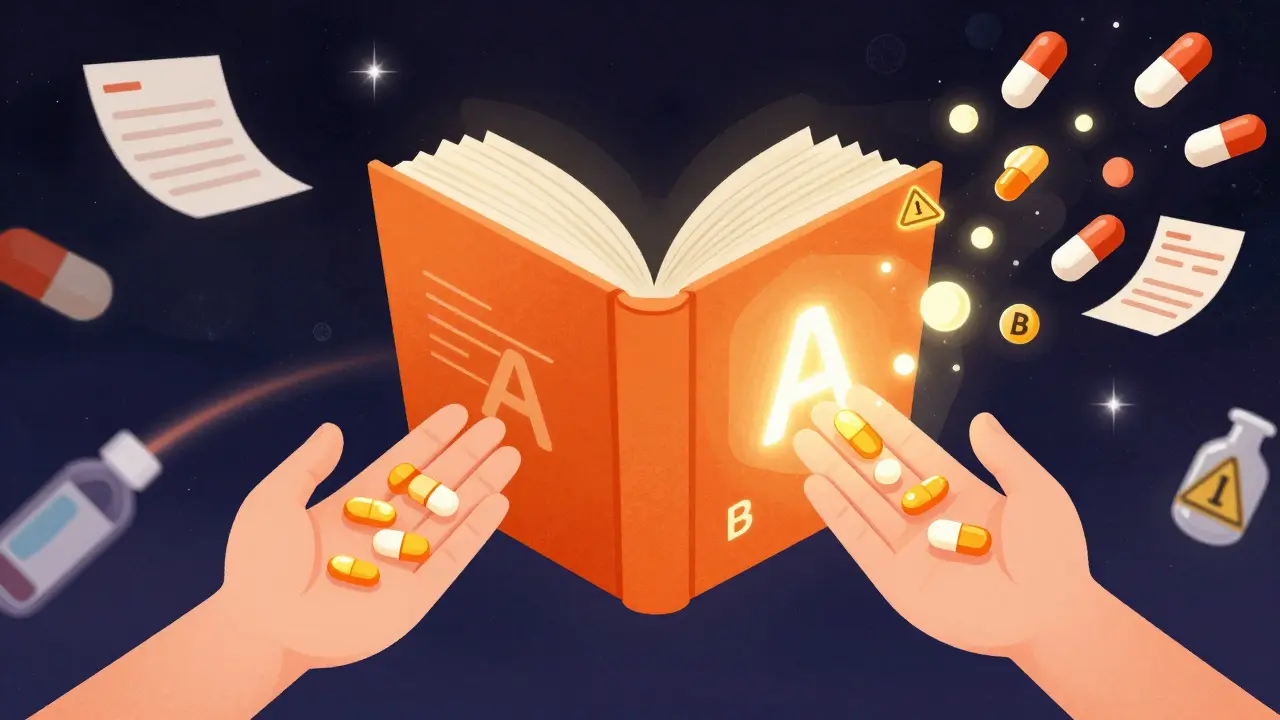
When you pick up a prescription, you might not realize that the generic pill in your hand was approved to replace the brand-name version-not because of cost alone, but because of a strict scientific and legal system called Therapeutic Equivalency Codes. These codes, published monthly by the FDA in the Orange Book, are the legal backbone of generic drug substitution in the U.S. They don’t just tell pharmacists which drugs are cheaper-they tell them which ones are legally allowed to be swapped without risking your health.
What Are Therapeutic Equivalency (TE) Codes?
Therapeutic Equivalency Codes are alphanumeric labels assigned by the FDA to prescription drugs that have multiple manufacturers. They answer one simple question: Can this generic drug be swapped for the brand-name version without changing how well it works or how safe it is?
The system was created by the Hatch-Waxman Act of 1984, which aimed to speed up access to affordable generics while protecting patient safety. Since then, the FDA has evaluated over 14,000 drug products using these codes. The first letter is the most important: A means the generic is considered therapeutically equivalent to the brand. B means it’s not. That’s it. No gray area.
For example, if your doctor prescribes Lipitor (atorvastatin), and your pharmacist gives you a generic with an AA or AB code, you’re getting the exact same clinical effect. If the generic has a BC or BT code, the FDA says it’s not yet proven to be interchangeable. That’s not a recommendation-it’s a legal barrier.
How the Code System Works
It’s not just A or B. The second character adds precision. Here’s what the letters mean:
- AA: Immediate-release oral drugs with no bioequivalence issues. These are the easiest to substitute. Think of common pills like metformin or lisinopril.
- AB: Products that initially had questions about bioequivalence but later proved equivalent through additional testing. These are still safe to swap.
- BC: Extended-release tablets or capsules with unresolved bioequivalence concerns. Pharmacists can’t legally substitute these in most states.
- BD: Proven bioequivalence problems. These are rare but do exist-usually because the generic didn’t match the brand’s release pattern.
- BT: Topical products like creams or gels where absorption is hard to measure. Even if the ingredients are the same, the skin may absorb them differently.
- BN: Aerosol or nebulized drugs. These require precise delivery, and small formulation changes can alter lung deposition.
- BX: Not enough data to judge. These are often new generics still under review.
These aren’t guesses. Each code is backed by data from clinical studies, bioequivalence trials, and lab tests. For instance, an AB code might mean the generic had a different filler than the brand, but the FDA confirmed the drug still released into the bloodstream at the same rate and intensity.
Why the Orange Book Is the Law, Not Just a Guide
The FDA doesn’t enforce substitution rules. That’s up to each state. But every state-California, Texas, New York, Florida-uses the Orange Book as their legal reference. In fact, state pharmacy boards require pharmacists to check the current edition before swapping any generic.
Take California: Business and Professions Code Section 4073 says pharmacists can only substitute if the generic has an A rating. If it’s a B, they must dispense the brand unless the doctor writes “Do Not Substitute.” Same in New York. Same in Illinois. Even in states with more lenient substitution laws, the Orange Book is still the starting point.
This isn’t optional. If a pharmacist substitutes a BT topical cream for a brand and the patient has a bad reaction, the pharmacist can be held liable. The FDA’s code isn’t a suggestion-it’s a legal shield.

What Happens When a Drug Gets a B Code?
Most people assume if a drug is FDA-approved, it’s interchangeable. That’s not true. Over 3,400 products in the Orange Book have a B code as of October 2023. That’s nearly a quarter of all listed generics.
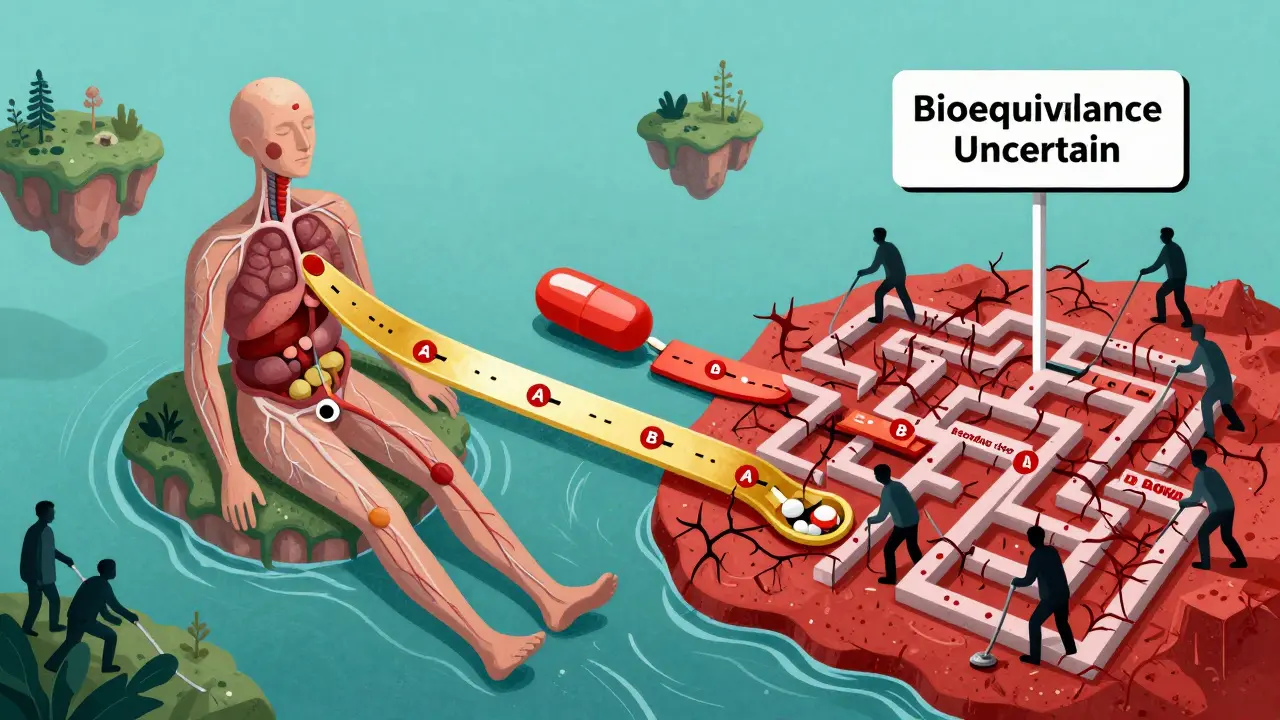
These are usually complex drugs: extended-release pills, inhalers, injectables, creams, or patches. For example, a generic version of a long-acting insulin or a transdermal pain patch might have the same active ingredient but a different polymer coating that changes how slowly the drug enters the body. The FDA can’t say for sure that it behaves the same in every patient-so it assigns a B code.
Pharmacists know this. A 2023 survey by the National Community Pharmacists Association found that 68% of pharmacists hesitate to substitute products with BT or BC codes-even if the prescriber doesn’t block it-because they’ve seen cases where patients had unexpected side effects after switching.
Brand-name companies often fight to keep drugs in the B category. In 2022, the FDA received 1,247 citizen petitions challenging TE codes-up 17% from the year before. Most came from brand manufacturers trying to delay generic competition on high-revenue drugs like asthma inhalers or biologic injectables.
How Much Money Is at Stake?
Therapeutic equivalency isn’t just about safety-it’s about cost. In 2022, generic drugs saved the U.S. healthcare system $298 billion. But that’s only for products with A codes. Those made up 97% of all generic prescriptions.
Products with B codes? They’re still approved by the FDA, but they’re rarely substituted. That means patients often pay full brand price for them, even if a cheaper version exists. For drugs like Copaxone (multiple sclerosis) or Advair (asthma), the difference between a B code and an A code can mean hundreds of dollars per month for patients.
The FDA knows this. Their 2023-2027 Strategic Plan aims to reduce the number of B code drugs from 24.3% to under 15% by 2027. They’re investing $28.7 million through GDUFA III to develop better testing methods for complex generics-like using advanced imaging to track how a patch releases drug into the skin.
What You Should Do as a Patient
You don’t need to memorize TE codes. But you should know this: if your pharmacist switches your medication and you notice a change-worse side effects, less relief, different timing-ask why.
Check your prescription label. If the generic name is listed, ask your pharmacist: “Is this an A-rated product?” If they say yes, you’re covered. If they say no, ask if the doctor needs to approve the switch.
Also, don’t assume all generics are equal. Two different generics of the same drug can have different codes. For example, one brand of metformin might be AA, while another is AB. Both are safe. But if your insurance switches you from one to the other, and you feel different, speak up.
Doctors and pharmacists rely on the Orange Book. You can too. The FDA makes it free to access online. If you’re on a chronic medication, it’s worth checking once a year to see if your generic’s code changed.
What’s Changing in 2025?
The FDA is making the Orange Book more useful. Since January 2023, it’s been fully digital with API access for electronic health records. That means your pharmacy’s system can now auto-check TE codes when filling a prescription.
They’re also updating how they test complex drugs. New guidance released in August 2023 says minor changes-like switching from cornstarch to rice starch as a filler-won’t automatically disqualify a drug from an A rating, as long as performance stays the same.
By 2028, experts predict over 93% of generic prescriptions will be for A-rated drugs. That’s progress. But until then, the B code remains a silent barrier-protecting some patients, limiting access for others.
Therapeutic Equivalency Codes are the quiet engine behind America’s generic drug system. They’re not perfect. But they’re the only legal framework we have to ensure that cheaper medicine doesn’t mean worse medicine.
What does an 'A' rating mean for a generic drug?
An 'A' rating means the FDA has determined the generic drug is therapeutically equivalent to the brand-name version. It contains the same active ingredient, dosage form, strength, and route of administration, and has been proven through testing to deliver the same clinical effect and safety profile. Pharmacists can legally substitute it without the prescriber’s permission.
Can a pharmacist substitute a drug with a 'B' code?
No, not legally. All 50 U.S. states require pharmacists to follow the FDA’s Orange Book TE codes. A 'B' code means the FDA has not found sufficient evidence that the generic is interchangeable with the brand. Pharmacists must dispense the brand-name drug unless the prescriber explicitly allows substitution.
Why do some generic drugs have different TE codes even if they contain the same ingredient?
Because formulation matters. Two generics of the same drug can have different inactive ingredients, release mechanisms, or manufacturing processes. For example, one might be an immediate-release tablet (AA), while another is an extended-release capsule (BC). Even if the active ingredient is identical, how the drug is delivered affects how it works in the body. The FDA evaluates each product individually.
Are over-the-counter (OTC) drugs assigned TE codes?
No. TE codes only apply to prescription drugs approved under Section 505 of the FD&C Act. OTC medications are not evaluated for therapeutic equivalence by the FDA, and substitution decisions for OTC drugs are left to manufacturers and retailers.
How often is the Orange Book updated?
The FDA updates the Orange Book monthly. New drugs get added, existing TE codes may be changed based on new data, and discontinued products are removed. Pharmacists are required to use the most current edition when making substitution decisions.
Can a doctor override a 'B' code and allow substitution anyway?
Yes. While state laws require pharmacists to follow TE codes, a prescriber can write ‘Dispense as Written’ or ‘Do Not Substitute’ on the prescription. In rare cases, a doctor may write ‘Substitution Permitted’ even for a 'B' code product, but this is uncommon and usually only done with strong clinical justification.
How do I check a drug’s TE code?
Visit the FDA’s Drugs@FDA website or the Orange Book portal (www.fda.gov/orangebook). Search by brand name, generic name, or active ingredient. The TE code is listed under the ‘Therapeutic Equivalence’ section. Many pharmacy systems also display this code automatically when filling a prescription.
What Comes Next?
The future of generic substitution hinges on solving the challenges of complex drugs. Inhalers, patches, and long-acting injectables are becoming more common-and harder to copy exactly. The FDA’s push to reduce B codes by 2027 isn’t just about cost. It’s about fairness. Patients shouldn’t pay more just because a drug is hard to replicate.
If you’re on a medication with a B code, don’t assume you’re stuck with the brand. Ask your doctor if there’s an A-rated alternative. Ask your pharmacist if a new version has been approved. And if you notice a change in how you feel after a switch-speak up. The system works best when patients are informed.
Comments (15)
Paul Ong
This is wild. I never thought about how a tiny change in filler could make a drug illegal to swap. Pharmacies are basically playing Jenga with our health.
Richard Thomas
The real issue isn't the codes themselves-it's the fact that the system was designed to balance access and safety, but now it's being weaponized by pharmaceutical lobbies to delay competition. The FDA's data is solid, but the political inertia around B-rated drugs is what keeps prices high. We're not talking about marginal differences here; we're talking about patients paying $500 a month for insulin when a chemically identical version exists, just with a different polymer coating. That's not science-it's economics disguised as pharmacology.
And yet, when patients report changes after a switch, pharmacists are told to dismiss it as placebo. But if bioequivalence is proven through blood concentration curves, why do we ignore real-world outcomes? The gap between lab results and lived experience is where the system fails. We need longitudinal studies, not just single-dose bioavailability tests.
gerard najera
A means safe to swap. B means don't. Simple.
Phoebe McKenzie
Of course the FDA lets brand-name companies manipulate these codes. They’re the ones writing the petitions. This whole system is a rigged game. You think they care about your health? They care about their quarterly profits. And now they’re using ‘bioequivalence concerns’ as a legal loophole to keep you paying $400 for a pill that costs $2 to make. Wake up. This isn’t medicine-it’s corporate extortion.
Donna Peplinskie
I’ve been a pharmacist in Ontario for 18 years, and I’ve seen this play out differently up here. We don’t have TE codes per se, but we do have interchangeability lists-and the same patterns emerge. Complex formulations like inhalers or patches? Patients *do* notice differences. Not always dramatic, but enough to make them anxious, or worse-non-adherent. I’ve had patients cry because they switched generics and suddenly couldn’t breathe right. It’s not placebo. It’s real. And the system needs to catch up.
Also, thank you for mentioning the Orange Book. So few people know it exists. I print the monthly updates and keep them behind the counter. If more patients asked for it, maybe the pressure on manufacturers would increase.
Layla Anna
I had no idea about this!! 😳 I just assumed if it’s generic, it’s the same. My mom switched to a generic for her blood pressure med last year and started feeling dizzy-she thought it was just aging. Turns out the new one was BC-rated. She went back to the brand and feels fine now. Thanks for explaining why this happens. I’m going to check her meds now 🙏
Todd Nickel
The assumption that all A-rated generics are functionally identical is misleading. Even within the AA category, differences in excipients can affect absorption kinetics in patients with GI disorders or altered metabolism. The FDA’s testing protocols are standardized, but they don’t account for population-level variability-especially in elderly patients or those on polypharmacy regimens. A drug may be bioequivalent in a controlled trial of 50 healthy adults, but what about a 72-year-old with renal impairment taking six other meds?
The system works statistically, but fails clinically in edge cases. That’s why pharmacists hesitate with BC/BT codes-not out of conservatism, but because they’ve seen the consequences. We need post-market surveillance tied to TE codes, not just pre-approval trials.
Ann Romine
This reminds me of how my cousin in Mexico gets the same generic drug but pays 1/10th the price. No TE codes there. Just price and availability. It makes me wonder if our system is really about safety-or just about controlling access to keep profits high. The FDA’s role feels less like a protector and more like a gatekeeper for corporate interests.
Austin Mac-Anabraba
Let’s be honest. The FDA is a regulatory capture success story. The same people who wrote Hatch-Waxman are now on pharma payrolls. The ‘A’ and ‘B’ codes are not scientific-they’re political compromises. The fact that 3,400 drugs are stuck in B purgatory while brand-name companies sit on patents they never innovated? That’s not regulation. That’s legalized theft. And you, the consumer, are the one paying for it.
Bryan Anderson
I appreciate the depth here. I work in a community pharmacy and see patients confused about why their insulin or asthma inhaler isn’t being switched. Most don’t know about the Orange Book. We hand them printed pages sometimes. It’s not ideal, but it’s the only way to make this real for them. Thanks for clarifying the legal weight behind these codes-it’s not just policy, it’s liability.
Stephen Gikuma
This is all part of the globalist agenda. The FDA is controlled by the same elites who want you dependent on expensive drugs. Why do you think they let these B codes exist? So you keep buying the brand. So you stay weak. So they can sell you more. The truth is, they could make every generic A-rated tomorrow if they wanted to. But they won’t. Because control is more profitable than health.
Andy Heinlein
I had no idea about this!! 😅 So like, if my generic metformin is AA, I’m good? But if it switches to AB, should I be worried? I’m just trying to save money lol. Also, can I look this up on my phone? Like a QR code or something?
Dusty Weeks
so the fda is just letting big pharma win?? 🤡 i just got my generic adderall switched and now i feel like a zombie. they said it was 'ab' rated but i think they're lying. i'm gonna file a complaint. also why do they use letters? why not like a star system? 🌟🌟🌟🌟🌟
Heather Josey
This is an incredibly well-articulated overview of a system that affects millions yet remains invisible to most. The fact that state laws rely on the Orange Book as a legal standard-and that pharmacists are held liable for substitutions outside of those codes-demonstrates how deeply embedded this framework is in our healthcare infrastructure. What’s often overlooked is that the burden of education falls on the patient. We need public health campaigns, not just online portals. A simple label on the pill bottle: 'A-Rated: Safe to Substitute' or 'B-Rated: Consult Your Provider'-could prevent confusion and anxiety. Thank you for bringing this to light.
Bobby Collins
i think the fda is just playing along with the big pharma scam. why else would they let b codes exist for so long? it’s not about science-it’s about money. and now they’re gonna spend 28 million to fix it? lol. they should’ve done that 20 years ago. also, why do they use the orange book? why not a website? who still uses a book?? 🤦♀️