
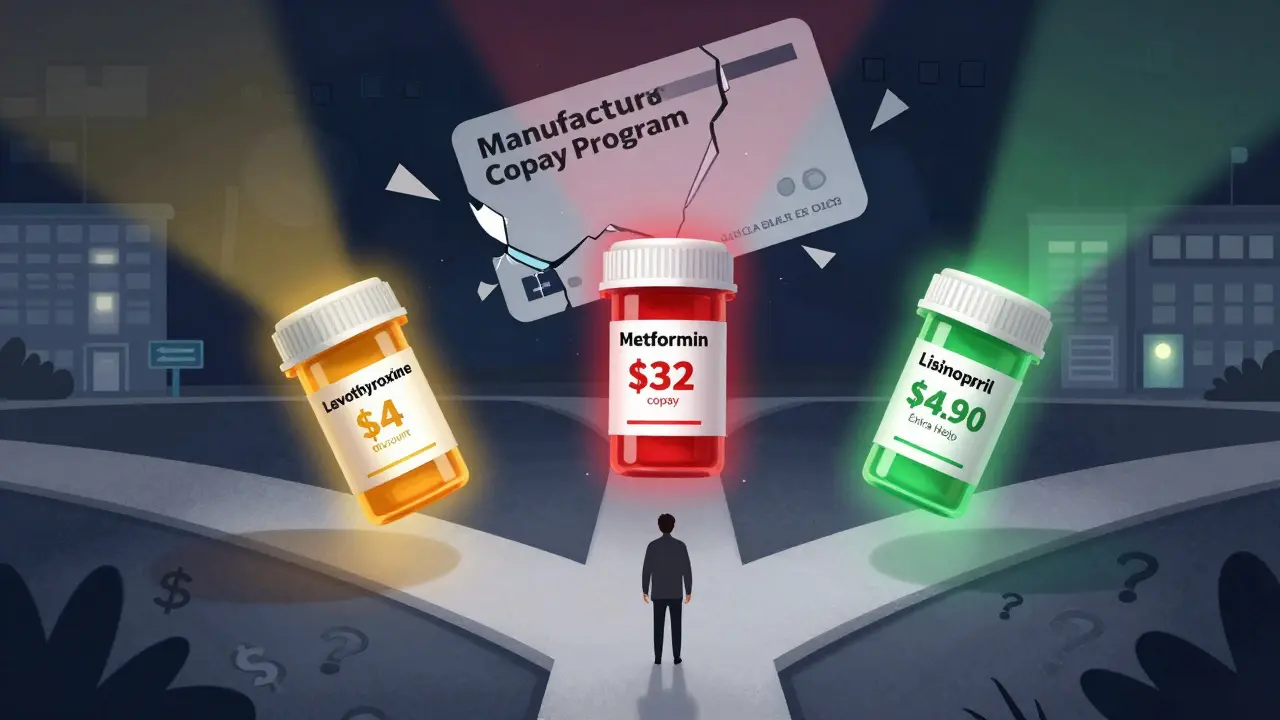
Let’s say you’re taking three generic medications every month: levothyroxine, metformin, and lisinopril. You know they’re cheaper than brand names, but your copay still hits $32 a month. That’s $384 a year. For someone on a fixed income, that’s not pocket change-it’s groceries, utilities, or medicine. And here’s the hard truth: copay assistance for generics doesn’t work like it does for brand-name drugs. There are no flashy cards from drugmakers. No $0 copay promises. Just a patchwork of programs, rules, and gaps that leave millions paying more than they should.
Why Generics Don’t Come With Copay Cards
Brand-name drugs often have manufacturer copay assistance programs. Companies like Gilead or Pfizer offer cards that cut your out-of-pocket cost to $5 or even $0. But generic drug makers? They don’t. Why? Because they make almost no profit. A generic pill might cost 85% less than the brand version. If the brand costs $150, the generic might be $20. After manufacturing, distribution, and pharmacy fees, there’s barely enough left to cover payroll, let alone patient assistance.So where does help come from? Not from the drugmaker. It comes from places you might not expect: pharmacies, government programs, and nonprofits. And understanding these options can save you hundreds-or even thousands-each year.
The Real Cost of Generics in 2026
You might think generics are always cheap. But that’s not always true. Here’s what you’re actually paying in 2026:- Commercial insurance (non-Medicare): Average copay: $5-$10 per generic. Sounds good-until you factor in deductibles. If you haven’t met your deductible, you pay full price: $15-$50 per script.
- Medicare Part D (without Extra Help): Copays range from $0 to $44 per generic. But remember: every dollar you pay counts toward your $8,300 out-of-pocket limit in 2024. That changes in 2025.
- Medicare Part D with Extra Help: In 2025, you pay exactly $4.90 per generic and $12.15 per brand. That’s it. No deductible. No cap to hit. This is the gold standard.
- Pharmacy discount programs: Walmart, Kroger, and independent pharmacies offer lists of generics for $4 or $10. These work even if you have insurance-but you can’t combine them with your copay. You have to choose: insurance or discount.
That’s why so many people are stuck. They think their insurance covers generics. It does-but not always enough. And they don’t know about the pharmacy discount programs. Or they assume they’re not eligible for government help because they make “too much.”
Who Gets Help-and Who Gets Left Out
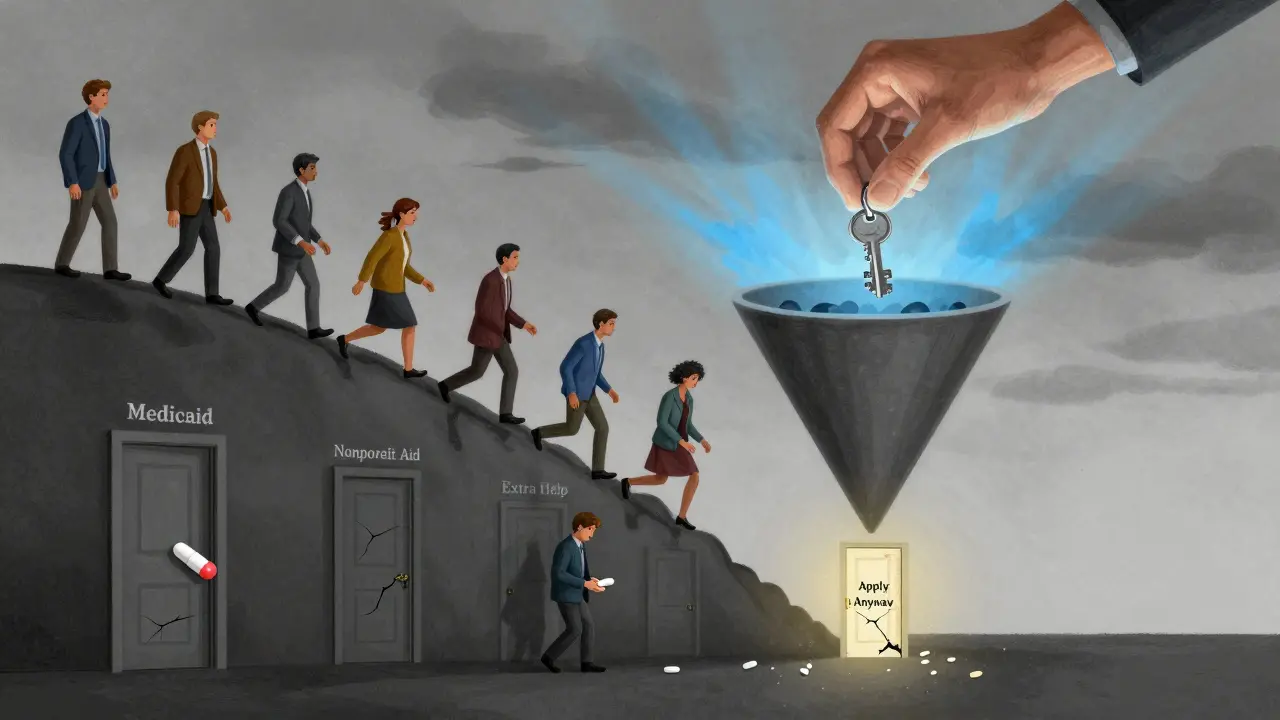
The system is built like a funnel. At the top: people with low income. At the bottom: everyone else.Who qualifies for the best help? If you get Medicaid, Supplemental Security Income (SSI), or qualify for Medicare Savings Programs, you automatically get Extra Help. That means $4.90 per generic. No questions asked.
But here’s the problem: if you make $37,150 a year (250% of the federal poverty level for a single person), you’re already too rich for Medicaid in most states. But you’re still not rich enough to afford $32 a month on three generics. That’s the assistance gap.
According to NeedyMeds, only 12% of applicants in that income range get approved for nonprofit help. Why? Because most programs are designed for people with specific diseases-like cancer or HIV-and generics for high blood pressure or thyroid issues rarely qualify.
And here’s the cruel twist: 87% of copay assistance programs exclude people with Medicare or Medicaid. So if you’re on Medicare but don’t qualify for Extra Help? You’re on your own. No manufacturer cards. No nonprofit aid. Just your insurance plan-and whatever discount the pharmacy offers.
What’s Changing in 2025 (And Why It Matters)
January 1, 2025, is a turning point. The Inflation Reduction Act kicks in major changes:- $2,000 annual out-of-pocket cap for Medicare Part D. That’s down from $8,300. Once you hit $2,000, your generics become free for the rest of the year.
- Elimination of deductibles for Extra Help recipients.
- $2 monthly cap on insulin-including generic versions.
- Quarterly cap of $100 during the coverage gap phase (don’t worry-this is automatic).
These changes will cut costs for millions. But they won’t fix everything. If you’re under 65 and on commercial insurance? The cap doesn’t apply to you. If you’re on Medicare but don’t qualify for Extra Help? You’ll still pay until you hit $2,000. And if you’re caught in the middle-earning too much for aid, but not enough to afford prescriptions-you’re still in trouble.
How to Actually Get Help (Step by Step)
Don’t wait for someone to tell you about these options. You have to find them. Here’s how:- Check your pharmacy’s discount list. Go to Walmart, Kroger, Target, or your local independent pharmacy. Ask: “What’s on your $4/$10 generic list?” They’ll give you a sheet. Bring it next time you fill a script. Use it instead of insurance if it’s cheaper.
- Apply for Extra Help. Even if you think you make too much, apply. The income limit for 2025 is $22,590 for a single person. But if you’re married, live with others, or have unusual expenses, you might still qualify. Apply at SSA.gov or call 1-800-772-1213.
- Use NeedyMeds.org. This nonprofit database lists 700+ assistance programs. Search by drug name. Filter by “generic.” Many programs require proof of income and a doctor’s note-but they’re free to apply for.
- Ask your pharmacist. Pharmacists know which programs work locally. They see patients every day who struggle. Ask: “Is there a patient assistance program for this drug?” Don’t be shy. They’ve done this hundreds of times.
- Apply for a Medicare Savings Program. If you’re on Medicare and your income is under $1,800/month (varies by state), you might qualify for help paying premiums and copays. Contact your State Health Insurance Assistance Program (SHIP). Call 1-877-839-2675.
Most people who get help use at least two of these options. The average successful applicant applies to 2.3 programs. Don’t stop at one.
Pitfalls That Cost People Money
Here’s what goes wrong-and how to avoid it:- “I don’t need help-my generics are cheap.” A 2023 study found 38% of people skipped doses because they thought generics didn’t need assistance. They were wrong. Even $10 a pill adds up.
- “I have insurance, so I can’t use the $4 list.” You can. You just have to choose: insurance copay or discount price. Always compare. Sometimes the discount is cheaper.
- “I applied once and got denied.” Don’t give up. Programs change. Income limits shift. Reapply every year. Even if you were denied last year, you might qualify now.
- “I make too much for Medicaid.” That’s true. But Extra Help has different rules. And nonprofit programs often help people earning up to 400% of poverty level ($60,000 for a family of four).
What’s Next? The System Is Fixing Itself
The good news? The system is changing. In 2025, 99% of Medicare beneficiaries will pay less for generics. The $2,000 cap alone will cut costs by 57% for many. Pfizer and other manufacturers are expanding their programs to include more generics. And Congress is considering the HELP Copays Act, which would force insurers to count copay assistance toward out-of-pocket maximums.But until then, the burden falls on you. You have to know your options. You have to ask. You have to apply. And you’re not alone. In 2023, SHIP counselors handled 1.2 million calls about generic drug costs. That’s 1.2 million people trying to make sense of a broken system.
You’re not failing. The system is just outdated. And you have the power to change your outcome.
Can I use a pharmacy discount program if I have Medicare?
Yes. You can use pharmacy discount programs like Walmart’s $4 list even if you have Medicare. But you can’t combine it with your Medicare copay. You have to choose: pay your Medicare copay (which might be $10) or pay the discount price (which might be $4). Always compare both prices at checkout. The lower one saves you money.
Do generic drugs have copay assistance cards like brand names?
No. Generic drug manufacturers rarely offer copay cards because their profit margins are too thin. Unlike brand-name drugs, which can afford to subsidize costs to keep patients loyal, generics are sold at near-cost prices. Assistance for generics comes from pharmacies, government programs, and nonprofits-not drug companies.
What’s the difference between Extra Help and Medicare Savings Programs?
Extra Help (Low-Income Subsidy) reduces what you pay for prescription drugs under Medicare Part D. It covers copays, deductibles, and coverage gap costs. Medicare Savings Programs help pay your Medicare Part B premiums and sometimes copays and deductibles. You can qualify for both. Extra Help is for drug costs. Medicare Savings Programs are for insurance premiums. Apply for both if you think you qualify.
Is there help for generics if I’m under 65 and have private insurance?
Yes, but it’s limited. Your best bet is pharmacy discount programs like SingleCare, GoodRx, or Walmart’s $4 list. Some nonprofits, like the PAN Foundation, offer limited assistance for certain generic medications used to treat chronic conditions. But you won’t find manufacturer copay cards. Your insurance plan’s formulary tier (Tier 1) is your main source of savings. Always compare your copay to the cash price at the pharmacy.
Will the $2,000 out-of-pocket cap in 2025 help people taking only generics?
Yes, it will help a lot. Because generics are cheaper and taken more often, people on only generics are more likely to reach the $2,000 cap faster than those on expensive brand-name drugs. Once you hit the cap, your generic prescriptions become free for the rest of the year. For many, this means paying $0 for all medications after just a few months.
Can I apply for assistance if I make $30,000 a year?
Absolutely. While Medicaid eligibility is strict, many nonprofit programs help people earning up to 400% of the federal poverty level ($60,000 for a family of four). Programs like NeedyMeds, PAN Foundation, and RxHope have income thresholds higher than Medicaid. Always apply-even if you think you’re too rich. You might be surprised.
Comments (10)
Mark Harris
I used to pay $40/month for my generics until I found out about Walmart's $4 list. Now I pay $4 for metformin and $10 for lisinopril. Total? $14 a month. I wish I knew this sooner. Seriously, go to your pharmacy and ask. They'll give you a paper. Don't overthink it.
Natasha Bhala
i just started using goodrx last year and my copays dropped by 60%... i didnt even know it was a thing. also, pharmacists are your best friends. just ask them. they see this every day. no shame.
Catherine Wybourne
I’ve seen so many people in the UK struggle with this too. The NHS covers most generics, but if you’re not eligible for free prescriptions? You’re paying £10+ per item. Same problem, different country. It’s not just an American issue.
Jesse Lord
i just want to say to anyone reading this: you're not lazy for not knowing this. the system is designed to confuse you. every time someone says 'just apply' like it's easy, they're forgetting how overwhelming the forms are. i cried filling out the Extra Help application. it took three tries. you're not failing. the paperwork is the enemy.
Niel Amstrong Stein
just applied for Extra Help last month. got approved in 11 days. now i pay $4.90 for all my meds. i was convinced i made too much money (made $38k) but turns out they look at household income, not just yours. also, they don't check your bank account. no one told me that. 🙌
Marcus Jackson
You know what's wild? The $2,000 cap in 2025 doesn't apply to people under 65 with private insurance. So if you're 52 and on an employer plan? You're still stuck. And no, your employer isn't going to help. They'll just raise your premiums next year. This isn't a fix. It's a band-aid with a price tag.
Heather Burrows
people act like this is a crisis but honestly? if you can't afford $32 a month, maybe you shouldn't be taking all three meds. i mean, is lisinopril really that urgent? i know people who skip doses on purpose to save money. not ideal, but... survival.
Ritu Singh
In India, we have a different reality. Generic medications are often sold at 1/10th the price of U.S. retail. Yet, even here, the stigma around affordability persists. We must remember: medicine is not a luxury. It is the scaffolding of human dignity. The systems we build reflect our moral architecture. When we allow a person to choose between insulin and rent, we have already failed as a civilization. The solution is not better programs. It is a fundamental reimagining of healthcare as a right-not a transaction.
Joey Gianvincenzi
The fact that this post even needs to exist is a national disgrace. We are the richest country on Earth and people are skipping doses because they can't afford $10 a pill? This isn't about 'personal responsibility.' This is about systemic failure. The pharmaceutical industry is a cartel. The FDA approves generics but does nothing to enforce price transparency. Congress is complicit. Stop pretending this is about 'finding programs.' It's about justice.
Tola Adedipe
I work in a pharmacy in Toronto. We have a similar issue. Canadians pay less than Americans, but we still have people coming in asking if they can split pills or skip days. One woman told me she takes her metformin every other day because she can't afford the refill. I handed her a GoodRx coupon and a free sample. She cried. That's not healthcare. That's charity. And we're running out of volunteers.