

Imagine you’re trying to copy a secret recipe-not by reading the ingredients, but by tasting the dish and guessing what’s in it. That’s what generic drug makers face when they try to copy complex generic formulations. These aren’t your typical pills or capsules. They’re inhalers that deliver medicine deep into the lungs, creams that penetrate skin layers, or injectables with nanoparticles that behave like tiny, unpredictable bubbles. And proving they work the same as the brand-name version? That’s where things get messy.
What Makes a Generic Drug "Complex"?
Not all generics are created equal. The FDA defines complex generics as products that can’t be easily compared using standard blood tests. These include five main types:- Drugs with tricky active ingredients-like peptides, natural extracts, or polymers
- Liposomes, emulsions, and other advanced delivery systems
- Topical products like gels, creams, and ointments meant to act on skin or eyes
- Inhalers, patches, and extended-release injectables
- Drug-device combos-like auto-injectors or nebulizers
These aren’t rare oddities. Around 400 such brand-name drugs are on the market in the U.S. with no generic alternative. Why? Because proving they’re bioequivalent-meaning they deliver the same amount of drug to the same place at the same rate-isn’t just hard. It’s often impossible with traditional methods.
Why Blood Tests Don’t Work
For a regular pill, proving bioequivalence is straightforward. You give the generic and brand versions to volunteers, draw blood over time, and check if the levels match. The FDA requires the 90% confidence interval for two key numbers-AUC (total exposure) and Cmax (peak concentration)-to fall between 80% and 125% of the brand drug’s values. Simple.But what if the drug isn’t meant to enter the bloodstream? Take a steroid cream for eczema. It’s supposed to stay in the skin. Measuring blood levels tells you nothing about whether it’s working where it’s supposed to. Same with an asthma inhaler. The drug needs to land in the lungs, not show up in your veins. Yet current regulations still demand blood tests for almost all generics-even when they make no sense.
The Reverse-Engineering Problem
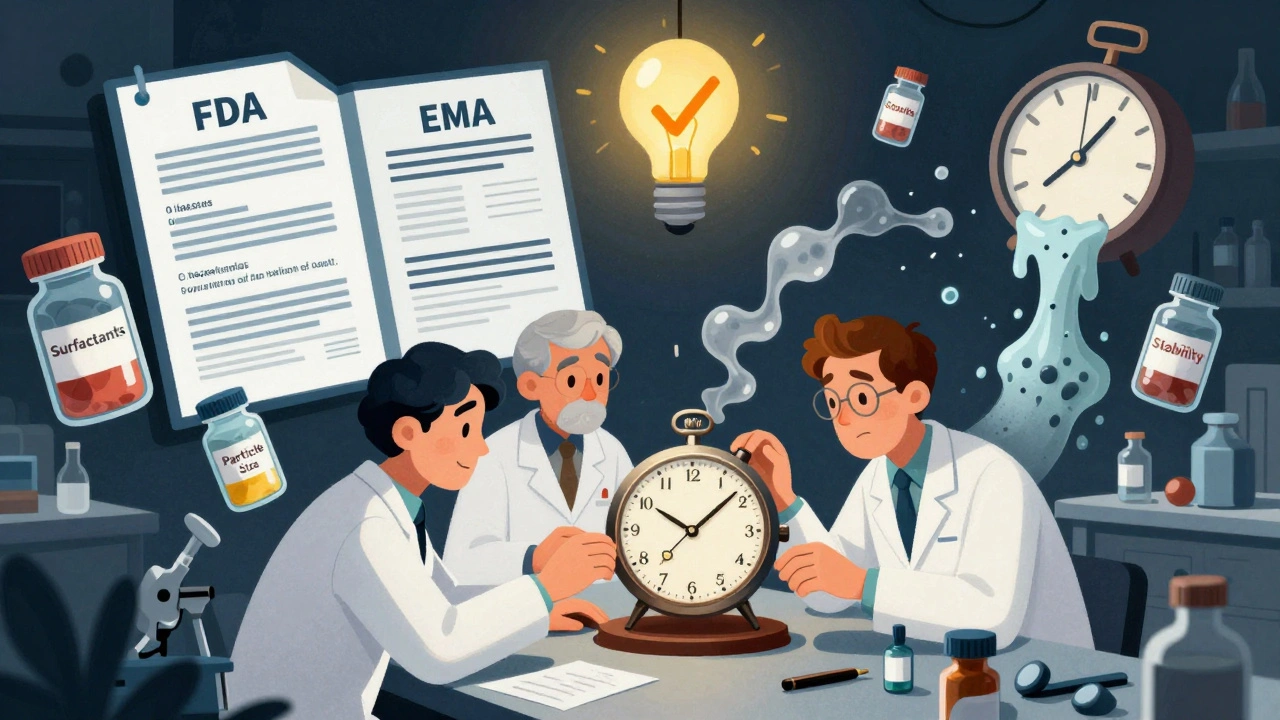
Generic manufacturers don’t get the recipe. They don’t know the exact ratios of ingredients, the mixing speed, the temperature control during production, or how the brand company stabilizes the formulation. They have to reverse-engineer it.It’s like trying to rebuild a watch by only watching it tick. One study compared the process to a chef tasting a dish and guessing the spices-without knowing if the chef used fresh herbs or dried, if the oil was heated before adding, or if the salt was added at the start or end. Small changes in inactive ingredients (like surfactants or stabilizers) can completely alter how the drug behaves. A change in particle size from 5 micrometers to 6 micrometers in an inhaled product can cut lung delivery by half.
And these aren’t just theoretical risks. Manufacturers report that 89% of their biggest challenge is finding the right way to prove bioequivalence. Another 76% say stability testing is a nightmare. Temperature, humidity, even light exposure during shipping can degrade the product-and no one knows exactly how the original brand handles it.

Global Rules Don’t Match
Even if you solve the science in the U.S., you’re not done. The European Medicines Agency (EMA) often requires different tests than the FDA. For a topical product, the FDA might accept in vitro skin penetration data. The EMA might demand clinical trials showing reduced symptoms in patients. That means companies have to run two separate development programs-one for the U.S., one for Europe. That doubles the cost and time.It’s not unusual for a complex generic to take 18 to 24 months longer than a regular one to develop. And failure rates? Over 70% at the bioequivalence stage. That’s why only 10-15% of complex generic applications get approved, compared to over 80% for simple pills.
What’s Being Done About It?
The FDA knows this is a problem. In 2022 and 2023 alone, they published 15 new guidance documents specifically for complex products-covering everything from inhaled corticosteroids to testosterone gels. They’re pushing for Quality by Design (QbD), which means planning for stability and performance from day one, not after the product fails tests.They’re also investing in new tools:
- In vitro lung models that simulate how particles deposit in the airways
- Advanced imaging to track how creams penetrate skin layers
- Physiologically-based pharmacokinetic (PBPK) modeling-computer simulations that predict how a drug behaves in the body based on its physical properties, not just blood levels
One study found PBPK modeling could cut the need for human bioequivalence studies by up to 60% for certain products. That’s huge. It means fewer volunteers, faster approvals, and lower costs.
Companies that talk to the FDA early-through their Complex Generic Drug Product program-have a 35% higher chance of approval. That’s not a coincidence. It’s about alignment. When developers understand what the regulator needs before they start, they avoid costly dead ends.
The Big Picture: Why This Matters
Complex generics aren’t just a technical headache. They’re a public health issue. These drugs treat asthma, eczema, multiple sclerosis, cancer, and chronic pain. Many cost $10,000 to $50,000 a year. A generic version could cut that in half-or more.The U.S. market for these drugs is worth $120 billion. Yet only a tiny fraction of that is covered by generics. That’s not because no one wants to make them. It’s because the science is too hard, the rules are too inconsistent, and the risk is too high.
But things are changing. The industry is investing in better analytical tools. Academic labs are creating standardized testing protocols for liposomes and nanosuspensions. The International Council for Harmonisation (ICH) is working on global standards for impurities in complex formulations, expected to be finalized in late 2024.
By 2028, sales of complex generics are projected to grow from $15 billion to $45 billion. That’s a 24.6% annual growth rate. The demand is there. The patients need it. The question is whether the system can catch up.
What’s Next?
The path forward isn’t about making the rules stricter. It’s about making them smarter. Regulators, manufacturers, and scientists need to agree on what “equivalent” really means for a product that doesn’t enter the bloodstream. That means accepting new methods-like imaging, in vitro models, and computer simulations-as valid proof of performance.It also means funding more research. The FDA’s Complex Generic Drug Products Committee is a start. But without more resources, progress will be slow. And without global alignment, manufacturers will keep paying twice to bring the same drug to market.
For now, the challenge remains: how do you prove two things are the same when you can’t measure the thing that matters most?
The answer isn’t in the blood. It’s in the science.
Comments (14)
ian septian
This is why generics cost so much less but still don’t exist for half the drugs we need.
Simple solution: stop pretending blood tests are the gold standard.
Chris Marel
I’ve seen family members struggle with asthma inhalers that just didn’t work right.
It’s scary to think the generic might be technically ‘equivalent’ but not actually help.
I hope the FDA keeps listening to real patients, not just lab data.
Evelyn Pastrana
So let me get this straight - we’ve got scientists trying to reverse-engineer a drug like it’s a IKEA chair with no instructions… and then they’re told to prove it works by measuring blood sugar?
Oh sweet baby jesus, I’m crying laughing.
Someone get these people a clue and a coffee.
Also, 89% of manufacturers say this is their biggest headache? That’s not a bug, that’s the whole system being on fire.
Nikhil Pattni
Look, I’ve worked in pharma R&D for 18 years and let me tell you, the real issue isn’t the FDA or EMA, it’s the lack of standardized analytical protocols for nanosuspensions and liposomal delivery systems. The problem is that most labs still rely on HPLC for everything, but HPLC can’t resolve particle size distribution or surface charge dynamics in emulsions. You need dynamic light scattering, cryo-TEM, and zeta potential analysis - but those are expensive and not FDA-validated for bioequivalence yet. And don’t even get me started on the fact that 70% of failures happen because of minor excipient changes that alter release kinetics - like switching from polysorbate 80 to poloxamer 188, which changes micelle formation. It’s not rocket science, it’s colloid chemistry. And no one wants to fund the basic research because generics are ‘cheap’ - but cheap doesn’t mean easy. We need more NIH grants for in vitro models, not more regulatory paperwork. Also, PBPK modeling is the future, but only if you have good physicochemical data - which you don’t have because Big Pharma won’t share their formulations. So it’s a catch-22. And yes, I’ve published 12 papers on this. I know what I’m talking about.
Arun Kumar Raut
It’s crazy how we can land rovers on Mars but can’t figure out if a cream works the same way.
Maybe we’re looking at this wrong.
What if we stopped trying to match blood levels and started matching patient outcomes?
Like, if the eczema clears up the same way, does it matter if the blood test says ‘different’?
We’re treating people, not data points.
precious amzy
One must wonder: is the pursuit of bioequivalence, as currently defined, not merely a metaphysical illusion - a Cartesian dualism of substance and effect, where the body is reduced to a vessel of pharmacokinetic metrics, and the soul of therapeutic efficacy is exiled to the realm of anecdote?
Perhaps the very notion of equivalence is a colonial construct - a Western epistemological imposition upon the heterogeneity of human physiology.
And yet, we cling to it - as if the blood, ever faithful, could ever speak the truth of the skin.
William Umstattd
Generic manufacturers are lazy. If they can’t reverse-engineer a damn inhaler after 10 years and $50 million, maybe they shouldn’t be in pharma.
They want taxpayer money and patent extensions but won’t do the hard science?
Pathetic. Stop crying and get to work.
Elliot Barrett
So what you’re saying is… the whole system is broken?
Wow. Groundbreaking.
Can we get a press release on that? Maybe a TED Talk?
Meanwhile, I’m still paying $1,200 for my asthma inhaler.
Thanks for the novel, guys.
Tejas Bubane
89% of manufacturers say proving bioequivalence is hard? Bro. That’s not a problem. That’s a confession.
You’re telling me you can’t figure out how to copy a cream after 15 years of trying?
Maybe you’re not the problem - maybe you’re just bad at your job.
Also, PBPK modeling? That’s not magic. It’s math. Do the math.
Stop whining and get better tools.
Maria Elisha
I just want to know why my generic steroid cream doesn’t work like the brand.
It burns more. Takes longer. Doesn’t help my rash.
But the FDA says it’s ‘bioequivalent’?
So what does that even mean anymore?
Am I the crazy one?
Andrea Beilstein
What if equivalence isn’t about chemistry at all
What if it’s about trust
What if the patient feels it
What if the skin remembers
What if the lungs know
What if the body doesn’t care about AUC
What if the body only cares about relief
What if we stopped measuring and started listening
What if the answer was never in the blood
Sabrina Thurn
There’s a huge gap between regulatory science and clinical reality. For topical products, we need validated in vitro permeation models with human skin equivalents - not just porcine or synthetic membranes. And for inhalers, we need aerodynamic particle size distribution data from cascade impactors linked to lung deposition models. PBPK is promising but only if you have accurate partition coefficients and tissue binding constants - which are rarely available. The real bottleneck isn’t technology - it’s data sharing. If brand companies would release even basic physicochemical parameters under confidentiality agreements, we could build predictive models faster. The FDA’s QbD framework is a step forward, but without mandatory data submission standards, we’re just rearranging deck chairs on the Titanic.
Simran Chettiar
It is a profound truth that the modern pharmaceutical industry has become a temple of reductionism where the essence of healing is reduced to molecular ratios and statistical confidence intervals. The human body, in its infinite complexity, is not a beaker in a lab. To measure equivalence by blood concentration alone is to mistake the shadow for the substance. The skin does not speak in plasma curves. The lung does not whisper in AUC values. And yet, we demand obedience from nature to our instruments. This is not science. This is dogma. And dogma, my friends, is the enemy of progress. We must move beyond the tyranny of the blood test and embrace the wisdom of the body itself. Only then shall true equivalence be found.
Rich Paul
Bro the FDA’s new guidance docs are just marketing fluff.
They say ‘QbD’ and ‘PBPK’ like it’s a magic spell.
Meanwhile, I’ve seen 3 different batches of the same generic inhaler and they all feel different.
One’s too dry, one’s too oily, one just doesn’t spray right.
They’re not even testing the *device* - just the liquid.
And don’t even get me started on how the nebulizer nozzle wears out after 3 months.
Who’s checking that?
NOBODY.
And we wonder why people don’t trust generics.