
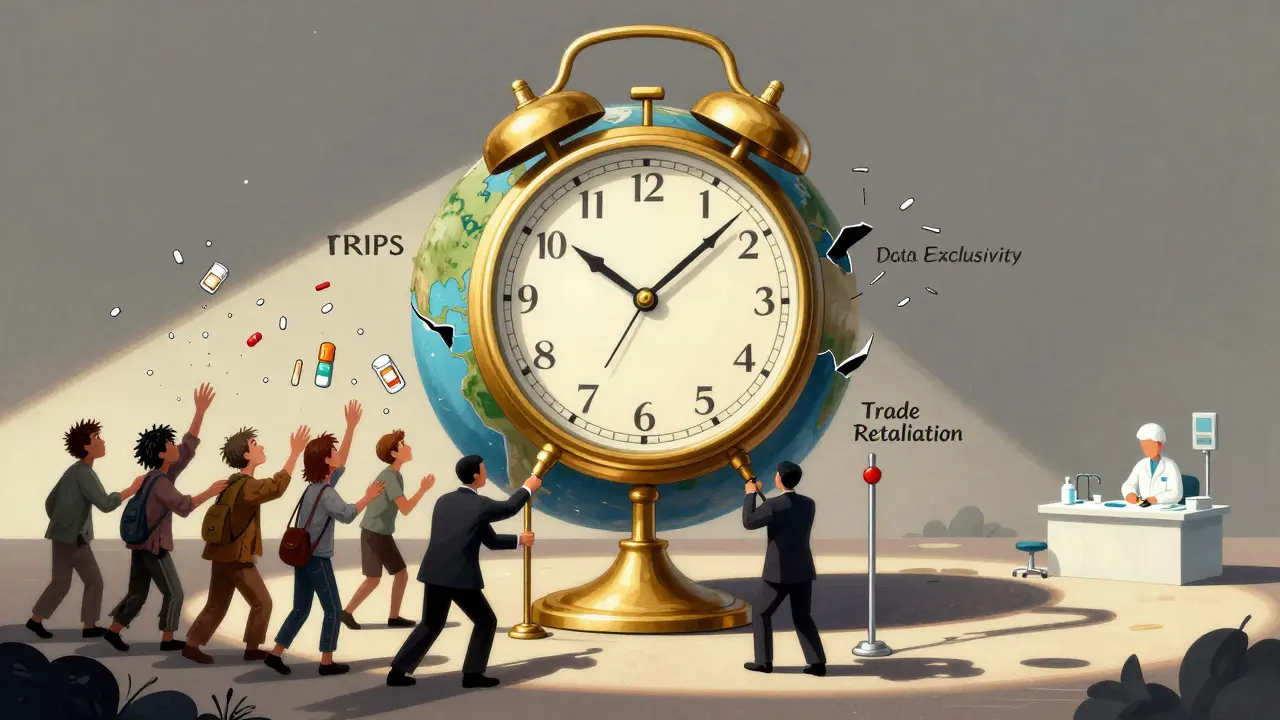
When a life-saving drug costs 100 times more in a poor country than in a rich one, it’s not a market failure-it’s a legal one. The TRIPS agreement is the reason why. Established in 1995 under the World Trade Organization (WTO), this treaty forced every member country to grant 20-year patents on pharmaceuticals. Before TRIPS, countries like India and Brazil made generic versions of HIV drugs for pennies on the dollar. After TRIPS, those factories shut down. Millions died waiting for prices to drop.
What TRIPS Actually Does
The Agreement on Trade-Related Aspects of Intellectual Property Rights, or TRIPS, wasn’t about health. It was about protecting corporate profits. It says every country must treat drug patents the same way: 20 years of exclusivity from the filing date, no exceptions. Even if a country has no drug industry, even if its people can’t afford the medicine, TRIPS still demands patent enforcement. The result? A global system where one company can hold a patent on a drug and charge $1,000 per dose while the same drug, made legally elsewhere, costs $10.
TRIPS doesn’t just cover patents. It also forces countries to restrict how generics are approved. Before TRIPS, regulators could approve a generic drug as soon as it was proven safe and effective. Now, they must wait until the patent expires-even if the patent was filed in a different country. This delay, called "data exclusivity," adds years to the monopoly. In some cases, it’s pushed beyond 20 years through "TRIPS-plus" clauses buried in trade deals with the U.S. or EU.
The Flexibility That Doesn’t Work
TRIPS does have "flexibilities"-legal loopholes meant to help countries in crisis. The most important one is compulsory licensing. It lets a government override a patent and allow a local company to make a generic version, usually to treat a public health emergency. Sounds simple, right? It’s not.
Article 31f of TRIPS says any compulsory license must be used "predominantly for the supply of the domestic market." That’s fine if you have a drug factory. But 48 of the world’s poorest countries have no pharmaceutical production at all. They can’t make the medicine. They can’t even legally import it from another country that made it under license-unless they jump through 78 bureaucratic hoops.
That’s where the 2005 amendment, known as Article 31bis, came in. It was supposed to fix this. It allowed countries without manufacturing capacity to import generics made under license elsewhere. Sounds like a win. Except it’s been used once. In 2008, Rwanda imported HIV drugs from Canada. It took four years. Médecins Sans Frontières helped navigate the paperwork. Apotex, the Canadian company, called the process "unworkable." And they were right.
Why No One Uses the Loopholes
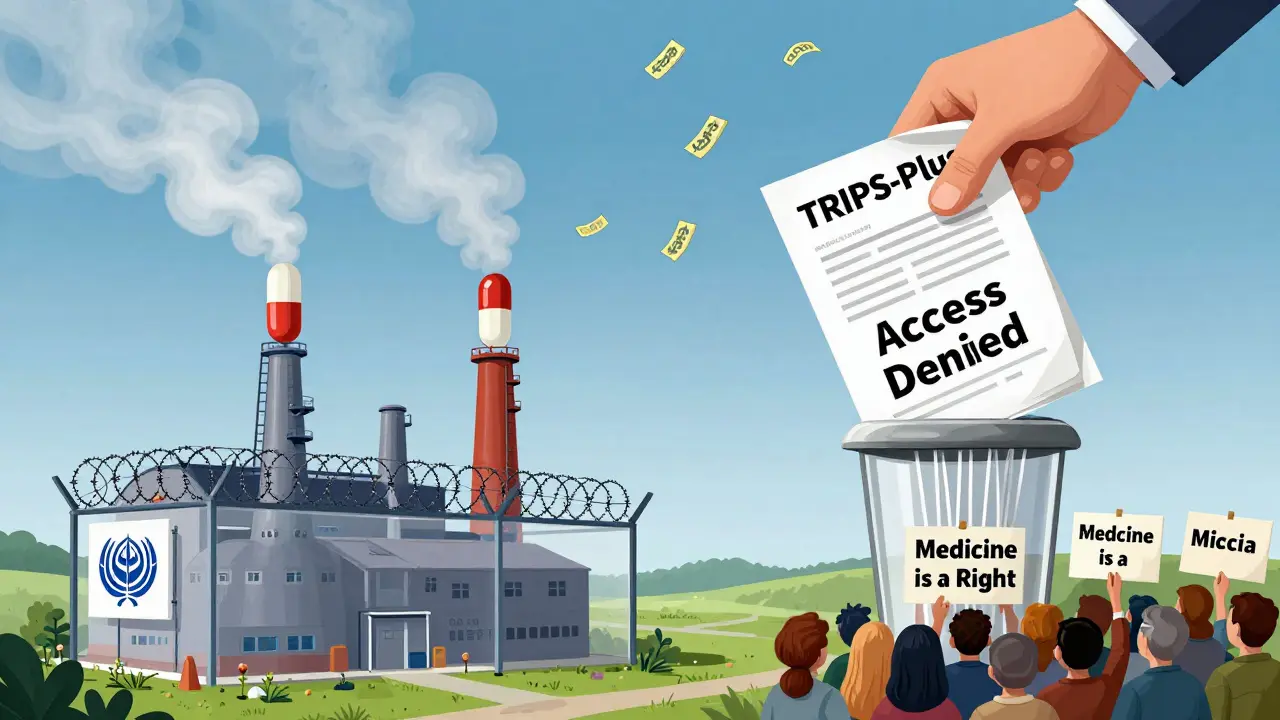
Most countries don’t even try. A 2017 study of 105 low- and middle-income countries found that 83% had never issued a compulsory license. Why? Fear. Pressure. Retaliation.
Thailand tried in 2006. It issued licenses for three key drugs: HIV treatment, heart medication, and cancer therapy. Prices dropped by 30% to 80%. Then the U.S. pulled Thailand’s trade benefits. Export losses? $57 million a year. Brazil did the same with efavirenz in 2007. The U.S. Trade Representative put Brazil on its "Priority Watch List" for two years. South Africa’s 1997 law allowing generics triggered a lawsuit from 39 pharmaceutical companies. The case was dropped only after global protests.
These aren’t isolated incidents. Between 2007 and 2015, the UN recorded 423 threats of trade retaliation against countries considering compulsory licensing. The message is clear: use the law, and you’ll be punished.
The Real Solution Isn’t in the Treaty
Some say the answer is voluntary licensing-like the Medicines Patent Pool (MPP). That’s where drug companies voluntarily let generic makers produce their drugs in poor countries. It’s worked for HIV. The MPP has helped 118 countries get cheaper antiretrovirals. But here’s the catch: it covers only 44 drugs out of thousands. And 73% of those licenses are limited to sub-Saharan Africa, even though the same diseases exist in Asia and Latin America.
Compare that to the pre-TRIPS era. Between 1996 and 2001, Brazil made and exported generic HIV drugs to 127 countries. Treatment cost one-tenth of what it did under patent. Coverage hit 85%. No bureaucracy. No waiting. No threats.
Today, 2 billion people still lack regular access to essential medicines. Eighty percent of that gap is due to patent barriers. Meanwhile, the global pharmaceutical market hit $1.42 trillion in 2022. Patented drugs make up 68% of that revenue, even though they’re prescribed in only 12% of cases. The math doesn’t lie: patents aren’t about innovation-they’re about profit.
What’s Changing Now?
The pandemic forced a reckoning. In October 2020, India and South Africa proposed a TRIPS waiver for COVID-19 vaccines and treatments. After two years of lobbying, the WTO agreed-partially. The waiver covers vaccines only. No diagnostics. No treatments. And it’s temporary. By the time it took effect, most high-income countries had already hoarded doses.
But the real shift is happening outside the WTO. The UN’s 2024 High-Level Meeting on Pandemic Preparedness called for "reform of the TRIPS Agreement." The WHO’s 2023 Digital Health Strategy now mentions TRIPS flexibilities as a tool for enabling local production of digital health tech-not just pills, but diagnostic tools, sensors, and data systems.
And civil society? They’ve built tools. MSF’s Compulsory Licensing Legal Database tracks 62 attempts since 2001. Only 30% succeeded. The rest failed because of legal threats, political pressure, or lack of legal expertise. Most countries don’t have a single full-time staff member assigned to handle patent issues.
The Bottom Line
TRIPS was sold as a global standard for fairness. In reality, it’s a system designed to protect corporate monopolies at the cost of human lives. The flexibilities exist on paper. But in practice, they’re buried under legal complexity, political intimidation, and economic coercion.
The world doesn’t need more loopholes. It needs a new system. One where access to medicine isn’t a privilege granted by patent holders, but a right protected by law. Until then, people will keep dying because a treaty written in 1994 still governs how the world treats disease today.
Can any country issue a compulsory license under TRIPS?
Yes, any WTO member can issue a compulsory license for pharmaceuticals under Article 31 of TRIPS, provided it follows certain conditions: the license must be non-exclusive, limited in scope, and accompanied by adequate compensation to the patent holder. The country must also demonstrate it has tried to negotiate a voluntary license first-unless it’s facing a public health emergency. However, many countries avoid doing this due to fear of trade retaliation or legal challenges from pharmaceutical companies.
Why was the Rwanda-Canada case the only success of Article 31bis?
The Rwanda-Canada case succeeded only because of extraordinary outside support. Médecins Sans Frontières, the UN Development Programme, and Apotex worked together for four years to navigate the complex WTO notification system. The process required detailed documentation from both countries, legal reviews, and approval from the WTO’s TRIPS Council. Most low-income countries lack the legal expertise, staff, or political will to repeat this. The system was designed to be difficult-intentionally-so that few would use it.
Do TRIPS flexibilities apply to vaccines and treatments equally?
Under the original TRIPS agreement, yes-flexibilities apply to all patented medicines, including vaccines, treatments, and diagnostics. But the 2022 WTO waiver for COVID-19 vaccines only covers vaccines. It does not extend to treatments like Paxlovid or diagnostics like rapid tests. This selective approach shows how political pressure shapes what gets included. Many experts argue that excluding treatments from the waiver was a deliberate move to protect pharmaceutical profits.
How do TRIPS-plus provisions affect generic access?
TRIPS-plus provisions are extra patent rules added in bilateral trade deals-often pushed by the U.S. or EU-that go beyond what TRIPS requires. These include extending patent terms beyond 20 years, banning parallel imports, and imposing data exclusivity (blocking generic approval even after patents expire). A 2021 WTO report found 141 of 164 member states have adopted such provisions. In countries like Jordan and Morocco, these rules have delayed generic entry by 5-7 years, costing billions in avoidable healthcare spending.
Is there a legal way for countries to produce generics without violating TRIPS?
Yes, but only under strict conditions. Countries can issue compulsory licenses if they meet TRIPS requirements: they must notify the WTO, pay fair compensation, and limit production to domestic needs unless they use the Article 31bis system. Least-developed countries have until 2033 to enforce pharmaceutical patents, meaning they can legally produce or import generics without permission until then. However, even these legal paths are rarely used due to fear of political backlash, lack of technical capacity, or pressure from pharmaceutical companies.
Comments (16)
Cory L
Let me tell you something - this TRIPS agreement is a masterclass in corporate greed dressed up as law. I mean, we’re talking about people dying because a patent says so? That’s not capitalism, that’s feudalism with lawyers. And don’t even get me started on how Rwanda’s one successful import took FOUR YEARS. Four. Years. Meanwhile, Big Pharma’s CEOs are sipping champagne on yachts. I’m not mad, I’m just disappointed.
And yeah, the Medicines Patent Pool? Cute. Like offering bandaids when someone’s bleeding out. 44 drugs? Out of thousands? That’s not a solution - that’s a PR stunt with a spreadsheet.
Bhaskar Anand
India made generics for the world before TRIPS. We fed Africa. We saved lives. Then came the American pressure. The threats. The sanctions. The lies. They called it free trade. It was economic colonialism. We had the factories. We had the skill. We had the will. And they took it away with ink on paper. No moral high ground. Just profit. And now they pretend to care about global health. Laughable.
Joanna Reyes
I’ve spent the last six months researching this, and honestly - the more I dig, the more disgusted I become. The TRIPS flexibilities aren’t just underused - they’re intentionally designed to be unusable. Article 31f? The domestic market clause? That’s a death sentence for landlocked, low-income countries with zero pharma infrastructure. And then they slap on data exclusivity on top? That’s not a loophole - it’s a trapdoor.
The fact that 83% of low- and middle-income countries have never issued a compulsory license isn’t because they don’t need to - it’s because the system is rigged to punish them. The U.S. doesn’t just lobby - it retaliates. That’s not policy. That’s terrorism with a trade agreement.
Vanessa Drummond
I just cried reading this. I work in public health. I’ve seen kids in rural clinics with empty shelves while the same drug costs $1,200 in the U.S. This isn’t about innovation. It’s about who gets to live and who gets to be collateral. The fact that we call this a ‘global system’ is the most cynical joke ever. And the waiver for vaccines? Too little, too late. They waited until people were dying in droves - then gave us crumbs. I’m so angry I can’t even type properly.
Why are we still pretending this is fair?
Gabrielle Conroy
Okay, real talk - I used to think patents were necessary for innovation. Then I looked at the data. 68% of Big Pharma’s revenue comes from 12% of prescriptions? That’s not innovation - that’s rent-seeking. And the MPP? It’s a Band-Aid on a hemorrhage. They cover HIV drugs because they’re politically safe. But what about insulin? Cancer meds? Antibiotics? No. Because those markets aren’t ‘charity-friendly’.
Also - did you know the U.S. Trade Representative has a whole division just to pressure countries over generics? It’s called the ‘Special 301’ unit. They literally have a spreadsheet of countries they’re threatening. This isn’t policy. It’s organized extortion.
And the worst part? We’re still letting them get away with it. 🤦♀️
Christopher Wiedenhaupt
It's important to note that the TRIPS agreement was negotiated under conditions of extreme asymmetry. Developing nations had little legal expertise, no lobbying power, and were pressured into signing. The U.S. and EU held all the cards. And now, decades later, we're expected to treat this as a neutral global standard? That's like calling a rigged poker game 'fair play'.
Also, the 2005 amendment (31bis) was a PR move. Designed to look helpful while being functionally impossible. The bureaucracy alone - notifications, translations, legal reviews - requires a team of lawyers and bureaucrats. Most countries can't afford one full-time patent officer. That's not an oversight. It's intentional.
John Smith
So let me get this straight - we’re supposed to feel bad because some people can’t afford drugs? Wow. What a tragedy. Next you’ll tell me rich people don’t get cancer. Newsflash: life isn’t fair. Patents incentivize innovation. If you can’t afford medicine, maybe don’t get sick. Or move to a country that doesn’t have patent laws. Oh wait - there aren’t any. Because we made them all sign TRIPS. So... yeah. Maybe stop blaming the system and start blaming biology.
Christopher Brown
TRIPS is a joke. The U.S. doesn’t even follow it. We have 30-year patents on some drugs. We block imports. We sue countries. We call it 'trade policy' - it’s corporate warfare. And now they want us to believe this is about fairness? Please. The only thing TRIPS protects is Wall Street. If you think this system is about health, you’re not paying attention. It’s about control. And control means profit. Always.
Sanjaykumar Rabari
TRIPS was created by the CIA and Pfizer to kill third world medicine. They don't want us to make drugs. They want us to buy them. The vaccine waiver? A trap. They knew we'd waste years on paperwork. And by then, the rich had already hoarded everything. This is genocide with legal paperwork. And the WHO? They're complicit. They took money from Gates and Big Pharma. They know. They just don't care.
Kenzie Goode
I’ve been following this for years. The emotional weight of this isn’t just in the numbers - it’s in the silence. The doctors who can’t prescribe. The parents who watch their kids die because the pharmacy says 'out of stock'. The governments that sign treaties but can’t afford the lawyers to fight them. This isn’t policy failure. It’s moral failure.
I don’t have a solution. But I won’t stop talking about it. Not until every child in every country has access. Not until we stop calling this 'trade' and start calling it what it is - a death sentence written in legalese.
Dominic Punch
Let’s be real - the TRIPS flexibilities exist, but they’re like a fire extinguisher in a burning building that’s locked. You can see it. You know it works. But the key? You don’t have it. And the people who do? They’re too busy counting their profits to hand it over.
And let’s not pretend the MPP is a win. It’s a controlled release - only for diseases that don’t threaten the rich. Insulin? No. Hepatitis C? Only after 15 years of lobbying. This isn’t access - it’s a slow drip of charity designed to make us feel better while the system stays intact.
We need to dismantle, not patch.
Christina VanOsdol
Let’s not romanticize Brazil’s pre-TRIPS era. They were lucky. They had a strong public health infrastructure, a domestic pharma industry, and political will. Most countries? Not even close. And now? They’re stuck. No factories. No lawyers. No funding. And the WTO? It’s a club for rich nations to write rules for poor ones. The 'flexibilities'? Just a mirror. They reflect the world we already live in - unequal, brutal, and designed to protect power.
Also - 2 billion people without access? That’s not a statistic. That’s 2 billion mothers, sons, teachers, artists. And we’re arguing about patent law. We’ve lost the plot.
Brooke Exley
I want to say this gently - but I mean it with everything I have: this isn’t about drugs. It’s about dignity. It’s about a mother in Malawi choosing between feeding her kids and buying her husband’s HIV meds. It’s about a teenager in Peru dying because the patent expired in the U.S. but not in her country. It’s about a nurse in Bangladesh who has to watch a child bleed out because the IV bag costs 80% of her salary.
TRIPS didn’t just change the law - it changed our moral compass. And we’re still walking forward, pretending we don’t see the blood on the floor.
Alfred Noble
So here’s the thing - most people don’t realize that the 'TRIPS waiver' for vaccines was only agreed on after 2 years of global protests. And even then, it was watered down. No diagnostics. No treatments. Just vaccines. And only for a few years. Meanwhile, the same companies that got the waiver? They’re already filing new patents on next-gen shots.
Also - did you know the U.S. government has spent over $10 billion on vaccine contracts that include clauses blocking generic production? Yeah. They’re not just profiting - they’re legally locking it down.
And the worst part? Nobody’s talking about it. 😔
Matthew Brooker
Here’s what nobody says out loud: the pharmaceutical industry doesn’t just lobby - they write the laws. The U.S. Trade Representative’s office has former pharma execs on staff. The WHO gets funding from Pfizer. The WTO? Staffed by lawyers who worked for Big Pharma. This isn’t corruption. It’s a revolving door with a diploma.
We call it 'global health governance'. It’s really just corporate governance with a humanitarian mask. And until we admit that - nothing changes. Not flexibilities. Not waivers. Not petitions. Just more death.
Cory L
One more thing - the Rwanda case took four years because the system was built to fail. Apotex had to submit 147 documents. Rwanda had to get approval from 12 different ministries. The WTO didn’t help - they just watched. And then? They called it a 'success'. Like it’s some kind of trophy. Meanwhile, a kid in Uganda died waiting. That’s not innovation. That’s cruelty with a logo.