
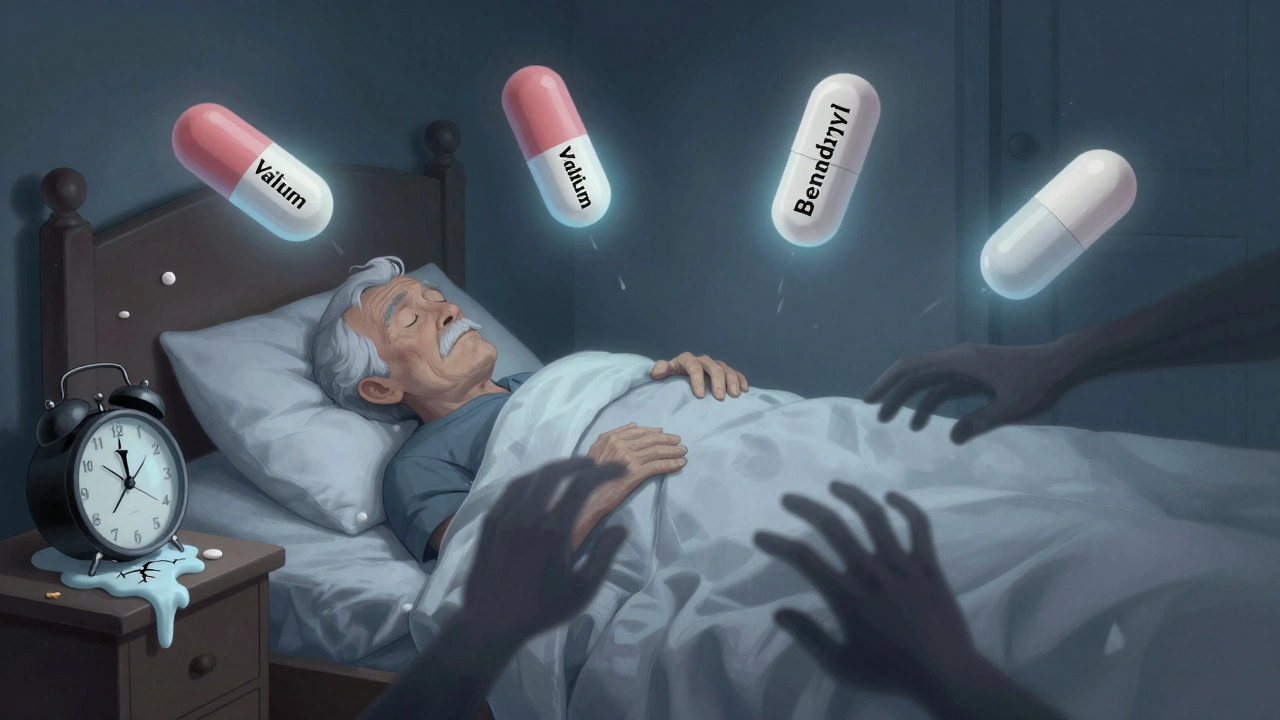
More than half of adults over 65 struggle with sleep. Some take pills to fix it. But those pills can make things worse-increasing the risk of falls, confusion, memory loss, and even dementia. The truth is, most sleep medications aren’t safe for seniors long-term. And yet, millions are still prescribed every year. So what should you do instead?
Why Most Sleep Pills Are Risky for Seniors
It’s not just about drowsiness. Older bodies process drugs differently. Liver and kidney function slow down. Fat increases, muscle decreases. That means medications stick around longer, building up in the system. A drug that’s fine for a 40-year-old can be dangerous for someone 70.
Benzodiazepines like diazepam (Valium) and triazolam (Halcion) are especially risky. They’re linked to a 51% higher chance of developing Alzheimer’s disease when used for more than six months. Even short-acting ones like lorazepam can cause next-day dizziness, leading to falls. One in three seniors who fall break a bone. That’s not just a scare-it’s a life-changing event.
Z-drugs like zolpidem (Ambien) and eszopiclone (Lunesta) were marketed as safer alternatives. But they’re not. A 2017 FDA warning says they still increase fall risk by 30% in people over 65. And they can cause strange behaviors-sleepwalking, driving, or even eating while asleep-with no memory of it the next day.
Even common off-label prescriptions like trazodone and diphenhydramine (Benadryl) aren’t safe. Trazodone can cause low blood pressure and dizziness. Diphenhydramine is an anticholinergic, which means it blocks a brain chemical tied to memory. Long-term use is tied to cognitive decline. The American Geriatrics Society’s Beers Criteria lists 10 sleep medications as potentially inappropriate for seniors. Most of them are still being prescribed.
What Actually Works: CBT-I for Seniors
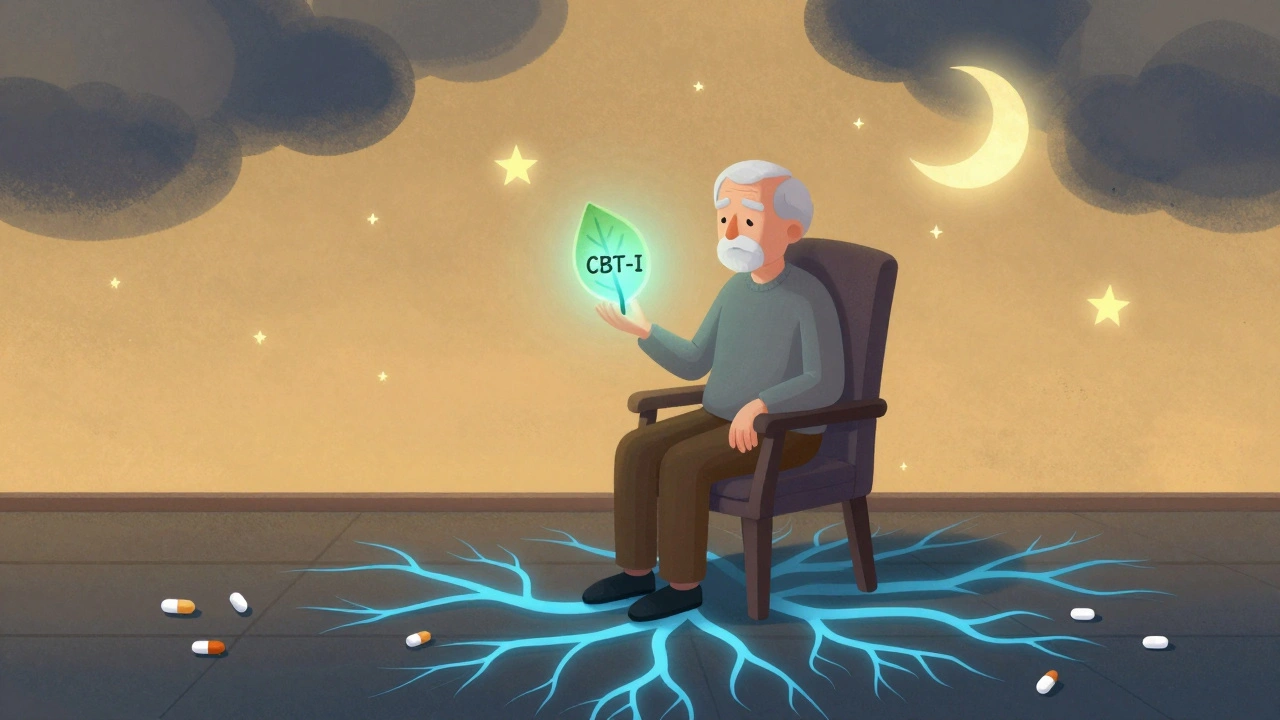
There’s a better way. Cognitive Behavioral Therapy for Insomnia, or CBT-I, is the first-line treatment recommended by the American Academy of Sleep Medicine. It’s not a pill. It’s a structured program that teaches your brain to sleep again.
CBT-I works in six to eight weekly sessions. It doesn’t require special equipment. You don’t need to be tech-savvy. A trained therapist helps you:
- Fix your sleep schedule-going to bed and waking up at the same time every day, even weekends
- Stop lying in bed awake for hours-only go to bed when sleepy, get up if you’re not asleep in 20 minutes
- Challenge thoughts like “I’ll never sleep again” that keep your brain wired
- Reduce caffeine, screen time, and naps that interfere with natural sleep cycles
Studies show CBT-I works better than pills. In one 2019 JAMA study, 57% of seniors over 60 who did telehealth CBT-I no longer met the criteria for insomnia. And 89% stuck with it. That’s higher than adherence to any sleep medication.
And the benefits last. Unlike pills, which stop working after a few weeks, CBT-I gives you tools that keep working. One 69-year-old woman in Melbourne told her therapist: “I used to rely on Lunesta. Now I sleep without anything-and I haven’t woken up confused in months.”
The Safer Medications: When Pills Are Still Needed
Sometimes, CBT-I isn’t enough right away. Or a senior can’t access therapy. In those cases, if medication is absolutely necessary, there are safer options.
Low-dose doxepin (Silenor) at 3-6 mg is one of the best. It’s an old antidepressant, but at this tiny dose, it only helps with staying asleep-not waking you up. It has almost no anticholinergic effects, meaning it doesn’t mess with memory. In studies, it improved total sleep time by nearly 30 minutes with side effects no worse than placebo.
Ramelteon (Rozerem) works differently. It targets melatonin receptors, not GABA. That means no sedation, no risk of dependence, no next-day grogginess. It helps you fall asleep faster-about 14 minutes quicker on average. It’s safe for long-term use and doesn’t cause withdrawal.
Lemborexant (Dayvigo) is newer. It blocks orexin, the brain’s wakefulness signal. A 2021 JAMA study found it caused less postural instability than zolpidem in seniors. That’s huge. Less wobbliness means fewer falls.
Even melatonin can help, but not the high-dose stuff you buy at the pharmacy. Stick to 2-5 mg of extended-release melatonin. It helps reset your internal clock, especially if you’re waking up too early. But it won’t help if you can’t fall asleep.
These are the only options that don’t come with a warning label screaming “danger for elderly.” Everything else-trazodone, benzodiazepines, diphenhydramine, even high-dose melatonin-should be avoided.
Cost, Access, and the Hidden Gap
Here’s the problem: the safest medications are expensive. Low-dose doxepin costs around $400 a month without insurance. Generic zolpidem? $15. It’s no surprise doctors reach for the cheap one.
And CBT-I isn’t always covered. Medicare doesn’t pay for it unless it’s delivered through a specific approved program. Many therapists don’t take Medicare. Telehealth platforms like Sleepio are cheaper and effective-but you need internet access and someone to help you set it up.
There’s also a stark racial disparity. A 2022 UCSF study found white seniors were three times more likely than Black seniors to use sleep meds frequently. Why? Access. Trust. Bias in prescribing. It’s not about need-it’s about who gets help.
Insurance shouldn’t decide who sleeps safely. But right now, it does.
How to Start Making Changes
If you or a loved one is on sleep meds, don’t quit cold turkey. That can cause rebound insomnia or seizures. Instead:
- Ask your doctor to review all medications. Bring a list-prescriptions, supplements, even over-the-counter sleep aids.
- Request a trial of CBT-I. Ask if your Medicare plan covers telehealth sleep therapy. If not, ask for a referral to a sleep specialist.
- If switching meds, ask for low-dose doxepin or ramelteon. Avoid anything with “-zol” or “-azepam” in the name.
- If you’re already on a risky drug, ask for a taper plan. STOPP/START guidelines recommend cutting dose slowly over 4-8 weeks.
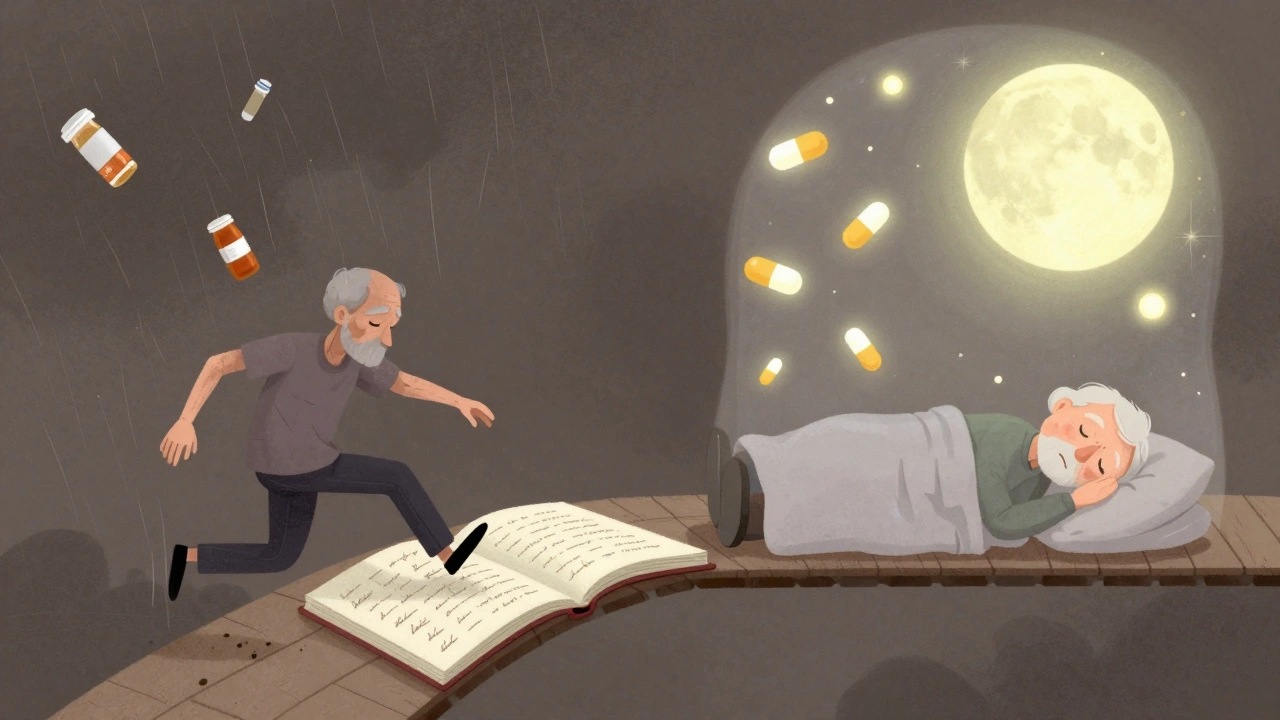
- Track sleep with a simple notebook: bedtime, wake time, how rested you feel. No fancy apps needed.
One man in his 70s, after 15 years on Ambien, switched to CBT-I and low-dose doxepin. He stopped taking pills entirely after three months. “I used to wake up scared I’d fall,” he said. “Now I wake up ready for the day.”
What’s Changing in 2025
The tide is turning. The American Geriatrics Society is updating its Beers Criteria in 2024 to push for stopping benzodiazepines within 12 weeks of starting them. Medicare is expanding telehealth CBT-I coverage. The NIH has invested $15 million into senior sleep safety research.
And digital CBT-I platforms are proving just as effective as in-person therapy. One 2023 study showed 63% of seniors over 65 improved their sleep using an app-based program. No travel. No waitlists. Just a tablet and a few minutes a day.
The future of sleep for seniors isn’t more pills. It’s personalized, behavioral, and safe. The tools are here. The question is: will we use them?
Are sleep medications safe for seniors?
Most are not. Benzodiazepines, Z-drugs like Ambien, and anticholinergics like Benadryl increase the risk of falls, confusion, memory loss, and dementia. The American Geriatrics Society recommends avoiding these as first-line treatments. Safer options exist, but only when used carefully and temporarily.
What’s the best non-medication treatment for senior insomnia?
Cognitive Behavioral Therapy for Insomnia (CBT-I) is the gold standard. It’s proven to work better than pills long-term. It teaches you how to fix your sleep habits, thoughts, and environment. Telehealth CBT-I is just as effective as in-person and is now covered by some Medicare plans.
Can seniors take melatonin safely?
Yes-but only low-dose, extended-release melatonin (2-5 mg). High doses (10 mg or more) can cause dizziness and next-day grogginess. Melatonin helps with falling asleep earlier, not necessarily staying asleep. It’s safest for seniors with circadian rhythm issues, like waking up too early.
What are the safest sleep medications for seniors?
The safest options are low-dose doxepin (3-6 mg), ramelteon (8 mg), and lemborexant (5 mg). These have minimal side effects, no risk of dependence, and don’t impair balance or memory. Avoid anything with “-zol” or “-azepam” in the name.
How do I stop taking sleep meds safely?
Never stop abruptly. Work with your doctor to create a taper plan-usually over 4 to 8 weeks. Reduce the dose by 10-25% every 1-2 weeks. Combine tapering with CBT-I to manage withdrawal symptoms. Keep a sleep diary to track progress and identify triggers.
Why are seniors prescribed risky sleep meds so often?
Because they’re cheap, fast, and familiar. Doctors are pressured to fix problems quickly. CBT-I takes weeks to work. Pills work tonight. Also, many doctors aren’t trained in geriatric sleep care. Insurance coverage for behavioral therapy is limited. And patients often don’t know there’s a better way.
Comments (9)
David Brooks
This is the most important article I've read in years. My mom was on Ambien for 8 years-she started forgetting her own phone number. When we switched her to CBT-I and low-dose doxepin, she started remembering birthdays again. I cried the first time she told me about her dream from last night. That’s not a miracle-that’s medicine that doesn’t destroy your mind.
Helen Maples
The systemic neglect of geriatric sleep care is a national scandal. Insurance companies prioritize cost over cognition. Doctors prescribe benzodiazepines because they’re fast, easy, and reimbursed. Meanwhile, seniors are dying from fractures, delirium, and accelerated dementia-all preventable. The Beers Criteria update is a start, but until Medicare covers CBT-I universally and penalizes inappropriate prescribing, this will keep happening. No more Band-Aids. This is a public health emergency.
Nicholas Heer
They don't want you to know this but the pharma giants are pushing these drugs because they're profit engines. CBT-I? Too cheap. Too human. No patent. The FDA's 'warnings' are just PR spin. They know Z-drugs cause sleep-driving and memory blackouts but keep them on shelves. And don't get me started on how Medicare only covers CBT-I if you're in a 'approved program'-that's a loophole designed to keep seniors dependent. Wake up people. This is control through chemically-induced confusion.
Sangram Lavte
I work with elderly patients in Delhi and see this daily. Families bring their parents to clinics begging for something to make them sleep. Doctors give them diphenhydramine because it's cheap and available. No one mentions CBT-I. No one has the time. But when we explain it-slowly, with drawings, with family help-they try it. And it works. Not because it's magic. Because it's honest. Sleep isn't a problem to be pill-punched. It's a rhythm to be restored.
Oliver Damon
There’s a deeper philosophical layer here: we’ve outsourced our biology to chemistry. We treat sleep like a broken machine that needs a part replacement, not a natural process that’s been disrupted by modern life-light, stress, isolation, poor routines. CBT-I doesn’t just fix insomnia; it re-anchors the self to the circadian rhythm. It’s not therapy-it’s reclamation. And the fact that we need a medical article to tell us this says more about our culture than our medicine.
Stacy here
They say 'sleep is the best medicine'-but they're lying. The real medicine is control. The pharmaceutical industry doesn't want you to sleep naturally. They want you to need their pills. And they've got the FDA, the doctors, and Medicare wrapped in their profit nets. Look at the numbers: 51% higher Alzheimer’s risk? That's not a side effect-that's a feature. They profit from your decline. And the worst part? You don't even know you're being poisoned until it's too late. Wake up. Before it's too late.
Kyle Oksten
Stacy here’s got a point about the industry, but let’s not turn this into a witch hunt. The real issue is access, not malice. Most doctors aren’t evil-they’re overwhelmed, underpaid, and undertrained in geriatrics. The solution isn’t outrage-it’s systemic reform: mandatory geriatric sleep modules in med school, full Medicare coverage for CBT-I, and subsidies for low-dose doxepin. We can fix this without conspiracies. Just with policy.
Ernie Blevins
So what? People take pills. They fall. They die. Big deal. My uncle took Lunesta for 10 years and still beat cancer. You think he’d trade that for some sleep diary? Nah. You’re all just overthinking. Let people choose. If they wanna sleepwalk and forget their grandkids’ names, that’s their business.
Jennifer Anderson
My grandma switched from trazodone to CBT-I and now she’s reading books again. She used to sit in the dark just staring at the wall. Now she talks about her dreams. I didn’t know sleep could be this… human. You don’t need a fancy app. Just a notebook, a quiet room, and someone who cares enough to sit with you while you learn how to rest again.