
When you take a pill for high blood pressure or diabetes, you expect every tablet to be exactly the same. That’s because small-molecule drugs are made in a lab using chemical reactions - like baking a cake from a recipe. Mix the same ingredients in the same way, and you get the same result every time. But what if your medicine isn’t a pill? What if it’s a complex protein made inside living cells? That’s where things get messy - and why lot-to-lot variability isn’t a flaw. It’s normal.
What exactly is lot-to-lot variability?
Lot-to-lot variability means that no two batches - or lots - of a biologic drug are ever 100% identical. Even when made by the same company, using the same equipment and process, each batch contains millions of slightly different versions of the same protein. Think of it like fingerprints: all human fingerprints are unique, but they still belong to the same person. The same goes for biologics. These tiny differences show up in things like sugar attachments (glycosylation), extra amino acids, or small structural twists in the protein chain.
The U.S. Food and Drug Administration (FDA) calls this inherent variation. It’s not a mistake. It’s built into the biology. Biologics are made using living cells - often Chinese hamster ovary cells or yeast - that act like tiny factories. These cells don’t follow a rigid blueprint. They respond to tiny changes in temperature, nutrient levels, or pH. Even a 0.5°C shift can change how the protein folds or what sugars get attached. That’s why a lot made in January might have a slightly different sugar pattern than one made in June. But here’s the key: both are still safe and effective.
Why does this matter for biosimilars?
Biosimilars are not generics. That’s not marketing jargon - it’s science. Generics are exact copies of small-molecule drugs. If you take a generic version of metformin, you’re getting the same molecule as the brand name. No variation. No surprises.
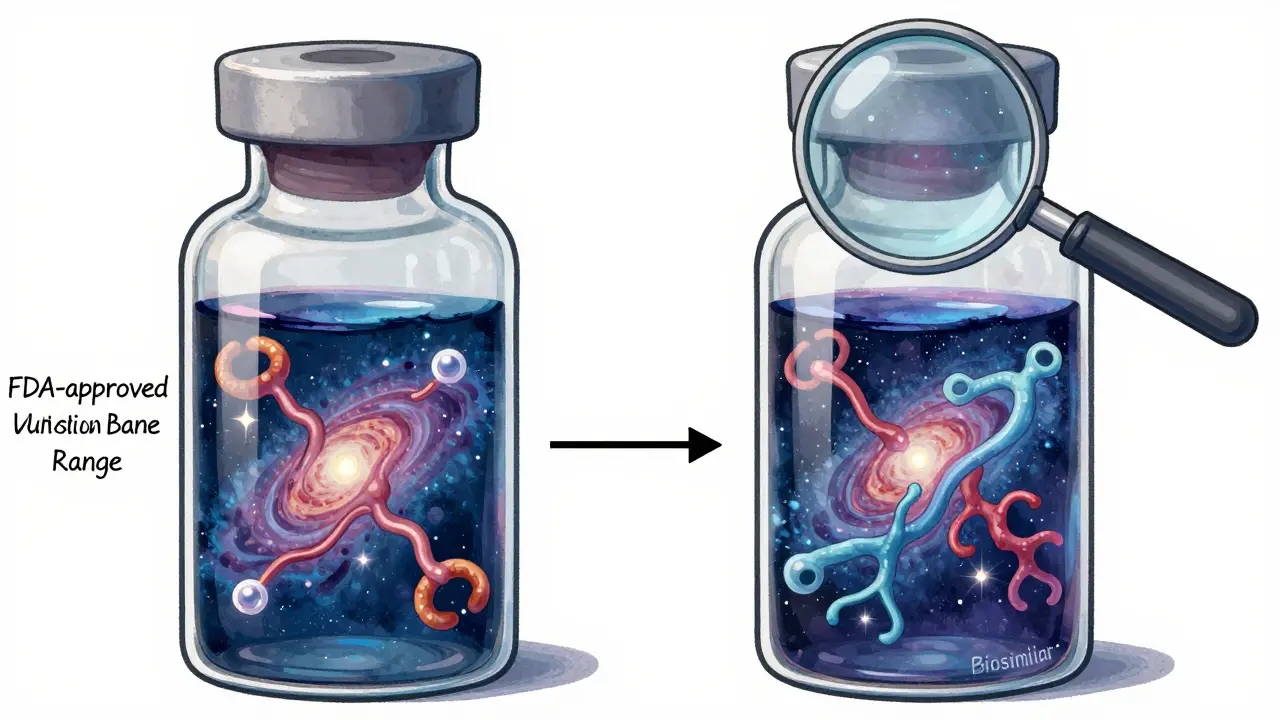
Biosimilars are different. They’re highly similar to their reference biologic - the original, expensive drug - but they’re not identical. A biosimilar must match the reference product in structure, function, and clinical performance. But because the reference product itself has lot-to-lot variability, the biosimilar doesn’t have to match one single batch. It has to match the range of variation seen across many lots of the original.
The FDA requires biosimilar makers to show this through hundreds of analytical tests. They look at things like molecular weight, charge, shape, and how the protein binds to its target. They compare the biosimilar’s lot-to-lot variation to the reference product’s. If the biosimilar’s variation falls within the same range, it’s approved. No clinical trial needed - unless the drug is meant to be interchangeable.
Interchangeable biosimilars: A higher bar
Not all biosimilars can be swapped at the pharmacy like a generic. Only those with the interchangeable designation can be substituted without a doctor’s permission. To earn that label, a manufacturer must prove more than similarity. They must prove that switching back and forth between the reference product and the biosimilar doesn’t change safety or effectiveness.
This means running a clinical study where patients alternate between the two drugs multiple times - sometimes over months. One study might have patients on the reference product for 12 weeks, then switch to the biosimilar for 12 weeks, then switch back. If blood markers, side effects, and disease activity stay stable throughout, the FDA approves interchangeability.
As of May 2024, 12 biosimilars in the U.S. have this designation. Most are for autoimmune diseases like rheumatoid arthritis or inflammatory bowel disease. These are conditions where patients stay on the same drug for years. Switching isn’t just about cost - it’s about trust. Patients need to know that a change in the vial doesn’t mean a change in their health.
How labs handle variability in testing
Lot-to-lot variability doesn’t just affect drugs. It affects the tests we use to monitor them. If your doctor checks your HbA1c to track diabetes, they’re relying on a lab test that uses a reagent - a chemical mixture that reacts with your blood. And that reagent? It comes in lots.
A 2022 survey found that 78% of lab directors consider reagent lot changes a major challenge. Why? Because a new lot might give slightly different results, even if the patient’s condition hasn’t changed. One lab reported that switching reagent lots caused an average 0.5% increase in HbA1c readings. That might sound small. But in diabetes, a 0.5% shift could mean the difference between a patient being told their control is good - or needing a medication change.
Labs fight this with strict verification. When a new reagent lot arrives, they test it on 20 or more patient samples - not just quality control samples. Why? Because QC samples don’t always behave like real patient blood. The only way to know if the new lot changes patient results is to test actual patient samples. They also use moving averages - tracking the average result for a specific test over time. If the average suddenly shifts, they investigate. It’s not perfect, but it’s the best system we have.
Why variability isn’t a weakness - it’s a feature
Some people hear “variability” and think “unreliable.” But in biologics, variability is what makes these drugs possible. Small-molecule drugs can’t treat complex diseases like cancer or autoimmune disorders because they’re too simple. Biologics, with their intricate shapes and multiple modifications, can target specific cells, block immune signals, or deliver toxins directly to tumors. That complexity requires variability. Without it, we wouldn’t have drugs like adalimumab (Humira), rituximab (Rituxan), or trastuzumab (Herceptin).
The real challenge isn’t the variation itself. It’s controlling it. Manufacturers must build quality into every step - from the cell line used to the storage conditions. The FDA reviews these control strategies in detail. They look at how the company monitors temperature, how they clean equipment, how they test each lot. If the variation is too wide, the drug doesn’t get approved. If it’s within the expected range, it’s approved - even if it’s not identical to the last batch.
What’s changing in 2026?
Technology is catching up. Advanced mass spectrometry now lets scientists detect differences in proteins that were invisible 10 years ago. High-throughput analytics can test hundreds of samples in a single day. This means manufacturers can better understand and control their processes. By 2026, experts predict that 70% of new biosimilar applications will include data on interchangeability - up from 45% in 2023.
The market is growing fast. The global biosimilars market hit $10.6 billion in 2023 and is expected to hit $35.8 billion by 2028. In the U.S., biosimilars now make up 32% of all biologic prescriptions by volume. More patients are getting access to lower-cost treatments for conditions that once cost tens of thousands a year.
But the biggest change? Mindset. Doctors, pharmacists, and patients are starting to understand that a biologic isn’t supposed to be identical. It’s supposed to be similar - and consistently effective. The goal isn’t to eliminate variation. It’s to understand it, measure it, and ensure it never affects patient outcomes.
What this means for patients
If you’re taking a biologic - whether it’s the original or a biosimilar - you don’t need to worry about which lot you get. The system is built to handle variation. Every batch, whether it’s the brand name or a biosimilar, goes through strict testing. If a lot doesn’t meet the standard, it’s thrown out.
For interchangeable biosimilars, switching is safe. Studies show no increase in side effects or loss of effectiveness when patients switch. In fact, many patients report fewer side effects after switching to a biosimilar - not because the drug is different, but because they’re less stressed about cost.
The bottom line: lot-to-lot variability isn’t a bug. It’s part of the biology. And the system - from manufacturers to labs to regulators - is designed to make sure that variability never becomes a risk.
Are biosimilars the same as generics?
No. Generics are exact chemical copies of small-molecule drugs. Biosimilars are highly similar - but not identical - copies of complex biologic drugs made from living cells. Because biologics have natural variation between batches, biosimilars don’t need to be exact copies. They just need to perform the same way in the body.
Can lot-to-lot variability affect my treatment?
No, not if the drug is FDA-approved. Every lot of a biologic or biosimilar is tested to ensure it falls within a safe and effective range of variation. Even if two batches have slightly different sugar attachments or protein shapes, they’re both designed to work the same way in your body. The FDA requires manufacturers to prove this before approval.
Why do some biosimilars have the "interchangeable" label?
Interchangeable biosimilars have passed an extra step: they’ve been tested in clinical studies where patients switched back and forth between the biosimilar and the original drug. These studies showed no increase in side effects or loss of effectiveness. That means pharmacists can substitute them without a doctor’s approval - just like generics.
Do labs have trouble with reagent lot changes?
Yes. Lab tests rely on reagents that also have lot-to-lot variation. A new lot can sometimes give slightly different results, which is why labs test 20+ patient samples when switching reagents. They also track long-term trends using moving averages to catch unexpected shifts. This is especially important for tests like HbA1c, where even a 0.5% change could affect treatment decisions.
Is lot-to-lot variability getting better?
Yes. New technologies like advanced mass spectrometry and AI-driven analytics now let manufacturers see and control variations that were invisible before. By 2026, most new biosimilar applications will include data on interchangeability. The industry is moving toward even more precise control - not to eliminate variation, but to understand it well enough to ensure every patient gets consistent care.
Comments (14)
Zacharia Reda
So let me get this straight - we’re okay with a drug that’s never the same twice, as long as it’s *consistently* not the same? That’s not science. That’s improv theater with a FDA stamp. I’ll take my generic metformin any day. At least I know what I’m getting. This biologic lottery is giving me anxiety just thinking about it.
Jeff Card
I’ve been on Humira for six years. I switched to a biosimilar last year. My doctor said the batches vary - but so does my coffee. One day it’s strong, next day it’s weak. Doesn’t mean it’s not coffee. Same here. My joints still don’t scream at 3 a.m. So I’m not sweating the sugar attachments.
Matt Alexander
Think of it like bread. No two loaves are exactly alike. Same oven, same recipe. But one rises a bit more, another’s crust is thicker. Still good. Still edible. Biologics are like that. The body doesn’t care about a 0.3% difference in sugar bits. It cares if it works. And they do.
Gretchen Rivas
I work in a lab. We test reagent lots every time we get a new batch. We run 20+ patient samples. It’s tedious. But it’s how we catch shifts before they mess up someone’s HbA1c. It’s not perfect - but it’s the best we’ve got.
Stephen Vassilev
Let’s not ignore the elephant in the room: if these drugs are so variable, why are we injecting them into people at all? Who’s auditing the cell cultures? What if the hamster ovary cells mutate? What if the pH drifts during shipping? The FDA says it’s 'inherent variation' - but that sounds like corporate speak for 'we don’t know why it works, but it kinda does.'
Tobias Mösl
THIS IS A SCAM. They’re not testing for consistency - they’re testing for ‘close enough.’ The FDA doesn’t have the resources to track every single lot. And guess who pays the price? YOU. Your insurance company? They’re laughing. You? You’re the guinea pig in a billion-dollar game of Russian roulette with your immune system.
tatiana verdesoto
I love how this post just says 'it's normal' like it's a weather pattern. But for people who’ve been on these drugs for years? It’s not just science - it’s peace of mind. I’ve switched biosimilars twice. No issues. Just less debt. That’s worth more than perfect consistency.
Ethan Zeeb
You think this is bad? Wait till you hear what happens when the Chinese hamster cells get contaminated with a rogue virus. Or when the bioreactor overheats and the protein folds wrong. The FDA doesn’t even know what half these molecules do. They just approve them because 'they work.' And you’re okay with that? You’re okay with being a data point in a corporate spreadsheet?
Darren Torpey
This isn’t about being identical - it’s about being *reliable*. Like a jazz solo. Every performance is different. But if the musician knows their scales, the audience still dances. Same here. The biologic’s got rhythm. It’s not a robot. It’s alive. And that’s beautiful. We don’t need clones - we need consistent magic.
Lebogang kekana
In my country, we don’t have access to these fancy biosimilars. We get generics or nothing. But I read this and I’m proud of how far we’ve come. This isn’t about perfection. It’s about access. A life saved because someone could afford the drug? That’s the real win. Stop overthinking the sugar bits. People are alive because of this.
Jessica Chaloux
I cried when I found out my biosimilar was cheaper. Not because I was sad - because I finally didn’t have to choose between rent and my medicine. The lot? I don’t care. My body knows what it needs. And it’s been telling me it’s fine. 💛
Mariah Carle
Variability is the universe’s way of saying: 'You think you’re in control? Ha. Life doesn’t do perfect copies.' We build drugs from living cells - cells that breathe, adapt, and respond. To demand sameness is to demand the impossible. The real revolution? Accepting that difference doesn’t mean danger. It means life.
Justin Rodriguez
I’ve reviewed biosimilar data for 12 years. The analytical methods today are insane. We’re detecting differences at the atomic level now. But here’s the kicker - those differences don’t correlate with clinical outcomes. The body doesn’t care about a 0.2% shift in glycosylation. It cares if the protein binds. And it does. Every time.
Raman Kapri
This entire argument is a fallacy. You claim variability is 'normal' because it's 'inherent.' But if it were truly inherent, why does the FDA require manufacturers to control it? If it's unavoidable, why are we spending billions on mass spectrometry? The truth: they’re hiding the fact that they can’t replicate consistency. This isn't biology. It's incompetence disguised as innovation.