
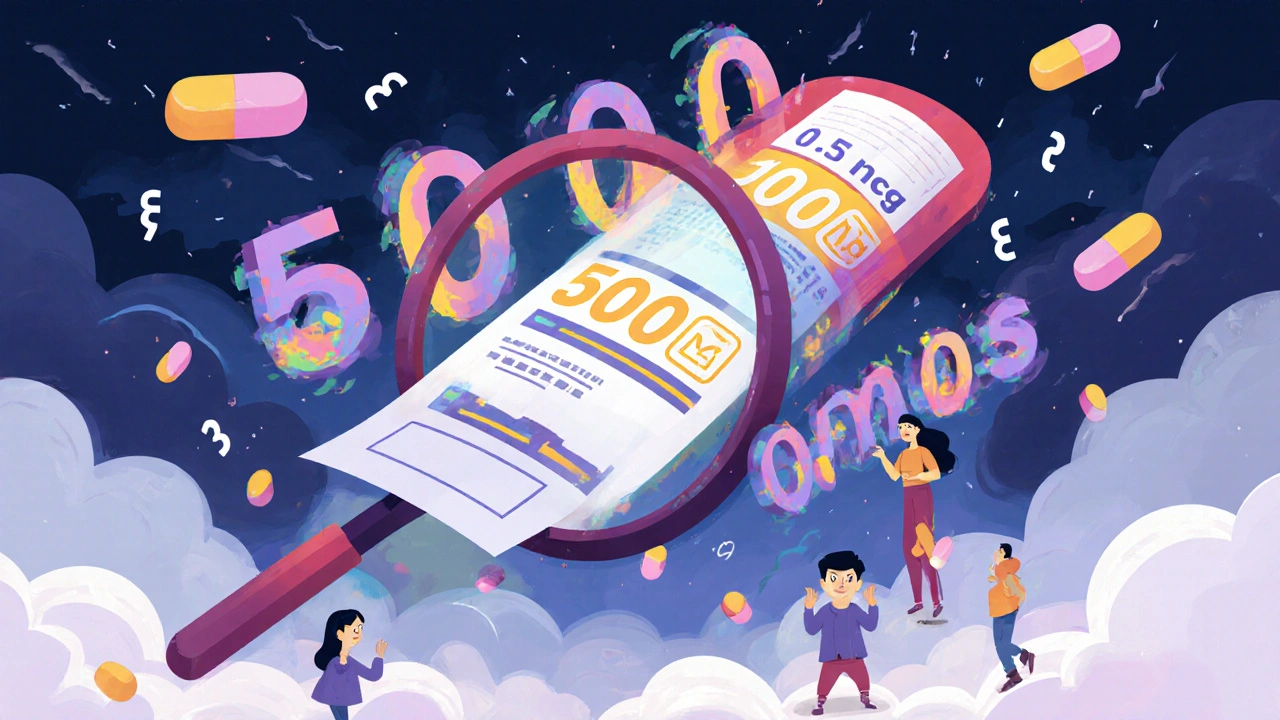
Every time you pick up a prescription, you’re holding your safety in your hands. The tiny print on that label isn’t just paperwork-it’s the last line of defense against a dangerous mistake. A single misread number can mean taking 10 times too much-or too little-of a life-saving drug. You don’t need to be a pharmacist to catch errors. You just need to know what to look for.
Where to Find Medication Strength on the Label
Strength tells you how much active drug is in each dose. It’s usually right next to the medication name, sometimes in parentheses or on the line below. Look for numbers followed by units like mg (milligrams), mcg (micrograms), or iu (international units). For example: AMOXICILLIN 500 MG means each pill contains 500 milligrams of amoxicillin.
Liquid medications show strength as a ratio: 250 MG/5 ML. That means every 5 milliliters of liquid contains 250 milligrams of the drug. If your doctor prescribed 10 mL, you’d be getting 500 mg total. Never assume-always check the ratio. A mistake here can be deadly, especially with children or elderly patients.
Topical creams and ointments use percentages: HYDROCORTISONE 1%. That means 1 gram of cream contains 10 milligrams of hydrocortisone. If you’re applying it to a large area, knowing the concentration helps avoid overuse.
Pharmacies like CVS and Walgreens place strength information slightly differently, but it’s always close to the drug name. If you can’t find it, ask the pharmacist. Don’t guess.
Understanding the Quantity: Total vs. Per-Dose
Quantity is the total amount dispensed. It’s not the same as how much you take each time. A label might say 30 TABLETS or 120 ML. That’s the full bottle or pack you got from the pharmacy.
But your daily dose? That’s separate. If your prescription says Take 1 tablet twice daily, and you have 30 tablets, that’s a 15-day supply. If you only take one a day, it lasts 30 days. Confusing total quantity with daily dose is one of the most common errors-and it leads to running out too soon or hoarding pills.
For liquids, the quantity is the total volume: 120 mL. But you still need to know the strength per dose. If the label says 5 MG/5 ML and you’re supposed to take 10 mL, you’re getting 10 mg-not 5 mg. Always multiply the dose by the concentration.
Why Units Matter: mg vs. mcg Can Kill
A tiny mistake with units can have huge consequences. One of the deadliest errors is mixing up mg and mcg. One milligram equals 1,000 micrograms. If you think you’re taking 0.5 mg but the label says 0.5 mcg, you’re getting 1,000 times less than intended. That could make a blood pressure med useless.
Or worse-accidentally taking 5 mg instead of 0.5 mg. That’s 10 times too much. The FDA reports that decimal point errors like this cause nearly 19% of fatal pediatric dosing mistakes. Always read the numbers slowly. Use a magnifying glass or your phone’s camera zoom if the print is too small.
Watch out for abbreviations. Never trust U for units-it looks like a zero. Always look for unit spelled out. Same with q.d. (daily)-it’s been banned on prescriptions because people misread it as q.i.d. (four times daily). Modern labels avoid these entirely.
Check Against Your Prescription and Pill Appearance
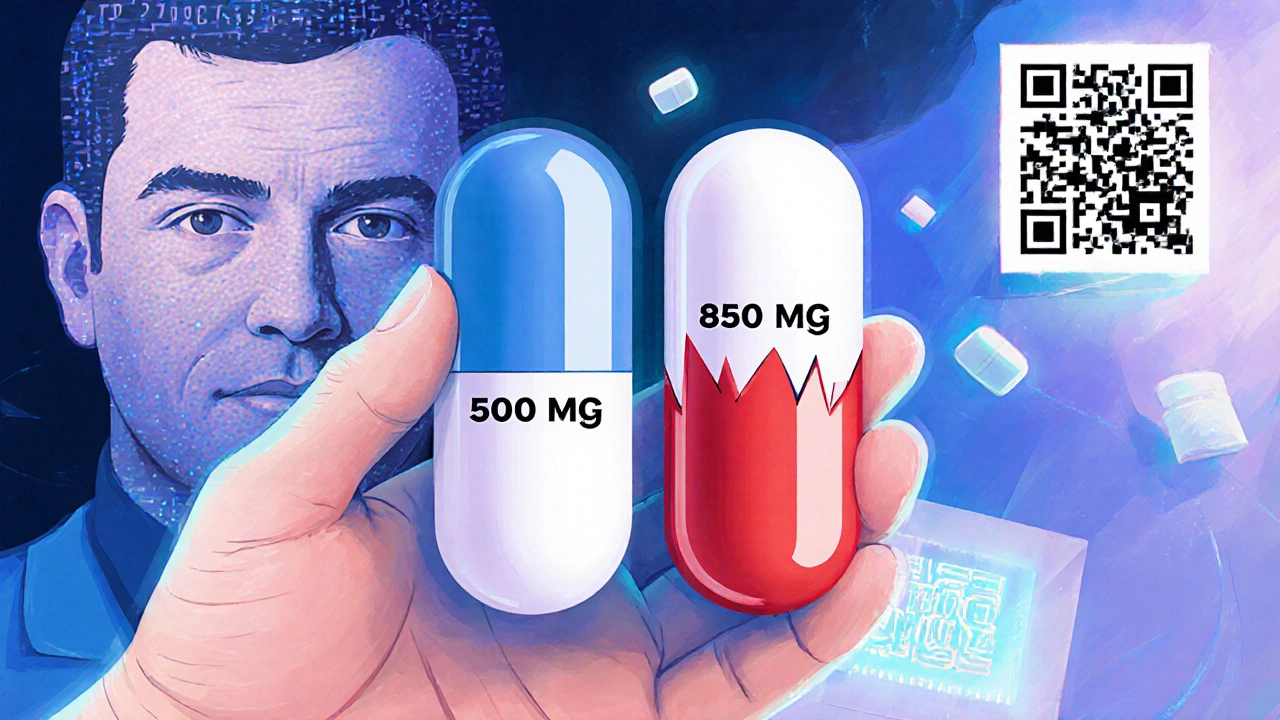
Your doctor’s written prescription should match the label. If your script says Metformin 500 mg but the bottle says 850 mg, something’s wrong. Don’t assume the pharmacy made a typo-they might have filled the wrong drug.
Also, look at the pills themselves. Most tablets have imprints: letters or numbers stamped on them. A 500 mg metformin tablet might have 500 or M500 on it. A 850 mg tablet will have a different imprint. If the shape, color, or imprint doesn’t match what you’ve taken before-or what your doctor described-ask.
Many people don’t realize that generic drugs look different from brand names. Your metformin might change from white oval to blue round between refills. That’s normal. But if the strength changes without your knowledge, it’s not.
Use Tools to Double-Check
Most major pharmacies now offer apps that scan your prescription barcode. Scan it, and the app shows you the exact strength, quantity, and dosing instructions. It even compares it to your doctor’s original order. Walgreens, CVS, and Kaiser Permanente all have this feature.
QR codes on labels link to FDA-approved medication guides. These guides explain what the drug does, how to take it, and what side effects to watch for. If you’re unsure, scan it. No smartphone? Ask the pharmacist to print a copy.
For seniors or those with low vision, most chain pharmacies offer large-print labels for free. Some even offer audio labels you can listen to with a phone. Don’t be shy to ask. Your safety matters more than pride.
Common Mistakes and How to Avoid Them
Here are the top three errors people make-and how to stop them:
- Misreading decimals: 0.25 mg looks like 25 mg if you rush. Slow down. Read it out loud: “zero point two five milligrams.”
- Confusing total quantity with daily dose: “I have 60 pills, so I can take two a day for 30 days.” But what if you’re only supposed to take one? Always check the instructions.
- Not checking liquids properly: “It says 5 mg per 5 mL, so I’ll take one teaspoon.” But a teaspoon isn’t always 5 mL-it can be 4 or 6. Use the measuring cup that came with the medicine. Never use kitchen spoons.
Studies show patients who check their labels before taking meds prevent 28% of potential dosing errors. That’s not luck. That’s awareness.
What to Do If Something Looks Wrong
If the strength or quantity doesn’t match what your doctor prescribed, don’t take it. Don’t wait. Don’t assume it’s “probably fine.”
Call the pharmacy immediately. Have your prescription number (Rx#) ready. Ask: “Can you confirm the strength and quantity on this bottle matches the prescription from Dr. Smith?”
If they dismiss you, ask to speak to the pharmacist on duty. Pharmacists are trained to catch these errors. If they still won’t fix it, call your doctor. Better to be safe than sorry.
One Reddit user caught her son’s amoxicillin dose doubled because the pharmacy filled 500 mg/5 mL instead of 250 mg/5 mL. She didn’t give it to him. She called. He didn’t get sick. That’s the power of checking.
Final Reminder: You Are the Last Line of Defense
Pharmacists are trained, but they’re human. They refill hundreds of prescriptions a day. Machines can misread. Labels can print wrong. Electronic systems can glitch.
But you? You’re the one who sees the pill before you swallow it. You’re the one who notices the bottle feels lighter. You’re the one who remembers your doctor said “one a day,” not “two.”
Take 30 seconds. Read the label. Compare it to your prescription. Trust your gut. If it doesn’t feel right, it probably isn’t.
Medication errors kill 7,000 to 9,000 people in the U.S. every year. Most of them are preventable. You don’t need a medical degree to save your own life. You just need to look.
What if the strength on my prescription label is written in a language I don’t understand?
All prescription labels in the U.S. must use English. If you see foreign text, it’s likely a brand name or extra note. The strength and quantity are always in English. If you’re unsure, ask the pharmacist to explain it in plain terms. Most pharmacies offer free translation services for non-English speakers.
Can I trust generic medications if they look different from the brand?
Yes-generic drugs contain the same active ingredient, strength, and dosage form as the brand name. The difference is in color, shape, or imprint, which are not regulated. Always check the strength (e.g., 500 mg) and quantity. If those match your prescription, it’s safe. If you’re unsure, ask the pharmacist to confirm the generic name matches the brand you were prescribed.
Why does my label say “as directed” instead of a specific dose?
This usually means your doctor gave the pharmacy a flexible dosing plan, often for pain, anxiety, or seizure medications. The label should still show the strength. You need to follow your doctor’s written instructions or call them for clarification. Never guess a dose-even if the label says “as directed.”
What should I do if I accidentally took the wrong strength?
Call your pharmacist or doctor immediately. If you took a higher-than-intended dose, especially of blood thinners, insulin, or heart meds, go to the nearest emergency room. Keep the bottle and label with you. Even if you feel fine, some errors take hours to show symptoms. Don’t wait.
Are there apps that can scan my prescription and tell me if the strength is right?
Yes. Apps like CVS Pharmacy, Walgreens, and MyTherapy can scan your prescription barcode and compare the label info to your doctor’s original order. Some even alert you if the dose doesn’t match your profile. These tools are free and available at most major pharmacies. Use them every time you refill.
Comments (14)
Ifeoma Ezeokoli
OMG I just realized I’ve been guessing my insulin dose for months because the label looked like ‘5 U’ and I thought it meant ‘5 units’… but what if it was ‘50’? 😳 I’m calling my pharmacy tomorrow. This post saved my life.
Daniel Rod
It’s wild how we hand over our health to strangers-pharmacists, algorithms, machines-and then just swallow whatever they give us. But you’re right: the last line of defense is always you. Not the system. Not the app. You. That’s the quiet revolution in healthcare right there.
gina rodriguez
This is such a helpful breakdown! I always check my labels now, especially after my mom had that mix-up with her blood pressure med. Just taking 30 seconds to read the strength and compare it to the script? So simple. So powerful. 🙏
Sue Barnes
Why are people still confused about this? It’s not rocket science. If you can’t read a label, don’t take the pill. Period. Stop being lazy and ask. Your life isn’t a gamble.
jobin joshua
Bro I just scanned my prescription with Walgreens app and it flagged that my amoxicillin was 500mg instead of 250mg 😱 I called and they fixed it. Tech saved me. 🙌
Sachin Agnihotri
Guys, I’ve been a pharmacist for 17 years, and I’ve seen it all-wrong strengths, wrong bottles, wrong labels. I’ve even seen pills with ‘0.5 mg’ printed as ‘0.5mg’ with no space, and someone took it as 5 mg. That’s how you die. Always. Always. Always. Check. It. Twice.
Diana Askew
They’re hiding the truth. The government lets pharmacies print labels wrong so they can sell more pills. You think that’s a mistake? No. It’s a scheme. And the apps? They’re tracking you. Don’t trust them. Call your doctor. And burn the label.
King Property
You people are clueless. This post is basic. If you don’t know mg vs mcg, you shouldn’t be taking meds at all. I’ve been reading labels since I was 12. My grandma died because she didn’t. You’re lucky you’re not dead yet.
Yash Hemrajani
Oh wow, you actually read the label? How novel. Most people just look at the color and go ‘yep, looks like last time’. Congrats, you’re now 10x safer than the average American. 🎉
Pawittar Singh
Y’all need to stop being scared of asking questions. I asked my pharmacist why my blood sugar pill looked different and he gave me a 10-minute lecture on generics. Now I know everything. Don’t be shy-your life’s worth it. 💪❤️
Josh Evans
Just checked my new prescription-yep, 500mg, not 850. Took me 15 seconds. No app needed. Just eyes and a brain. You guys make this too complicated.
Allison Reed
It’s remarkable how such a simple act-reading the label-can prevent catastrophic harm. This is public health literacy in its most vital form. Thank you for sharing this with such clarity and precision. Everyone should bookmark this.
Jacob Keil
you know what’s worse than misreading a label? trusting the pharmacy. i saw a guy get the wrong med and the pharmacist just shrugged. they dont care. the system is rigged. i dont trust anyone anymore. 😔
Rosy Wilkens
Let me be perfectly clear: The pharmaceutical industry profits from your ignorance. They design labels to be confusing. They use ambiguous units. They rely on your apathy. This isn’t an error-it’s a calculated design flaw. You are being manipulated. And if you don’t fight back, you will die quietly. And they will bill your insurance.