
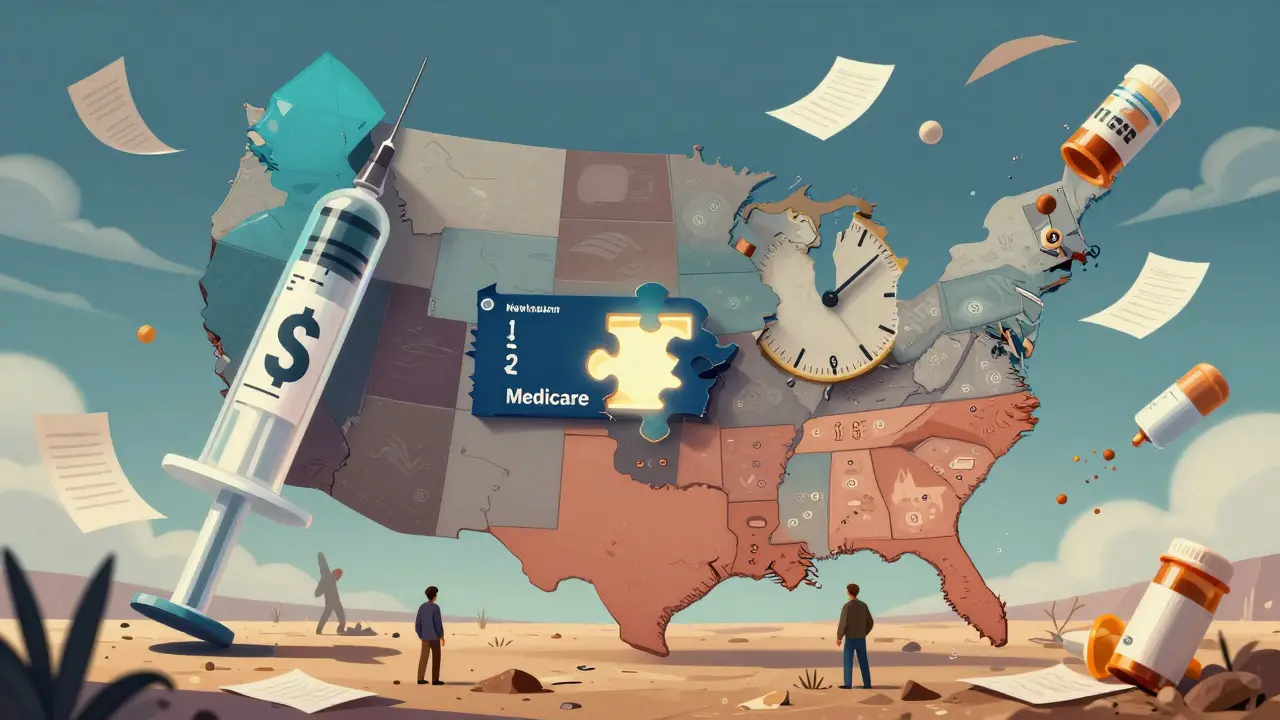
If you’re struggling to pay for prescriptions, you’re not alone. In 2025, nearly 1 in 4 Medicare beneficiaries said they had trouble affording their medications. The good news? Every state has some kind of government program to help - but they’re not the same. What works in New Jersey won’t necessarily help in Texas. And if you move, you might lose coverage overnight.
What Exactly Are State Medication Assistance Programs?
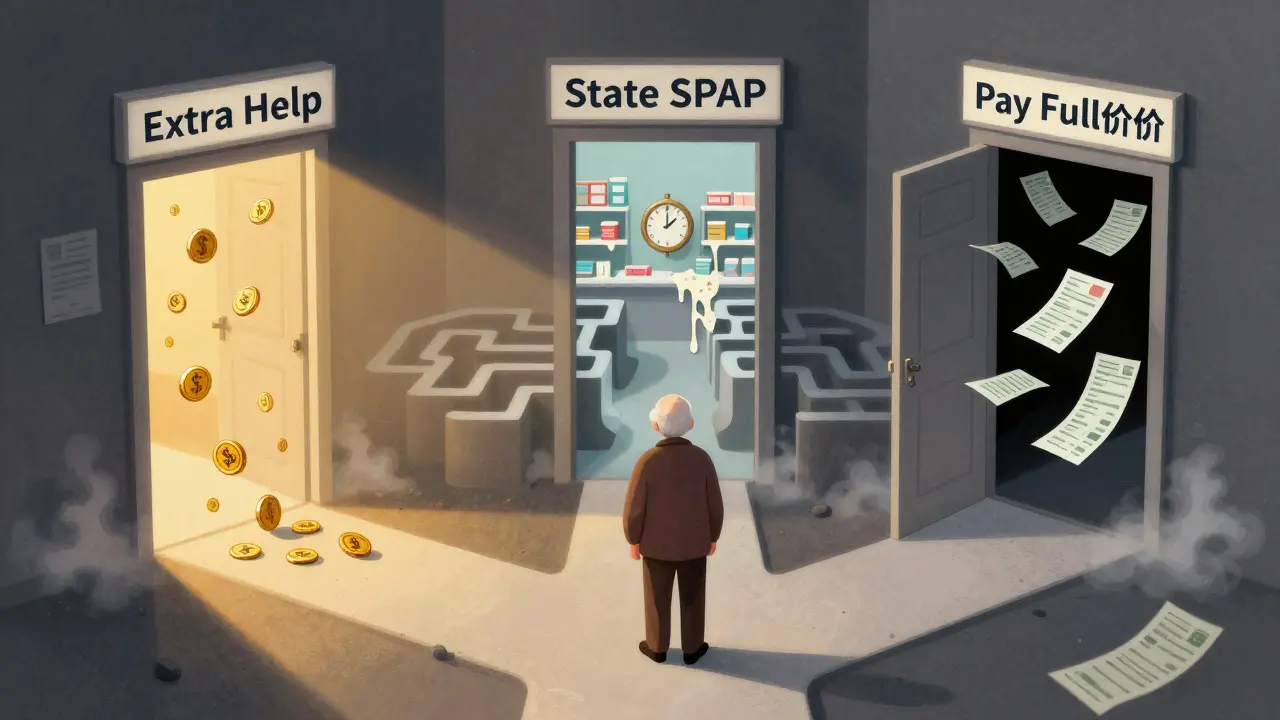
These are state-run programs that help people pay for prescription drugs. They’re called State Pharmaceutical Assistance Programs, or SPAPs. Thirty-two states have them in 2025. They mostly help seniors, people with disabilities, and those with low income. They work alongside federal programs like Medicare Extra Help, but they’re not part of Medicare.
Some SPAPs pay for your Part D premiums. Others cover co-pays. A few even pay for drugs that Medicare won’t cover at all. New Jersey’s PAAD program, for example, has been around since 1967. It covers insulin, needles for MS treatments, and most prescription drugs. You pay just $5 for generics and $7 for brand names - and they pay your Part D premium if it’s under $34.70 a month.
But not every state is that generous. Wyoming’s SPAP budget is $15 million. Pennsylvania’s is $215 million. The difference? Coverage, income limits, and how fast you get help.
Medicare Extra Help: The Federal Safety Net
Before you apply for state help, check if you qualify for Medicare Extra Help. It’s a federal program that cuts your Part D costs to the bone. In 2025, if you’re single and make less than $23,475 a year, or married and make less than $31,725, you’re likely eligible. Your resources - savings, stocks, property (not your home) - must be under $17,600 for individuals or $35,130 for couples.
What does Extra Help actually do? Nothing for premiums. Nothing for deductibles. Just $4.90 for every generic drug. $12.15 for every brand name. That’s it. No surprise bills. No annual cap to hit. And if you don’t have a Part D plan, Medicare picks one for you automatically.
Here’s the catch: you have to apply. It’s not automatic. Even if you get SSI or Medicaid, you still need to fill out the SSA-1020 form. Processing takes about 90 days. And if you’re waiting? You pay full price. One man in Ohio told the Medicare Rights Center he paid $872 out of pocket for his heart medication while waiting - money he didn’t have.
State-by-State Differences: It’s a Wild Ride
Let’s say you live in California. Your Medicare Part D plan doesn’t cover a specialty drug you need for rheumatoid arthritis. Medi-Cal Rx does. It adds 127 drugs that Part D leaves out. That’s huge. In Florida? No such luck. Their state program only helps with co-pays, not extra drugs.
Pennsylvania’s PACE program is one of the most generous. It covers your Part D premium AND drugs not covered by Medicare. Income limit? $27,470 for individuals, $36,900 for couples. But here’s the twist: you have to apply for Extra Help first. Then PACE fills in the gaps. The whole process takes 120 days on average. That’s four months without help.
And then there’s New Jersey. PAAD doesn’t just pay co-pays - it pays your premium. But only if you’re on a standard plan under $34.70/month. If your plan costs $45? You’re on your own. And if your doctor switches you to a drug not on PAAD’s list? You have to appeal. That takes 6 to 8 weeks. No medication. No coverage. Just paperwork.
Some states use Average Wholesale Price (AWP) to set drug payments. Others use Wholesale Acquisition Cost (WAC). These are behind-the-scenes pricing systems that determine how much the state pays pharmacies. If your state uses AWP minus 20%, your drug might be cheaper than in a state using WAC plus $10. You won’t see it on your receipt. But it affects whether your drug stays on the formulary.
Who Gets Left Out?
Not everyone who needs help gets it. Only 42% of eligible people actually enroll. Why? Complexity. The forms are long. The rules change. The income limits don’t match reality.
Take the resource limit for Extra Help: $17,600. That’s fine if you live in Iowa. But in San Francisco? That’s less than six months of rent. KFF’s 2025 analysis says this limit excludes thousands in high-cost states. People with $18,000 in savings - maybe a little emergency fund - get denied, even if they’re barely scraping by.
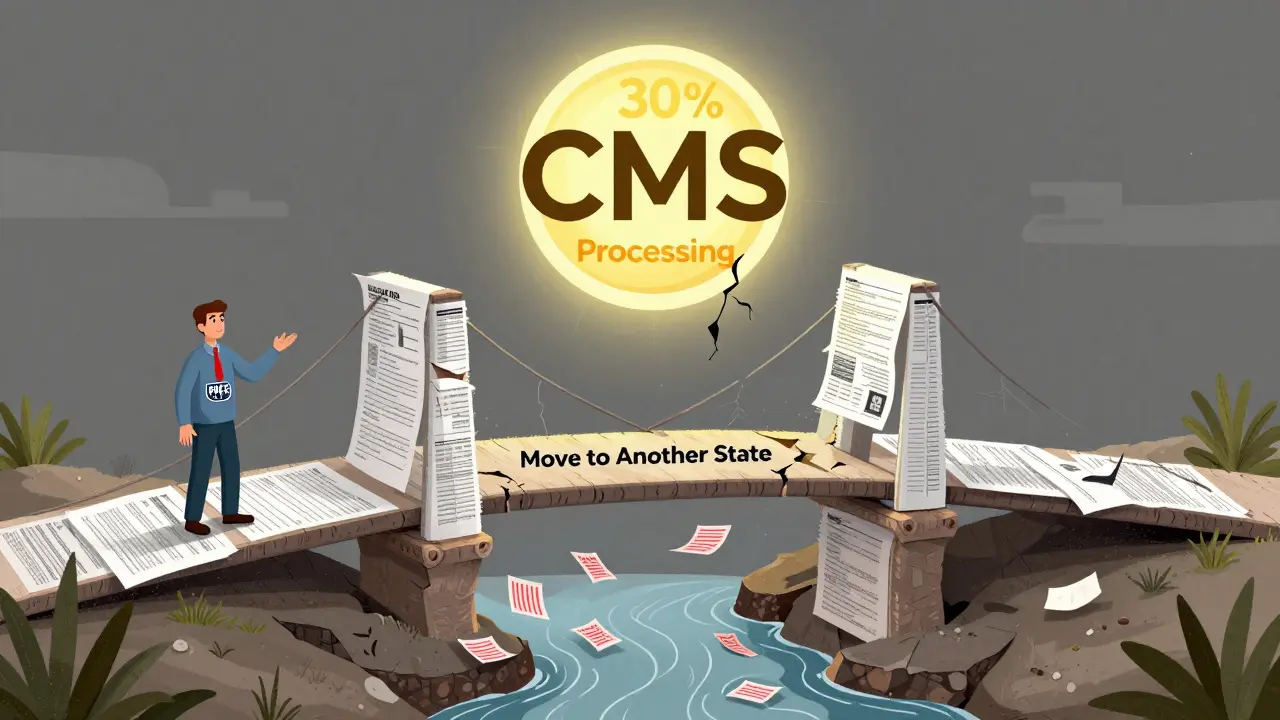
And then there’s the mobility problem. A 2024 Medicare Rights Center study found 63% of people who moved between states lost coverage temporarily. You leave Pennsylvania for Florida. Your PACE benefits vanish. Florida doesn’t have a comparable program. You’re stuck paying full price until you reapply. That’s not just inconvenient - it’s dangerous.
What’s Changing in 2025 and Beyond
The Inflation Reduction Act made big changes. Starting in 2025, your annual out-of-pocket drug costs are capped at $2,000. That’s down from $7,050. For Extra Help recipients, that means you hit the cap faster - and pay even less.
Also in 2025: if you’re on Medicaid or Extra Help, you can switch your Part D plan once a month. Before, it was once a year. That’s huge if your drug gets pulled from the formulary or your co-pay jumps.
CMS is rolling out a new standardized Extra Help application in January 2026. It’s supposed to cut processing time by 30%. That’s good news. But will it fix the 8.5 hours most people spend filling out forms? Unlikely.
Meanwhile, state budgets are struggling. Specialty drug costs are rising 12.3% a year. State SPAP budgets are growing 4-6%. That gap is growing. Seven states could run out of money by 2026. Eighteen states have already cut formularies or added prior authorizations. Your drug might be covered today - but not next year.
How to Apply: Real Steps, No Fluff
Here’s how to get help, no matter where you live:
- Check Extra Help eligibility. Go to SSA.gov/extrahelp. Use their online tool. It takes 10 minutes. If you qualify, apply. You’ll need your Social Security number, income proof (tax return or benefit letter), and asset info.
- Call SHIP. Every state has the State Health Insurance Assistance Program. Free counselors. No sales pitch. Just help. Find yours at shiptacenter.org. They’ll walk you through your state’s SPAP application.
- Apply for your state program. Don’t wait. Some states require annual re-certification. New Jersey processes applications in 30 days - but complex cases take 90. Get started early.
- Keep copies of everything. Save your application, confirmation emails, and letters. If your drug is denied, you’ll need proof.
- Check your formulary every 6 months. Drugs get added and removed. Call your pharmacy or log into your plan’s website. If your drug’s gone, ask about an exception.
Pro tip: If you’re on both Extra Help and a SPAP, you’re golden. But make sure the programs talk to each other. Pennsylvania’s PACE requires you to apply for Extra Help first. California’s Medi-Cal Rx doesn’t. Know your state’s rules.
What to Do If You’re Denied
Denials happen. Maybe your income was off by $500. Maybe your bank statement didn’t show a recent deposit. Don’t give up.
- Request a written explanation.
- Appeal within 60 days.
- Get help from SHIP. They’ve done this 10,000 times.
- Ask your doctor for a letter explaining why the drug is medically necessary.
One woman in New Jersey was denied PAAD because her 401(k) balance was $18,000. She didn’t know retirement accounts counted as resources. After an appeal with help from SHIP, they excluded it. She got coverage. She’s now paying $5 for her insulin.
Final Reality Check
These programs save lives. One Reddit user in New Jersey said PAAD saved him $400 a month on diabetes meds. That’s $4,800 a year. That’s rent. That’s groceries. That’s breathing room.
But these programs are fragile. They’re patchwork. They’re confusing. And they’re not enough.
If you’re eligible - apply. Even if it feels overwhelming. Even if you think you won’t qualify. The worst that happens? You get a no. The best? You get $5 co-pays for the rest of the year. And maybe, just maybe, you’ll be one of the 89% of Extra Help users who say they’re satisfied.
Don’t wait until you can’t afford your pills. Start today. Call SHIP. Fill out the form. Save your future self from a nightmare.
Do all states have medication assistance programs?
No. As of 2025, 32 states have some form of State Pharmaceutical Assistance Program (SPAP). The rest rely on federal programs like Medicare Extra Help or Medicaid. Check your state’s health department website or call SHIP to confirm what’s available where you live.
Can I get both Medicare Extra Help and my state’s program?
Yes - and you should. Most states encourage it. Pennsylvania’s PACE program requires you to apply for Extra Help first, then pays what’s left. New Jersey’s PAAD works alongside Extra Help to cover premiums and co-pays. In California, Medi-Cal Rx can cover drugs that Medicare Part D doesn’t. The key is applying for both - and making sure the programs coordinate.
What if I move to a different state?
Your state program benefits usually end when you move. You’ll need to reapply in your new state. A 2024 study found 63% of people who moved between states lost coverage temporarily. Plan ahead. Contact SHIP in your new state before you move. Don’t wait until your prescriptions run out.
Are insulin and other specialty drugs covered?
Most state programs cover insulin - New Jersey’s PAAD explicitly includes it. But specialty drugs like those for MS, rheumatoid arthritis, or cancer vary widely. California’s Medi-Cal Rx covers 127 extra specialty drugs not on Medicare’s formulary. Other states don’t. Always check your state’s formulary list before switching medications.
How long does it take to get approved?
Medicare Extra Help takes about 90 days on average. State programs vary: New Jersey processes applications in 30 days, but complex cases take 90. Pennsylvania’s PACE takes 120 days because it requires Extra Help approval first. Apply early - and keep paying for your meds while you wait. Some pharmacies offer discount cards for temporary relief.
Is there help filling out the forms?
Yes. The State Health Insurance Assistance Program (SHIP) offers free, local counseling in every state. They have 14,000 trained counselors who help people apply for Extra Help and state programs. No sales pitch. No cost. Just real help. Find yours at shiptacenter.org or call 1-877-839-2675.
What happens if my drug gets removed from the formulary?
You can request an exception. Your doctor must submit a letter saying the drug is medically necessary. If denied, you can appeal. The process can take weeks. In the meantime, ask your pharmacist about patient assistance programs from drug manufacturers - many offer free or low-cost meds for those who qualify.
Comments (12)
Vicki Yuan
Just applied for PAAD in New Jersey last week - took 24 days. Got approved. Now I’m paying $5 for insulin and $7 for my blood pressure med. I cried when I saw the confirmation email. This isn’t charity - it’s survival. Thank you for writing this. I’m sharing it with every senior in my neighborhood.
Oluwapelumi Yakubu
Ah, the grand tapestry of American healthcare - woven with threads of state-by-state whimsy and federal bureaucracy’s lazy stitching. One wonders if the architects of these programs ever held a pill bottle in their hands, or merely sketched them on whiteboards while sipping artisanal lattes. The real tragedy? It’s not the cost - it’s the *dignity* we’re forced to beg for, one 120-day application at a time.
Terri Gladden
OMG I JUST GOT DENIED FOR EXTRA HELP BECAUSE MY 401K HAD $18K IN IT AND I WAS LIKE WAIT THAT’S MY EMERGENCY MONEY NOT A VACATION FUND?? I CALLED SHIP AND THEY SAID OH THAT COUNTS AS A RESOURCE?? I WAS SO MAD I ATE AN ENTIRE PIZZA AND CRIED IN THE SHOWER. I NEED HELP. SOMEONE PLEASE HELP ME.
Jennifer Glass
I’ve been researching SPAPs for my mother since January. What struck me most isn’t the variation in coverage - it’s how the rules assume everyone has time, tech access, and someone to help them navigate. My mom’s 78, uses a flip phone, and doesn’t trust email. She’s been paying full price for metformin for 8 months because she couldn’t figure out the online form. The system isn’t broken - it’s designed to exclude people like her.
Joseph Snow
This article is a government propaganda piece disguised as helpful advice. The real issue? The pharmaceutical industry and Medicare have colluded to create this illusion of choice. SPAPs exist to make you think the system works - while they quietly shift costs onto seniors and let Big Pharma raise prices 12% annually. The cap of $2,000? A distraction. They’ll just raise premiums next year. Don’t trust any of this.
melissa cucic
It’s worth noting, however, that while the Inflation Reduction Act’s $2,000 cap is significant, it does not apply to non-Medicare beneficiaries - and many low-income individuals fall through that gap entirely. Moreover, the formulary exclusions, while frustrating, are often the result of actuarial necessity - not malice. Still, the disparity between states is indefensible. We should demand federal minimum standards.
Akshaya Gandra _ Student - EastCaryMS
i read this for my school project and i didnt know so many people cant afford medicine 😭 i live in india and we have free govt clinics but still people pay out of pocket. this is so sad. can i use this info for my presentation? thanks for sharing!!
Aaron Mercado
Let me get this straight - you’re telling me I’m supposed to trust a system that took 120 days to approve my dad’s PACE application, while he was skipping doses? And now you want me to believe a ‘standardized form’ is going to fix this? That’s like handing a drowning man a paper boat and calling it ‘innovation.’ This isn’t a policy failure - it’s a moral collapse.
John Wilmerding
Thank you for the comprehensive overview. I would like to add one critical point: many state SPAPs now offer automatic enrollment for Medicaid recipients, which significantly reduces application burden. Additionally, some pharmacies - particularly CVS and Walgreens - have partnered with SPAPs to offer on-site application kiosks. I recommend contacting your local pharmacy’s patient services department - they often have dedicated staff trained to assist with these forms. The 90-day wait for Extra Help remains the biggest bottleneck - but the new CMS portal, launching in January 2026, should reduce that by 30% as noted.
Peyton Feuer
just wanted to say i applied for PAAD last year after reading a post like this. got approved in 3 weeks. now i pay $5 for my asthma inhaler. i used to skip doses to make it last. not anymore. thanks for the real talk. also - SHIP counselors are angels. one lady walked me through the whole thing on the phone while i was crying. you’re not alone.
Siobhan Goggin
This is one of the clearest, most compassionate summaries of a deeply complex system I’ve read. The point about mobility and coverage loss is especially critical - it’s not just a bureaucratic hurdle, it’s a public health risk. I’ve worked in elder care for 18 years, and I’ve seen too many patients go without medication because they moved. We need portable benefits. Not patchwork.
Vicki Yuan
John Wilmerding - thank you for mentioning the pharmacy kiosks. I didn’t know about those. I went to my local Walgreens yesterday and the clerk helped me fill out the Extra Help form on their tablet. Took 12 minutes. I didn’t even need to go online. I’m going back to get my mom’s done next week.