
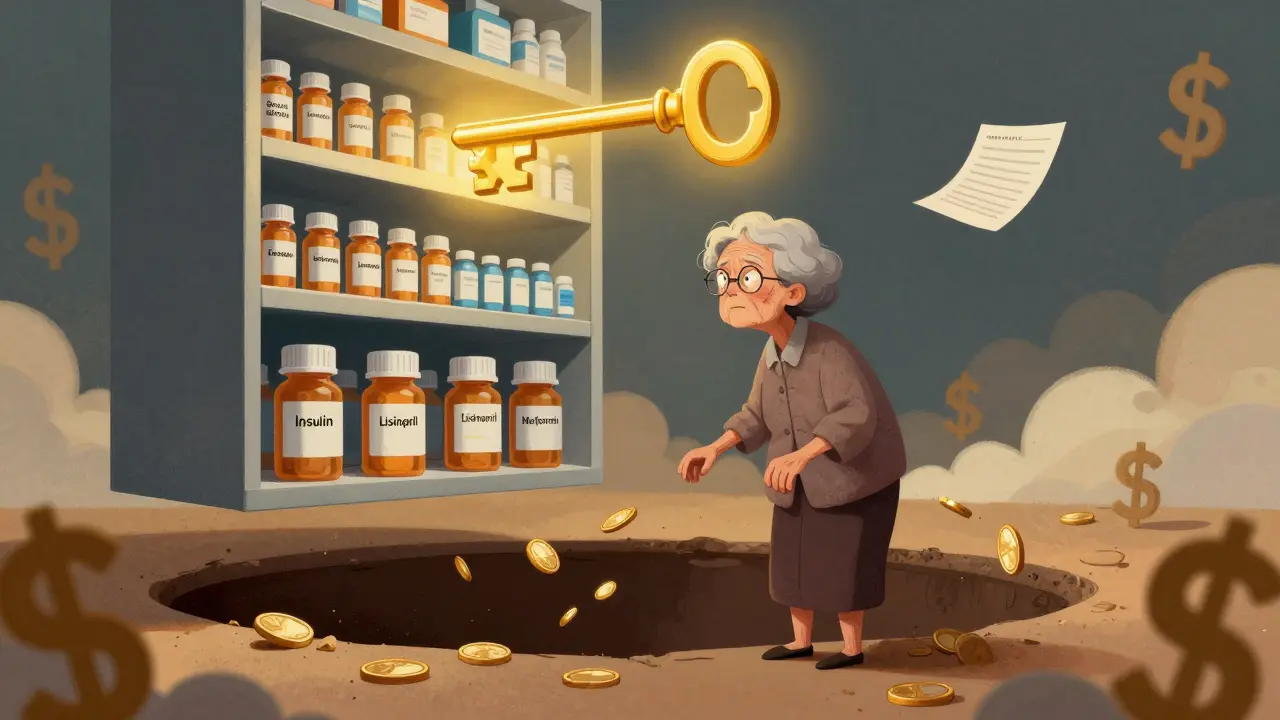
Every year, millions of seniors in the U.S. struggle to afford their prescription medications. For many, the cost of insulin, heart pills, or diabetes drugs eats into their fixed incomes. But there’s a federal program designed exactly for this: the Extra Help Program. It’s not a secret, and it’s not hard to get - yet nearly 4.3 million eligible seniors still don’t enroll. If you or someone you know is on Medicare and struggling with drug costs, this is the guide you need.
What Is the Extra Help Program?
The Extra Help Program, officially called the Part D Low-Income Subsidy (LIS), is a federal program that cuts your Medicare prescription drug costs to almost nothing. Run by the Social Security Administration, it pays for your Part D premiums, deductibles, and copays. Since January 1, 2024, the program no longer has partial and full tiers - everyone who qualifies gets the full benefit. That means no more confusing rules about how much you get based on income brackets. If you’re eligible, you get the maximum help.
On average, Extra Help saves enrollees about $6,200 a year on drug costs. For someone taking five or more prescriptions monthly, that’s the difference between choosing between medicine and groceries.
Who Qualifies for Extra Help in 2025?
To qualify, you must be enrolled in Medicare Part D and meet strict income and resource limits. These numbers are updated yearly based on the Federal Poverty Level. For 2025, here’s what you need:
- Income limits: $23,475 per year for individuals; $31,725 for married couples living together.
- Resource limits: $17,600 for individuals; $35,130 for married couples.
Income here means your adjusted gross income (from your tax return) plus any tax-exempt interest - like from municipal bonds. Resources include cash, bank accounts, stocks, bonds, mutual funds, and real estate you don’t live in. But here’s the key: your home, one car, personal belongings, and up to $1,500 for burial expenses are not counted. Many people think they don’t qualify because they own a house or a car - but those don’t disqualify you.
There are also important income exclusions. The first $20 of monthly income doesn’t count. The first $65 of earned income (like from a part-time job) plus half of anything over that is also excluded. Income from a child in military service doesn’t count either. So if your income looks slightly above the limit, you might still qualify after these exclusions are applied.
How Do You Get Extra Help?
You don’t always have to apply. In fact, about 12.5 million people get Extra Help automatically - no paperwork needed. You’re automatically enrolled if you:
- Have both Medicare and Medicaid
- Get Supplemental Security Income (SSI)
- Are enrolled in a Medicare Savings Program (MSP)
- Get state help paying your Medicare Part B premium
If you’re not automatically enrolled, you need to apply. There are three easy ways:
- Online: Go to ssa.gov/extrahelp and fill out the form. It takes about 15 minutes.
- By phone: Call the Social Security Administration at 1-800-772-1213 (TTY: 1-800-325-0778). Hours are 8 a.m. to 5:30 p.m. Monday through Friday.
- In person: Visit your local Social Security office. No appointment needed.
You’ll need to provide proof of income - like your most recent tax return or pay stubs - and proof of resources, like bank statements. If you don’t have these handy, Social Security can often get them for you.
Most applications are processed within 21 days. The approval rate for complete applications is 72%. Common mistakes? Including income that doesn’t count (like SSI payments), misvaluing assets, or leaving out pages of documentation. Double-check everything before you submit.

What Benefits Do You Get?
If you’re approved, here’s what you save:
- $0 monthly premiums: You can enroll in a Part D plan with no premium. In most states, there are 2 to 7 such plans to choose from.
- No deductible: The $595 Part D deductible is fully covered.
- Low copays: If your income is at or below 100% of the Federal Poverty Level, you pay $1.60 for generics and $4.80 for brand-name drugs. If you’re between 100% and 150%, you pay $4.90 for generics and $12.15 for brands.
- No late enrollment penalty: If you didn’t sign up for Part D when you first qualified for Medicare, you won’t be charged a penalty.
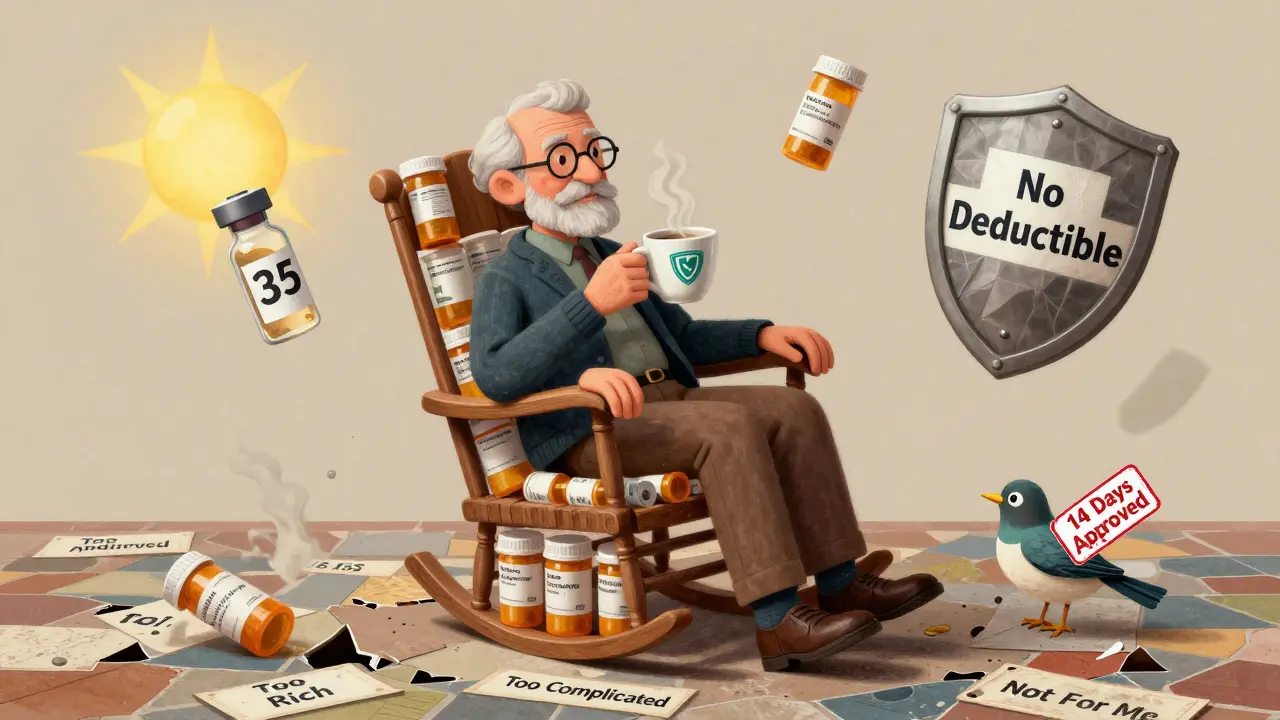
- Insulin capped at $35/month: Since January 2025, all Extra Help recipients pay no more than $35 for each insulin prescription.
- Free vaccines: Shingles, flu, pneumonia, and other recommended vaccines cost $0.
Once approved, Social Security will notify you and automatically enroll you in a Part D plan if you’re not already enrolled. The whole process - from application to coverage - usually takes about 45 days.
Why So Many Seniors Miss Out
The Government Accountability Office found that 4.3 million eligible seniors aren’t enrolled in Extra Help. That’s $26.8 billion in unclaimed benefits every year. Why? Most seniors think they make too much money. Others don’t know the program exists. Some believe it’s too complicated.
But the truth is, the rules are simpler than ever. The 2024 reforms removed the partial benefit tier. The application is shorter. And Social Security now has an automated screening tool on their website that can flag people who might qualify - even if they’ve never applied before.
Don’t assume you don’t qualify. If you’re on a fixed income and take even one prescription, it’s worth checking. Many people with incomes just above the limit still qualify after exclusions are applied.
What Happens After You Apply?
Once approved, you’ll get a letter from Social Security confirming your Extra Help status. Your Part D plan will change automatically. You’ll start paying the lower copays right away. If you’re not enrolled in a Part D plan, one will be chosen for you - usually a $0 premium plan that covers your medications.
You don’t need to reapply every year. Social Security checks your income and resources annually. If your situation changes - like if you get a raise, inherit money, or sell property - you must report it. But if things stay the same, your Extra Help continues automatically.
Some people worry that getting Extra Help will affect other benefits. It won’t. You can still get Medicaid, SSI, or a Medicare Savings Program while enrolled in Extra Help. In fact, 92% of people on Medicaid are already getting Extra Help automatically.
Real-World Example
Maria, 78, lives in Ohio. She takes five medications: metformin, lisinopril, atorvastatin, levothyroxine, and insulin. Before Extra Help, her monthly drug costs were $287. After applying and being approved, her out-of-pocket cost dropped to $37. She pays $1.60 for metformin, $4.80 for lisinopril, $4.80 for atorvastatin, $1.60 for levothyroxine, and $35 for insulin. That’s $47.80 a month - not $287. She now has extra money for groceries, heating, and her grandson’s birthday.
Maria didn’t know she qualified. She thought her Social Security check was too high. But after talking to a local senior center counselor, she applied - and got approved in 14 days.
Where to Get Free Help Applying
You don’t have to do this alone. Free help is available everywhere:
- State Health Insurance Assistance Program (SHIP): Free, local counselors who help with Medicare questions. Find yours at shiptacenter.org.
- Area Agency on Aging: Offers free application assistance. Call 1-800-677-1116.
- Local senior centers: Many have staff trained to help with Extra Help applications.
- Nonprofits: Organizations like the National Council on Aging (NCOA) offer free online tools and phone support.
These services are free. No one should charge you to help you apply for Extra Help. If someone asks for money, walk away.
Final Thoughts
The Extra Help Program isn’t charity. It’s a benefit you’ve paid into through your taxes and Medicare premiums. If you’re a low-income senior, you’re entitled to it. The rules are clearer, the benefits are stronger, and the process is easier than ever.
Don’t wait. Don’t assume. Don’t guess. If you’re on Medicare and pay for prescriptions, check your eligibility today. It could save you thousands - and maybe even keep you healthy.
Do I qualify for Extra Help if I have savings in a 401(k)?
Yes, but only the value of your 401(k) or IRA counts toward your resource limit. If you’re 72 or older and taking required minimum distributions, the money in those accounts is included. But if your total countable resources (including bank accounts, stocks, and non-primary real estate) are under $17,600 (individual) or $35,130 (couple), you still qualify.
Can I get Extra Help if I’m not on Medicaid?
Absolutely. Medicaid is not required. Extra Help is based on your income and resources alone. Many people get Extra Help without Medicaid. In fact, over 60% of Extra Help enrollees don’t have Medicaid.
What if my income goes up next year?
Social Security reviews your eligibility every year using your tax information. If your income rises above the limit, your Extra Help may be reduced or ended. But if you’re still below the threshold after exclusions, you’ll keep it. You don’t lose it immediately just because you got a small raise.
Does Extra Help cover all my medications?
It covers all drugs on your Part D plan’s formulary - the list of covered medications. Most plans cover at least 90% of commonly prescribed drugs for seniors. If your medication isn’t covered, you can request an exception. Extra Help doesn’t change the formulary - it just lowers your costs for what’s already covered.
Is there a deadline to apply for Extra Help?
No. You can apply anytime. If you qualify, your benefits start the month after your application is approved. There’s no open enrollment period. Apply as soon as you need help - you won’t lose money by waiting.
Comments (13)
Dikshita Mehta
I applied for Extra Help last year after my insulin bill hit $400/month. Got approved in 18 days. Now I pay $35 for insulin, $1.60 for metformin, and zero for my flu shot. I didn’t know my 401(k) didn’t count as long as I didn’t cash it out. So many seniors think they’re too rich - but the exclusions save people all the time.
pascal pantel
Let’s be real - this program is just another federal entitlement that incentivizes dependency. The real issue is why drug prices are so inflated in the first place. Why are we subsidizing Big Pharma’s pricing model instead of forcing transparency? Also, ‘$6,200 in savings’? That’s just redistribution with a pretty name. And don’t get me started on the formulary restrictions - it’s not ‘free’ if they only cover 90% of your meds.
Guillaume VanderEst
My aunt applied for this last winter after she got her shingles shot for free. She cried. Not because she was happy - because she realized she’d been overpaying $200/month for five years. She didn’t know about the income exclusions. She thought her part-time job at the library disqualified her. Turns out, the first $65 of earned income doesn’t count. I told her she should’ve applied in 2020. Now she’s got $1,800 extra in her pocket every year. We’re telling everyone.
Kevin Motta Top
Extra Help isn’t charity. It’s justice. You paid into Medicare your whole life. This is your return on investment. No one should choose between insulin and groceries. Period.
Carolyn Benson
It’s fascinating how society constructs these safety nets only to make them feel like favors, not rights. The fact that millions don’t apply because they feel ‘undeserving’ speaks volumes about our internalized class guilt. We’ve been taught to be grateful for crumbs - when the system owes them the whole table. Extra Help is just a bandage on a hemorrhage. But still - if it saves one life, it’s worth it. I guess.
Chris porto
I helped my neighbor fill out the form. She was scared they’d take her house. I had to explain - your home doesn’t count. Neither does your car. She had $12,000 in savings and thought that was too much. We sat there for an hour going through every line. When she got the approval letter, she just stared at it. Said, ‘I didn’t know I was allowed to have this.’ That broke my heart.
Aadil Munshi
LOL the ‘$6,200 savings’ stat is cute. But if you’re on SSDI and make $1,500/month, you’re technically over the limit. But wait - they exclude the first $20 of income and half your earned income. So if you babysit your grandkids for $200/month? Only $90 counts. That’s how people slip through. The system’s weird but it works if you know the loopholes. And yes, your 401(k) counts - but only the balance, not the monthly withdrawals. Most people don’t get that.
Danielle Stewart
If you’re reading this and you’re over 65 and taking any meds - please, just apply. It’s 15 minutes online. No one is going to judge you. No one is going to take your house. You’ve earned this. You’re not asking for a handout - you’re claiming what’s yours. I’ve walked 17 seniors through this. Every single one got approved. You’re not alone. You’re not a burden. You’re worthy.
Ryan van Leent
Why do we even have this program? People should just work longer. My grandma worked till she was 80. She didn’t need help. If you can’t afford your meds maybe you shouldn’t have spent all your money on vacations in the 90s. Also why are we giving free vaccines? That’s not what Medicare is for. This is a slippery slope.
Andrew Kelly
Ever wonder why the SSA doesn’t just auto-enroll everyone over 65 with a bank account? They say it’s privacy. I say it’s control. They want you to beg. They want you to jump through hoops. They want you to feel like a charity case. And that’s why 4.3 million people don’t apply. It’s not ignorance - it’s resentment. This isn’t help. It’s humiliation dressed up as policy.
Anna Sedervay
One must question the epistemological foundations of this program. Is ‘income’ a socially constructed metric? And if resources are counted based on liquidity, does that not privilege those who hold assets in illiquid forms? Furthermore, the implicit assumption that ‘$35 insulin’ is sufficient neglects the structural violence of pharmaceutical monopolies. One wonders if this is merely performative benevolence - a distraction from the true pathology: the commodification of health itself. (Also, I think there’s a typo on page 3. It says ‘$35,130’ but should be ‘$35,130.00’ - precision matters.)
Tim Goodfellow
Man, this program is a godsend. I used to see my uncle on the corner selling his pills just to afford his rent. He got Extra Help last year - now he’s got money for groceries, a new pair of shoes, and even took a bus to see his grandkid in Chicago. That $6,200? That’s not just savings - that’s dignity. That’s freedom. Don’t let anyone tell you it’s not worth it. It is.
Elaine Douglass
my mom just got approved and she's so happy she's crying i just want everyone to know you don't have to suffer like this