
Medication Dry Mouth Risk Calculator
Dry Mouth Risk Assessment
How many medications do you currently take? Risk increases significantly with multiple medications.
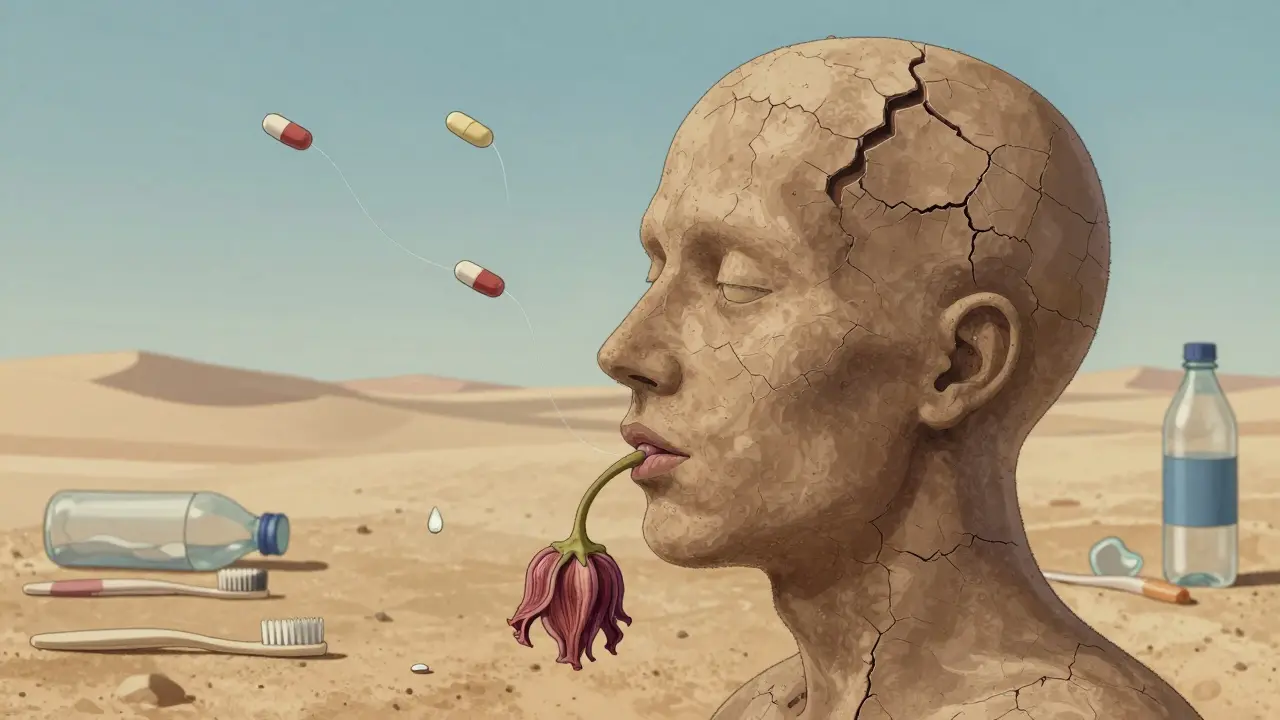
More than 11 million Americans have dry mouth because of their medications. It’s not just discomfort - it’s a silent threat to your teeth, your ability to eat, and even your sleep. If you’ve ever felt like your mouth is full of cotton, especially after taking a pill, you’re not alone. And it’s not something you should just live with.
Why Your Medications Are Drying Out Your Mouth
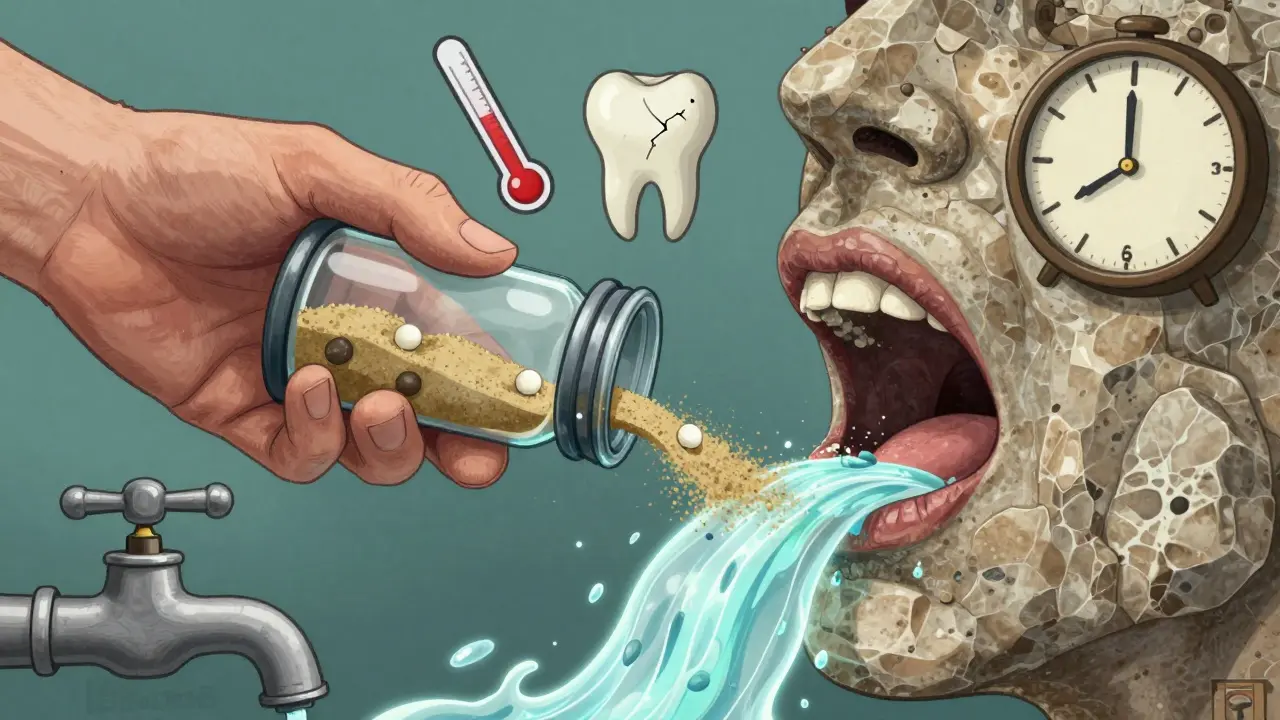
Your saliva doesn’t just help you swallow food. It’s your mouth’s natural defense system. It washes away food particles, neutralizes acids, and fights off bacteria that cause cavities and gum disease. When your salivary glands slow down or stop working, that protection vanishes - and fast.
The main reason? Most medications that cause dry mouth interfere with your autonomic nervous system. Specifically, they block acetylcholine, a chemical signal that tells your salivary glands to produce saliva. This is called an anticholinergic effect. About 68% of all drugs linked to dry mouth work this way, according to research from USC’s Ostrow School of Dentistry.
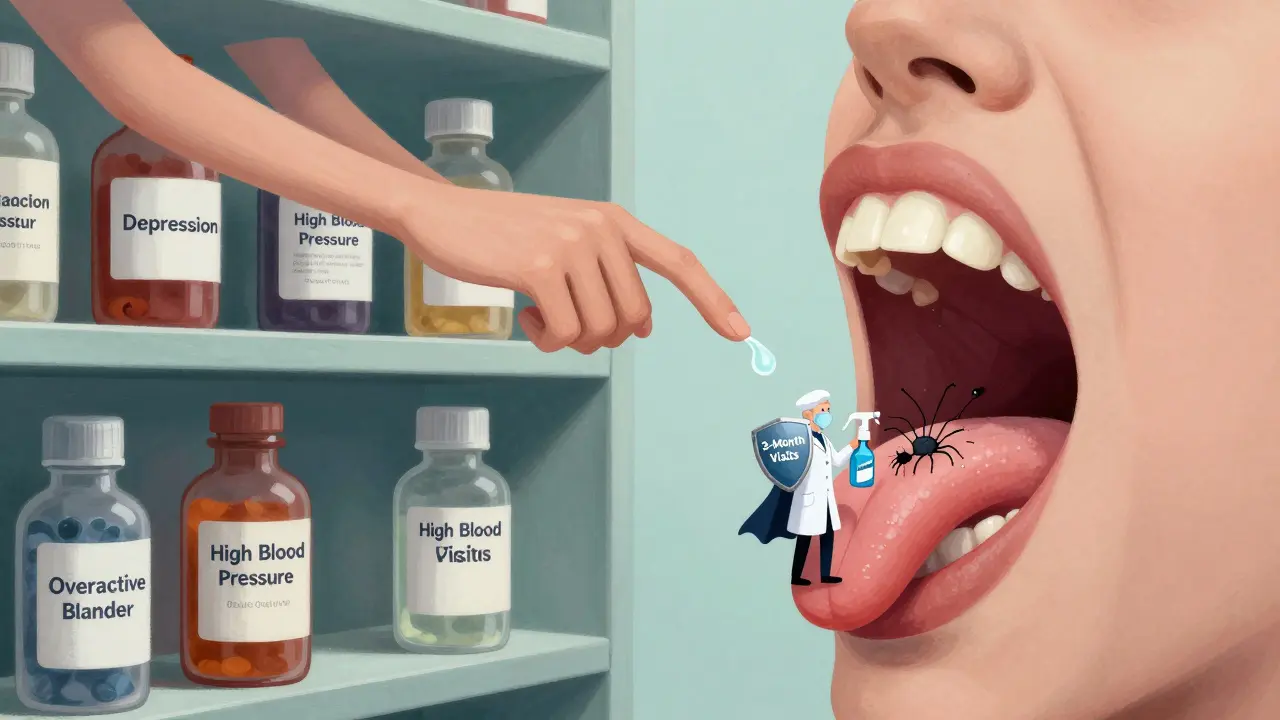
It’s not just one type of drug. Over 1,110 medications - from common prescriptions to over-the-counter pills - can trigger this reaction. The biggest culprits? Medications for overactive bladder, depression, allergies, and high blood pressure. For example:
- Oxybutynin (Detrol) for bladder control causes dry mouth in over 70% of users.
- Diphenhydramine (Benadryl) leads to dry mouth in nearly 6 out of 10 people.
- Amitriptyline, a tricyclic antidepressant, causes dry mouth in 63% of patients.
And here’s the catch: it gets worse the more pills you take. People on three or more medications are 2.3 times more likely to have severe dry mouth than those on just one. If you’re on five or more, 18% of you may experience nearly total saliva shutdown.
Who’s Most at Risk?
You don’t have to be old to get dry mouth from meds - but if you are, your risk jumps sharply. About 76% of all cases occur in adults over 65. Why? Because older adults are more likely to take multiple prescriptions. In fact, 38% of seniors take five or more daily medications, according to CDC data.
But it’s not just age. People with chronic conditions - diabetes, Parkinson’s, Sjögren’s syndrome - often take drugs that compound the problem. Even if you’re young and healthy, if you’re on long-term antihistamines, antidepressants, or blood pressure meds, you’re at risk.
And here’s something most doctors don’t tell you: dry mouth isn’t just annoying. It’s a direct path to dental disaster. Patients on multiple medications have a 47% higher rate of root cavities than those on one or two drugs. One study found that untreated dry mouth can accelerate tooth decay by 300% within just 12 months.
What You’re Feeling - Real Stories
On Reddit’s r/DryMouth community, users share daily struggles:
- "I started oxybutynin for my bladder. Within two weeks, I couldn’t eat crunchy food. My tongue stuck to the roof of my mouth. I got three cavities in six months - even though I brushed twice a day."
- "I take sertraline for anxiety. I need a water bottle at my desk. I wake up 2-3 times a night because my mouth is so dry."
Amazon reviews for Biotene products show 83% of users blame prescription meds. And Healthgrades data reveals that patients rate antihistamines with dry mouth side effects 2.7 out of 5 stars - far lower than ratings for other side effects.
One big problem? Doctors rarely mention it. A Delta Dental survey found 67% of patients say their prescriber never talked about dry mouth as a possible side effect. That’s a huge gap. You’re being told to take a pill - but not warned about the damage it might do to your teeth.
How to Fight Back - Practical Steps
You don’t have to suffer. There are real, evidence-backed ways to manage this. The American Dental Association recommends a four-step plan:
- Review your meds with your doctor. Sometimes, switching to a different drug can help. For example, switching from diphenhydramine (Benadryl) to loratadine (Claritin) drops dry mouth risk from 58% to 12%. Switching from a tricyclic antidepressant to an SSRI like sertraline reduces the chance from 63% to 31%. About 42% of people who switch meds see improvement.
- Try a salivary stimulant. Pilocarpine (Salagen) and cevimeline (Evoxac) are FDA-approved drugs that directly trigger saliva production. In clinical trials, cevimeline improved saliva flow by 72% in just weeks. These aren’t over-the-counter - you need a prescription, but they work.
- Use oral moisturizers. Products like Biotene Dry Mouth Oral Rinse or Glandosane gel provide relief for up to 7 hours. A 2023 UCLA study found the new "Enzyme-Activated Moisturizing System" lasts longer than older versions. Apply these 5-6 times a day - not just when you feel dry.
- See your dentist every 3 months. Standard 6-month checkups aren’t enough. If you’re on meds that dry your mouth, you need to catch decay early. Dentists now recommend 3-month visits for high-risk patients.
Also, drink water throughout the day - not just when you’re thirsty. Avoid caffeine, alcohol, and sugary drinks. They make dry mouth worse. Chew sugar-free gum with xylitol - it stimulates saliva and fights bacteria.
The Bigger Picture: Why This Isn’t Being Fixed
The dry mouth management market is worth over $1.2 billion and growing. But the healthcare system is still behind. Only 28% of primary care doctors routinely ask patients about dry mouth during medication reviews. And only 43% of dental insurance plans cover prescription salivary stimulants like pilocarpine.
Dentists are trying to fill the gap. 89% now ask about medications during intake exams. But only 52% feel trained to manage it properly. That’s why coordinated care matters. Health systems that link pharmacists and dentists - like 47 programs launched in 2023 - have cut dental complications by 38% among patients.
And change is coming. The FDA approved cevimeline for severe dry mouth in April 2023. The NIH launched a $15.7 million research project in early 2024 to find non-anticholinergic alternatives for bladder meds. The ADA predicts that by 2027, all new medications will be required to include dry mouth risk assessments.
What You Can Do Today
Start with this checklist:
- Make a list of every medication you take - including OTC, vitamins, and supplements.
- Check if any are on the list of 1,110 drugs known to cause dry mouth (many are listed on GoodRx or Healthgrades).
- Ask your doctor: "Could any of these be causing my dry mouth? Is there a similar drug with less risk?"
- Ask your dentist: "Am I at risk for decay from my meds? Should I come in every 3 months?"
- Buy a sugar-free saliva substitute (like Biotene) and use it at least 4 times a day.
This isn’t about quitting your meds. It’s about protecting your mouth while you take them. Dry mouth from medication is common, preventable, and treatable. But you have to speak up. No one else will.
Can dry mouth from medication be permanent?
In most cases, no. Saliva production usually returns within days or weeks after stopping the medication. But if dry mouth lasts for years - especially in older adults - the salivary glands can shrink and lose function over time. That’s why early management is critical. The longer you go without treatment, the harder it is to reverse.
Are over-the-counter mouthwashes safe for dry mouth?
Most are not. Regular mouthwashes contain alcohol, which dries out your mouth even more. Look for products labeled "alcohol-free" and "sugar-free." Only use moisturizing rinses designed for dry mouth, like Biotene, Glandosane, or Oralbalance. These contain enzymes and humectants that mimic natural saliva.
Can I use sugar-free gum instead of medication?
Sugar-free gum with xylitol can help stimulate saliva, but it won’t fix the root cause. If your medication is blocking signals to your salivary glands, chewing gum only gives temporary relief. It’s a helpful tool - not a solution. Combine it with other strategies like oral moisturizers and dentist visits.
Why don’t doctors warn me about this?
Many doctors aren’t trained to connect dry mouth with dental health. They focus on whether the drug works for the condition - not the side effects on your mouth. A 2023 survey found only 28% of primary care doctors screen for dry mouth. You have to bring it up. Say: "I’ve been having a dry mouth since I started this med. Could it be related?"
Is there a cure for medication-induced dry mouth?
There’s no cure - but there are effective ways to manage it. The goal isn’t to eliminate the medication (unless you can switch), but to protect your mouth while you take it. With the right combination of drug adjustments, oral moisturizers, dental care, and lifestyle changes, most people can live comfortably without major dental damage.
Comments (10)
Laura Gabel
This is why I stopped taking Benadryl. My dentist was like 'bro your teeth look like they survived a war.' No one tells you this stuff until it's too late.
Amadi Kenneth
I knew it! I KNEW IT! The pharmaceutical companies are in cahanne! They don't care if your mouth turns to dust as long as you keep buying pills! They're deliberately keeping saliva-stimulating drugs off the market because they make more money off fillings and root canals!!! AND THE FDA IS IN ON IT!!!
jerome Reverdy
The anticholinergic burden concept is legit. I work in geriatric pharmacy and we call it the 'dry mouth cascade'-one med triggers it, then another gets added for the side effect, then another for THAT side effect... and suddenly you've got a 78-year-old with no saliva, three cavities, and a $1200 dental bill. It's a system failure, not just a drug issue.
Andrew Mamone
I switched from amitriptyline to sertraline last year. 🤯 My mouth went from 'desert after a drought' to 'normal human hydration' in 3 weeks. Also started using Biotene gel before bed. Life-changing. 🙌
Srividhya Srinivasan
This is what happens when you let Big Pharma control your body! You think your doctor has your back? HA! They're paid by the pill companies! I read a study that said 89% of dry mouth cases are preventable-but they don't teach this in med school because they don't want you to know how easy it is to fix!
Stephen Habegger
Good post. I’ve been on 5 meds for 3 years. Started using xylitol gum and saw a 70% drop in nighttime awakenings. Simple fix, big difference.
Justin Archuletta
I’ve been using Biotene for 6 months. My dentist said I’ve avoided 3 cavities. Worth every penny. Don’t wait until you’re in pain.
Sanjana Rajan
People who take antidepressants and then complain about dry mouth? You signed up for this. If you want to feel better mentally, you gotta pay the price. My grandma took 12 pills a day and still smiled. You’re too soft.
Kyle Young
It's fascinating how the autonomic nervous system's cholinergic suppression leads to systemic oral consequences. One might argue that this represents a broader epistemological gap between pharmacological intervention and physiological integrity. The clinical paradigm prioritizes symptom management over holistic systemic preservation. Is this not indicative of a deeper structural flaw in our medical episteme?
Ryan Voeltner
Thank you for this comprehensive and evidence-based overview. The integration of dental and pharmaceutical care pathways represents a critical advancement in patient-centered health systems. I commend the initiatives linking pharmacists and dentists-this interdisciplinary model should be scaled nationally.