
When you pick up a pill, whether it’s a generic version of a brand-name drug or an over-the-counter pain reliever, you might think you’re getting the same thing. But what’s inside that tablet or capsule is more complicated than it looks. Two types of ingredients make up every medication: the active ingredient and the inactive ingredients. One gets all the attention. The other? Often ignored. But that doesn’t mean it doesn’t matter.
What exactly is an active ingredient?
The active ingredient is the part of the drug that actually does the work. It’s the component that interacts with your body to produce a therapeutic effect. For example, in Tylenol, the active ingredient is acetaminophen. In Advil, it’s ibuprofen. In Lipitor, it’s atorvastatin. These are the molecules that block pain signals, lower cholesterol, or fight infection.
The FDA requires that every active ingredient go through years of testing before it’s approved. Companies must prove it’s safe and that it actually works - not just in test tubes, but in real people. More than 90% of new active ingredients fail during clinical trials. That’s how strict the process is.
Once approved, the active ingredient must be present in a precise amount. A 500mg acetaminophen tablet can’t have 480mg or 520mg. That’s why generic drugs must match the brand-name version in strength, dosage form, and how quickly the body absorbs the active ingredient.
What are inactive ingredients - and why are they even in there?
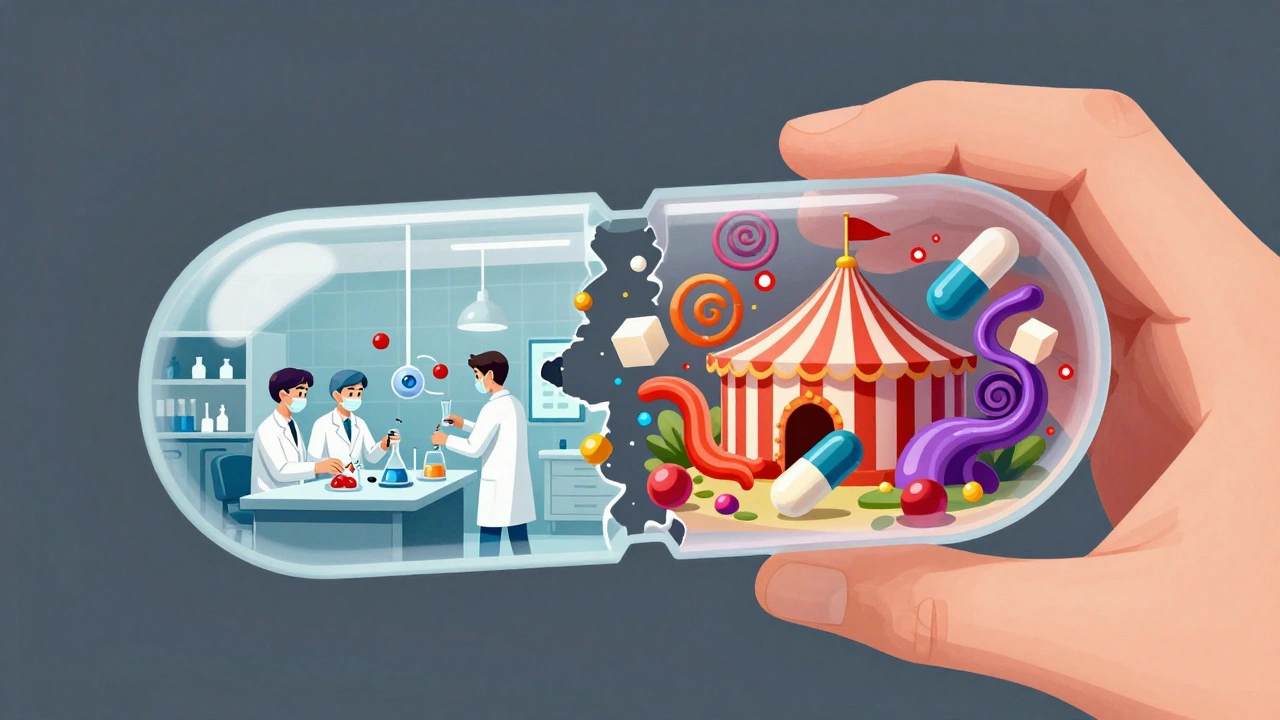
Inactive ingredients, also called excipients, don’t treat your condition. But they’re not just filler. They’re essential for the drug to work properly - or even to exist in a usable form.
Think of them as the support crew. They do things like:
- Hold the tablet together (binders like gelatin or microcrystalline cellulose)
- Make the pill easy to swallow (coatings like hydroxypropyl methylcellulose)
- Prevent it from breaking down too soon (stabilizers)
- Keep bacteria out (preservatives like parabens)
- Improve taste or color (flavorings, dyes like D&C Red 7)
- Add bulk so tiny doses of medicine can be made into pills (fillers like lactose or starch)
Without these, most pills would be impossible to make. Imagine trying to press a single grain of aspirin into a tablet - it wouldn’t hold shape. Or swallowing a bitter powder without any flavoring. That’s why excipients are in nearly every medication.
But are they really ‘inactive’?
The name ‘inactive’ is misleading. In 2021, a major study led by researchers at the University of California, San Francisco, and Novartis tested 639 FDA-approved inactive ingredients against over 3,000 human proteins. They found that about 14% of these so-called ‘inactive’ compounds had biological activity - meaning they could interact with your body in ways scientists didn’t expect.
Some compounds, like propyl gallate (a preservative) and D&C Red 7 calcium lake (a red dye), bound strongly to proteins involved in inflammation, metabolism, and even brain function. These weren’t just floating around harmlessly. They were talking to your cells.
This doesn’t mean every pill is dangerous. Most of these interactions happen at very low levels and may have no noticeable effect. But for some people - especially those taking multiple medications daily or with chronic conditions - these hidden interactions could add up.
The FDA responded by launching the Excipient Safety Initiative in 2022, investing $4.2 million to study these effects more closely. Now, manufacturers are required to screen excipients more carefully, especially in high-dose or long-term medications.
Why should you care about inactive ingredients?
Because they can cause real side effects - and they’re not always listed where you’d expect.
Lactose, for example, is in about 20% of all oral medications. It’s cheap, stable, and easy to work with. But around 65% of the global population has trouble digesting lactose. If you’re lactose intolerant, taking a daily pill with lactose could mean bloating, cramps, or diarrhea - even if the active ingredient is perfectly safe.
Same goes for gluten. Some pills use wheat starch as a binder. For people with celiac disease, even tiny amounts can trigger an immune reaction. About 15% of Americans have some level of gluten sensitivity. Yet, many don’t realize their medication could be the culprit.
Sulfites, used as preservatives in some injectable drugs, can trigger asthma attacks in 5-8% of asthmatics. Benzyl alcohol, found in some IV solutions, can be toxic to newborns. And dyes like FD&C Yellow 5 have been linked to hyperactivity in children.
These aren’t rare cases. According to FDA data from 2020-2022, about 0.5% of all reported adverse drug reactions were caused by inactive ingredients. That’s thousands of people each year experiencing side effects - not because the medicine didn’t work, but because something else in the pill didn’t agree with them.
How to check what’s in your meds
You don’t need a chemistry degree to find out what’s in your pills. Here’s how:
- Over-the-counter drugs: Look at the Drug Facts label. It lists active ingredients first, then ‘inactive ingredients’ at the bottom.
- Prescription drugs: Check the package insert (the paper that comes with your pills). It’s often tucked inside the box. If you don’t have it, ask your pharmacist for a copy.
- Online: The FDA’s Inactive Ingredient Database is free to search. You can look up any ingredient and see what dosage forms it’s approved for - and how much is allowed per dose.
For example, if you’re allergic to corn, you might want to avoid medications with cornstarch. If you’re vegan, you might want to avoid gelatin capsules. If you have kidney disease, you might need to avoid sodium-based fillers. These aren’t just preferences - they’re safety issues.
What pharmacists can do for you
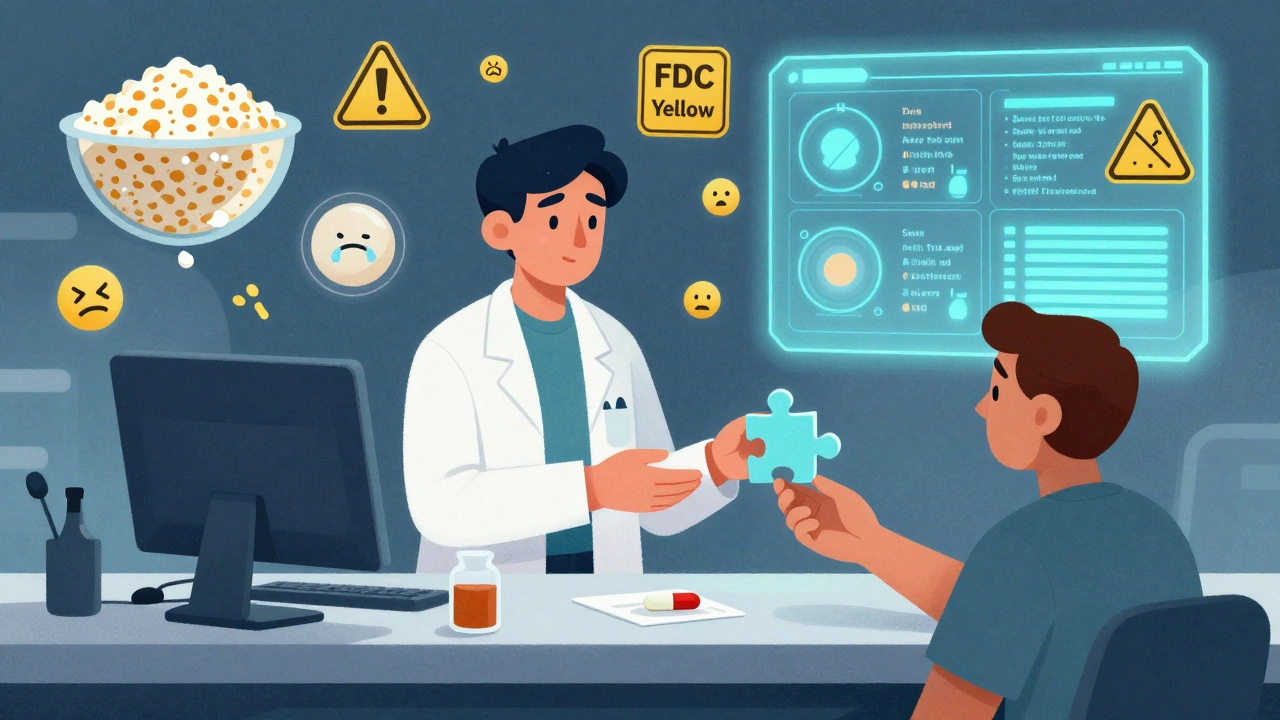
Pharmacists are your best ally when it comes to inactive ingredients. They see hundreds of prescriptions a week and know which ones have problematic fillers.
In 2022, 22% of medication switches in U.S. pharmacies were due to concerns about inactive ingredients - not because the drug wasn’t working, but because the patient couldn’t tolerate the filler. A pharmacist can often find an alternative brand or formulation that uses a different excipient.
For example, if your generic levothyroxine tablet contains lactose and you’re sensitive to it, your pharmacist might switch you to a capsule version that uses sucrose instead. Or if your blood pressure pill has a dye you react to, they might find a tablet without coloring.
Don’t be shy about asking. Say: ‘I have a sensitivity to [ingredient]. Do you have a version of this without it?’ Most pharmacists will help - if you ask.
The future of drug ingredients
The idea that ‘inactive’ means harmless is slowly changing. Experts now argue that we need better terminology. ‘Excipient’ is fine, but ‘inactive’ is outdated. Some researchers are pushing for an ‘activity spectrum’ label - showing whether an ingredient is truly inert, mildly active, or potentially interactive.
AI is already being used to predict which excipients might cause problems before they’re even put into a pill. Pharmaceutical companies are screening hundreds of ingredients digitally, saving time and reducing risk.
And in places like Australia, doctors are now required to prescribe by active ingredient name - not brand. This helps pharmacists find the most affordable version without hidden fillers that could cause trouble.
It’s not about fear. It’s about awareness. Your medication isn’t just one chemical. It’s a carefully engineered system. And every part of that system matters.
Bottom line
The active ingredient gets you better. The inactive ingredients make sure you can take it - and sometimes, they’re the reason you feel worse. Ignoring them is like buying a car and only caring about the engine, not the brakes or the tires.
If you take multiple medications, have allergies, or experience unexplained side effects, check the inactive ingredients. Talk to your pharmacist. Ask for alternatives. Your body might thank you.
Comments (15)
Carolyn Woodard
The more I read about excipients, the more I realize how little we’re taught about the full pharmacological ecosystem of a pill. It’s not just chemistry-it’s biocompatibility, bioavailability, and unintended protein binding all wrapped in a tiny tablet. The FDA’s Excipient Safety Initiative is a start, but we need longitudinal studies on polypharmacy patients. Most of us are on 5+ meds. What’s the cumulative effect of 14% of excipients having biological activity? We’re treating symptoms, not systems.
And calling them ‘inactive’ is a linguistic relic. Like calling a conductor ‘inactive’ in an orchestra because they don’t play an instrument.
Allan maniero
Interesting piece, really made me think. I’ve always assumed that if the active ingredient was the same, the pill was the same. But now I’m wondering-how many of us have had weird side effects that just… never got explained? I had this persistent bloating for months, thought it was diet, then switched generic levothyroxine brands and it vanished. Turns out, the first one had lactose, the second used sucrose. Simple fix, but no one ever told me to check the fine print. I’m gonna start reading those inserts like novels now. Maybe I’ll find out why my knees crack after taking that one ibuprofen but not the other.
Also, props to pharmacists. They’re the unsung heroes of the medical world. If only more people knew to ask.
william tao
How is this even legal? The FDA approves drugs with dyes that trigger hyperactivity in children and preservatives that can kill neonates, yet we’re told to trust the system? This isn’t medicine-it’s corporate risk arbitrage. They’re gambling with human biology because it’s cheaper than reformulating. And don’t get me started on the fact that gluten and lactose are still rampant in pills. This is negligence dressed up as science.
Sandi Allen
They’re lying to us. EVERYTHING is active. EVERYTHING. The dyes, the fillers, the preservatives-they’re all part of a grand experiment. You think they don’t know propyl gallate binds to inflammatory proteins? They DO. And they don’t care. Because if they told you the truth, you’d stop taking your meds. And then what? Wall Street would crash. Big Pharma would collapse. So they call them ‘inactive’ to keep you docile. Wake up. The system is designed to keep you sick and dependent. Check your pills. Cross-reference the ingredients. You’re being poisoned slowly-and they’re calling it ‘medicine’.
PS: FD&C Yellow 5 is banned in Norway. Why? Because they care about children. We don’t. We’re sheep.
Eddy Kimani
This is such a crucial perspective. I work in clinical research, and we’re starting to see excipient interactions pop up in pharmacokinetic models more often than we used to. The old assumption that excipients are inert is literally outdated. We’ve got AI models now that can predict off-target binding of fillers with >85% accuracy before a single tablet is pressed. The future of personalized medicine isn’t just pharmacogenomics-it’s pharmaco-excipiomics. We need to start labeling excipients with their activity spectrum: inert, low, moderate, high. Imagine a pill with a QR code that tells you not just the active ingredient, but the molecular footprint of everything else in it. That’s the next frontier.
Chelsea Moore
I CRIED. I literally cried. I’ve been suffering from migraines for 12 years. My neurologist said it was stress. My naturopath said it was toxins. I took 17 different meds. None worked. Then I checked the inactive ingredients on my daily blood pressure pill. It had FD&C Red 40. I stopped it. Switched to a dye-free version. My migraines? Gone. In 3 days. I didn’t know. NO ONE TOLD ME. This is a national scandal. Why isn’t this on the news? Why isn’t every pharmacy posting signs? I’m going to start a petition. I’m going to call my senator. I’m going to make them listen. I’m not just a patient-I’m a survivor. And I won’t be silent anymore.
TOO MANY PEOPLE ARE SUFFERING IN SILENCE BECAUSE NO ONE TOLD THEM TO LOOK BEYOND THE ACTIVE INGREDIENT.
PLEASE SHARE THIS.
John Biesecker
mind = blown 🤯 i had no idea my daily zoloft had lactose in it… and i’m lactose intolerant 😅 i’ve been getting stomach cramps every morning and thought it was coffee. switched to a capsule version last week and now i feel like a new person. also, why do we still use gelatin in pills? like… there’s vegan options. why not just use them? 🤔 pharmacists are wizards. go talk to one. they’ll change your life. seriously. i’m telling you.
ps: if you’re vegan, check your meds. your body will thank you 🌱
Genesis Rubi
USA is the only country that lets Big Pharma get away with this. In Germany, they test excipients like they’re new drugs. In Japan, they ban dyes in pediatric meds. Here? We’re guinea pigs. And the FDA? They’re asleep at the wheel. I’m not surprised. We let them put aspartame in everything and call it ‘safe’. Now this? Of course. We’re a nation that thinks ‘natural’ means ‘bad’ and ‘chemical’ means ‘good’. Wake up, sheeple. We’re being engineered to be sick.
Doug Hawk
It’s fascinating how much we overlook the formulation side of pharmacology. Most people think the active ingredient is the whole story, but the excipient profile determines bioavailability, stability, even patient compliance. I’ve seen patients switch generics and report ‘new side effects’-turns out, the new version used a different binder that altered dissolution kinetics. The active ingredient is the same, but the delivery system isn’t. We need to treat excipients as part of the therapeutic profile, not as an afterthought. And yes, pharmacists should be the first line of defense here-they’re trained for this. Just ask.
Also, lactose intolerance prevalence is higher than most realize. 65% global? That’s not a niche concern. That’s a public health blind spot.
John Morrow
Let’s be honest: the entire pharmaceutical industry is built on obfuscation. They spend billions on active ingredient patents but treat excipients like an afterthought because they’re not patentable. That’s why you get the same active ingredient in three different brands with three different fillers-each one subtly engineered to create a ‘new’ product that justifies a price hike. The FDA’s $4.2 million study? A PR stunt. The real money is in the brand-name drugs. The generics? They’re the disposable vessels. You think they care if your tablet gives you diarrhea? No. They care if you keep buying. This isn’t medicine. It’s capitalism with a white coat.
Kristen Yates
I work in a rural clinic. Many of our patients can’t afford to switch medications. They take what’s on the shelf. I’ve had patients come in with rashes, GI issues, and we trace it back to a dye or filler they didn’t know was in their pill. We don’t have time to check every ingredient. But we should. We need better labeling. Simpler language. Maybe even color-coded warnings. This isn’t just science-it’s access. And right now, access is unequal.
Michael Campbell
They’re poisoning us. And they call it medicine. That’s it. That’s the whole thing.
Victoria Graci
I used to think ‘inactive’ meant ‘harmless.’ Now I think of it as ‘unexamined.’ It’s like calling the background music in a horror movie ‘inactive’-it doesn’t slash you, but it makes your heart race anyway. Excipients are the ambient noise of pharmacology. Some are silent. Some hum. Some scream. And we’ve been too busy listening to the lead instrument to notice the orchestra. The future isn’t just about better drugs-it’s about better compositions. We need to hear every note.
Saravanan Sathyanandha
In India, we often rely on generic drugs because of cost. But many of them contain starches derived from wheat or corn, which are problematic for those with sensitivities. I’ve seen patients suffer from bloating and fatigue, and when we switched formulations, symptoms resolved. This is not a Western problem-it’s a global one. We need standardized, transparent labeling across borders. Pharmacists in developing nations are often the only ones who know this, but they lack the resources to advocate. This issue requires international collaboration-not just regulatory reform, but education. The patient must be empowered, not just informed.
Carolyn Woodard
Actually, this reminds me of a 2023 paper in Nature Pharmacology where they found that titanium dioxide (used as a whitening agent) altered gut microbiome composition in mice. Not a direct interaction with human proteins-indirect, systemic. That’s the real danger. It’s not just one molecule binding to one receptor. It’s the cascade. The ripple effect. We’re studying excipients like they’re isolated variables. But the body isn’t a test tube. It’s a network. And we’re missing the connections.